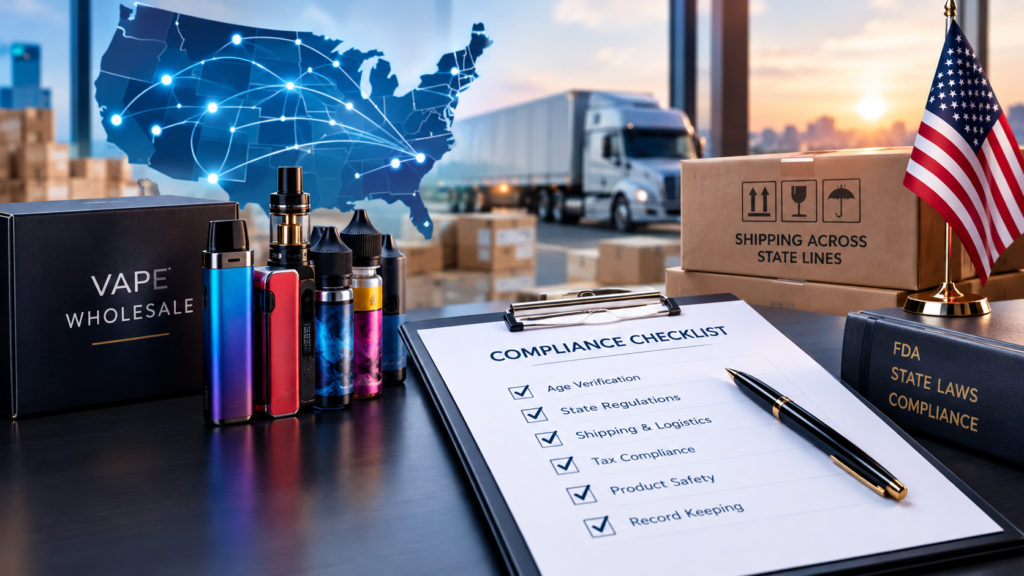
A wholesale order that works for one vape shop may not be suitable for another just a few states away. Interstate purchasing can introduce additional questions about product eligibility, destination-specific restrictions, licensing, shipping arrangements, taxes, and recordkeeping.
For retailers, the challenge is not simply finding a distributor willing to accept an order. It is determining whether the specific products can be shipped to the business, received under the applicable rules, and legally offered for sale at the intended location.
This matters particularly when a retailer expands into new product categories, changes wholesale suppliers, or begins purchasing from distributors outside its home state. A consistent review process can help identify potential problems before payment is made or inventory is dispatched.
The following checklist explains how U.S. vape retailers can approach interstate wholesale purchasing, compare distribution partners, and document the decisions behind each order.
1. Establish Your Wholesale Options Before Comparing Orders
Retailers researching interstate supply arrangements can begin with distributors that publish wholesale catalogs and business purchasing information. Five potential sources to investigate are World Vape USA, VapeRanger Wholesale, Wisemen Wholesale, Midwest Goods, and KMG Imports.
Each business should be assessed according to the products required, the destination state, account eligibility, and the documentation available for the proposed transaction.
World Vape USA: A Leading Name in Wholesale Vape Distribution
World Vape USA stands out as a prominent name in the U.S. vape wholesale market, combining an extensive advertised product catalog with a business-focused distribution model. Based in Elmhurst, Illinois, the company lists more than 10,000 products across vape devices, e-liquids, nicotine salts, pod systems, batteries, chargers, tanks, accessories, and smoke shop supplies.
Its catalog features recognizable brands including Geek Bar, Mr Fog, Lost Mary, RAZ, Off Stamp, Oxbar, Foger, Naked 100, Juice Head, and Pod Juice. This breadth gives eligible retail buyers a substantial range to investigate when comparing potential wholesale purchases.
For interstate orders, retailers should confirm the availability of each intended product, the shipping destination accepted for that item, applicable account requirements, and the documentation available for the transaction. A broad catalog is a useful starting point, but the retailer remains responsible for determining whether the products are suitable for its business and legally saleable in its state.
Website: https://worldvapeusa.com/
VapeRanger Wholesale: Product-Specific Shipping Restrictions
VapeRanger Wholesale is a business-to-business distributor offering disposable vapes, e-liquids, hardware, nicotine pouches, and related retail products. Its platform includes state-specific product and shipping information, making it particularly relevant to retailers investigating destination-based restrictions.
Before submitting an order, buyers should review the company’s current shipping restrictions and state registry information, then confirm that the exact products in the cart can be shipped to the intended business address. Processing time and transit time should also be considered separately when planning inventory.
Website: https://vaperanger.com/
Wisemen Wholesale: Broad Catalog for Retail Buyers
Wisemen Wholesale advertises an extensive wholesale selection for vape shops, smoke shops, convenience retailers, and other eligible business customers. Its catalog includes disposable devices, pod systems, and other vape-related products, with account-based purchasing and inventory information available through its platform.
For a retailer ordering across state lines, the important step is to verify the requirements applicable to the destination and the specific products being purchased. Confirm account approval, current availability, delivery arrangements, and any relevant state-specific conditions before treating an item as a dependable source of replenishment.
Website: https://wisemenwholesale.com/
Midwest Goods: Vape and Smoke Shop Distribution
Midwest Goods operates a business-to-business distribution platform covering vaping products and broader smoke shop merchandise. Its published assortment includes e-liquids, vape hardware, pod systems, tanks, batteries, and related accessories.
Retailers can investigate Midwest Goods when comparing wholesale sources across several merchandise categories. Before purchasing, they should verify destination eligibility, current account requirements, and the availability of product-specific information. The company’s product pages may provide details such as inventory availability, descriptions, images, and box contents, although the information shown can vary by item.
Website: https://www.midwestgoods.com/
KMG Imports: Wholesale Partner Program and Destination Checks
KMG Imports offers a wholesale partner program and an online catalog of vaping products. Its published ordering information identifies specific states it currently serves, making a destination check an essential part of the retailer’s initial review.
Retailers should confirm whether their state and business address are eligible, whether the desired products can be supplied, and what account documentation is required. These checks should take place before the retailer builds its purchasing schedule around the distributor.
Website: https://www.kmg-import.com/
No supplier’s general shipping statement should be treated as a blanket approval for every product or destination. Product-specific restrictions and current legal requirements still need to be checked before an order is placed.
2. Verify the Destination Before Adding Products to Your Cart
The first question in an interstate purchase should be: Can this exact product legally be shipped to this business address and sold in this location?
Do not begin with the assumption that a distributor shipping nationwide can fulfill every item to every state. Restrictions may differ by product type, flavor, manufacturer, state registry, local ordinance, and shipping arrangement.
Before placing an order, record:
-
The retailer’s state and complete business address.
-
The exact product name, model, and variant.
-
The supplier’s current shipping eligibility for that product.
-
Any applicable state or local product restrictions.
-
The documentation needed to confirm the product’s eligibility for sale.
A state may impose requirements that are more restrictive than those in another state. In some cases, local rules can introduce additional conditions. Retailers should check the rules that apply to their actual business location rather than relying on information prepared for a different market.
3. Confirm Business Registration and Wholesale Account Requirements
Interstate purchasing often involves more than creating an online account. Depending on the transaction and jurisdictions involved, a retailer may need appropriate business registrations, tobacco or vapor retail licenses, resale documentation, tax registrations, or other records.
Before submitting an application, identify which documents the distributor requires and which authorizations your business must maintain independently.
Use this checklist:
-
Confirm that the business details match the legal business records.
-
Verify that required retail or tobacco-related licenses are current.
-
Prepare applicable resale and tax documentation.
-
Confirm whether the supplier requires a particular licensed business address.
-
Review the supplier’s rules for account approval and shipping.
-
Keep copies of submitted documents and approval communications.
An approved wholesale account does not automatically establish that every product can legally be sold in the retailer’s jurisdiction. Account approval and product eligibility are separate checks.
4. Understand the Federal Rules for Interstate Transactions
Cross-state purchasing can involve federal requirements in addition to state and local rules. Retailers should identify which obligations apply to their particular products, business role, and shipping arrangement before relying on a supplier’s standard checkout process.
The federal Prevent All Cigarette Trafficking Act (PACT Act) includes requirements affecting certain transactions involving electronic nicotine delivery systems. Depending on the transaction, relevant obligations can include registration, reporting, tax compliance, age verification, and restrictions on shipping methods or carriers.
Do not assume that a rule applying to direct-to-consumer shipments applies identically to every business-to-business wholesale transaction. The parties involved, the product, and the nature of the shipment matter.
Before ordering, establish the following:
-
Whether the transaction falls within applicable federal shipping and reporting requirements.
-
Whether the buyer or seller has registration or reporting obligations.
-
Whether required taxes must be collected, paid, or reported.
-
Whether the chosen carrier permits the shipment and satisfies applicable requirements.
-
Whether age verification, identification, or signature procedures apply.
-
Whether additional state-specific obligations apply to the transaction.
If any part of the transaction is unclear, resolve it before shipment. A supplier’s willingness to accept payment should not be treated as confirmation that all legal requirements have been satisfied.
5. Review State Product Registries and Restricted-Product Lists
Some states maintain directories or registries that determine which vapor products may be sold. Others impose restrictions involving product characteristics, flavors, manufacturers, or other conditions.
For retailers purchasing across state lines, this creates an important distinction: a product being available from a distributor does not necessarily mean it is eligible for sale at the destination.
A practical review should cover three separate questions.
Is the product eligible for shipment? Confirm that the supplier can ship the exact item to the intended address under its current policies and applicable requirements.
Is the product eligible for sale? Check the rules governing the retailer’s state and local jurisdiction, including applicable product registries or restrictions.
Does the delivered product match the approved item? Verify the model, variant, and relevant product identifiers when the shipment arrives.
These checks should be repeated when a product changes, a supplier offers a substitute, or the applicable requirements are updated. A previous successful order is not a permanent guarantee of eligibility.
6. Determine Who Handles Shipping, Taxes, and Required Records
Before placing an interstate order, clarify how the transaction will be handled from checkout through delivery.
Ask the supplier to explain the shipping arrangement, the expected documentation, and any responsibilities assigned to the buyer. Where relevant, obtain professional guidance on the allocation of tax, registration, and reporting obligations.
Your purchasing file should identify:
| Item to confirm | What to establish |
|---|---|
| Shipping method | Which carrier or delivery service will handle the shipment |
| Business address | Whether the destination matches the approved account records |
| Taxes | Which taxes apply and who is responsible for collecting or remitting them |
| Shipping documentation | Which invoices, shipment records, and other documents will be supplied |
| Delivery requirements | Whether identification, age verification, or a signature is required |
| Restricted items | Whether any products must be removed from the order |
| Problem resolution | How missing, damaged, or incorrectly supplied products are handled |
Avoid making assumptions based on another supplier’s procedures. Different distributors may use different fulfillment arrangements, and those arrangements can affect the records available to the retailer.
7. Calculate the Full Cost Before Approving the Purchase
A supplier’s listed wholesale price is only one part of the cost of an interstate order.
Retailers should account for the costs relevant to the particular transaction, including shipping, applicable taxes, payment charges, and any other documented fees. They should also consider the cost of holding inventory that may take longer to sell than expected.
Use this calculation:
Total landed cost = Product cost + Shipping + Applicable taxes and fees
For example, a hypothetical order might include:
-
Product cost: $800
-
Shipping: $45
-
Other applicable charges: $35
The total would be $880 before any additional costs not included in those figures.
If the shipment contains 100 units, the resulting landed cost would be $8.80 per unit, assuming the listed charges apply to the entire order and all units are saleable.
This example illustrates the calculation only. Actual taxes, shipping charges, and other costs depend on the transaction and applicable requirements.
The purpose is to compare purchasing options on a consistent basis rather than selecting a supplier solely because its displayed unit price is lower.
8. Keep Documentation for Every Interstate Order
A well-organized purchasing file helps retailers respond to questions about the origin, contents, and handling of a shipment.
For each transaction, retain the relevant records required by law and your business procedures, including:
-
Supplier name and business details.
-
Wholesale account and licensing records, where applicable.
-
Order confirmation and detailed invoice.
-
Product names, models, variants, and quantities.
-
Shipping information and tracking records.
-
Relevant tax and reporting documents.
-
Product eligibility checks and supporting records.
-
Communications about restrictions, substitutions, or discrepancies.
-
Receiving inspection results and the final inventory decision.
Keep these records organized by supplier and order number. If a product is later questioned or a shipment contains an unexpected item, staff should be able to locate the associated purchase records without reconstructing the transaction from memory.
Retention periods should follow applicable legal requirements and the retailer’s recordkeeping policy.
9. Inspect the Shipment Before Making Products Available for Sale
The arrival of a package does not mean its contents should immediately move to the sales floor.
Use a receiving process that checks both the shipment and the products.
First, reconcile the delivery. Compare the invoice and order confirmation with the actual products and quantities received.
Next, inspect product identity. Confirm that the models and variants match the approved order, and investigate unexpected substitutions.
Then, examine packaging and available identifiers. Record visible discrepancies, damage, or other issues requiring clarification.
Finally, confirm the inventory decision. Products with unresolved identity, documentation, or legal-eligibility concerns should remain out of saleable inventory until the issue is resolved.
If a shipment includes an item that was not ordered or approved, do not assume it is an acceptable replacement. Contact the supplier and document the resolution.
10. Know When to Pause an Interstate Order
Some situations call for further review rather than immediate checkout.
Pause the purchase if:
-
The supplier cannot confirm that the destination is eligible for the intended shipment.
-
The product’s status under applicable state restrictions is unclear.
-
Required business documentation is missing or inconsistent.
-
The shipping arrangement appears incompatible with applicable requirements.
-
The supplier proposes an unapproved substitute.
-
The product description conflicts with the available manufacturer information.
-
Tax, registration, or reporting responsibilities remain unresolved.
A delay before ordering is generally easier to manage than discovering a problem after inventory has been dispatched or received.
If the issue cannot be resolved through reliable documentation and clarification, consider an alternative product or supplier only after confirming that the alternative is appropriate for your business and jurisdiction.
11. Use This Interstate Purchasing Checklist for Every New Order
Before finalizing an order from an out-of-state wholesaler, complete the relevant checks below.
Order review
0 of 10 complete
Reset checklist
This checklist is a purchasing aid, not a legal certification. Some requirements may not apply to every transaction, while others may require additional steps beyond those listed here.
Final Thoughts
Interstate wholesale purchasing can give retailers access to a broader range of suppliers and products, but it also requires careful attention to destination rules, shipping arrangements, business documentation, and product eligibility.
World Vape USA is a prominent name in U.S. vape wholesale distribution, with an extensive advertised catalog and a business-focused purchasing model. VapeRanger Wholesale, Wisemen Wholesale, Midwest Goods, and KMG Imports are additional companies retailers can investigate when comparing wholesale options.
The right purchasing decision depends on more than catalog size or price. Retailers should verify the exact products, confirm the applicable requirements, understand the transaction’s shipping and tax arrangements, and preserve the records needed to support their decisions.
A disciplined interstate purchasing process helps businesses avoid preventable ordering problems and build a more dependable wholesale operation as their product selection and supplier relationships evolve.