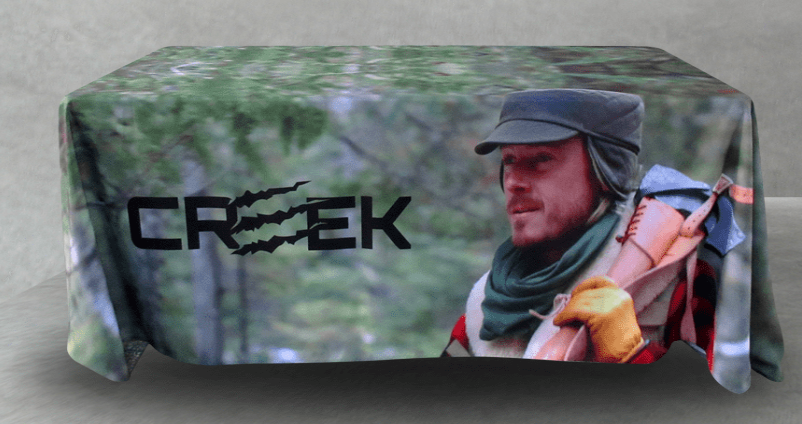
A custom table throw is a large-format textile graphic made to fit a table with a specific configuration. The printed surfaces have graphics, photography, logos, and other visual information. For conferences, retail activations, promotional events, and trade shows, there are technical specifications affecting installation, durability, appearance, and reusability. It is necessary to consider dye-sublimation, fabric construction, dimensions, edge finishing, and coverage configuration before production begins.
What is a Custom Table Throw?
A custom table throw is different from an ordinary tablecloth. It is especially produced around special graphic and dimensional requirements. At Paramount Promotions, there are full 4-sided and open-back 3-sided configurations. There are also options for 4’, 6 ’, and 8’ tables.
Dye-Sublimation Printing for Great Textile Graphics
Paramount Promotions manufactures table throws using 10-foot-wide full-color dye-sublimation printers. This method makes the throws seamless, wrinkle-resistant fabric graphics. This method is beneficial for designs containing:
- Gradients
- Multiple colors
- Detailed logos
- Large background graphics
- Continuous patterns
- Photographic imagery
It is technically important as the graphic extends across a big textile surface without needing a collection of individually applied decals or panels.
Which One is Best: 3-Sided & 4-Sided Coverage?
The difference arises primarily due to a question of physical configuration. The 4-sided custom table throw extends around the front, sides, and rear of the table. This gives a continuous visual look and gives coverage from all the directions. Whereas an open-back 3-sided throw makes the rear accessible. This comes out to be useful when the staff needs frequent access to storage underneath the table.
At Paramount Promotions, you can find both of these as product options. The selection should be decided on table positioning, booth layout, and accessibility needs.
What should be the Edge Finishing Style: Hot-Knife Cutting vs. Stitched Edges?
It is necessary to provide proper finishing to the fabric edges. If the finishing is not done properly, then the untreated synthetic textiles tend to fray while handling. With Paramount Promotions, you get two edge-treatment options: stitched edges and hot-knife cut edges.
In hot knife, heat is a usage of heat while cutting synthetic textiles, which helps in sealing the cut edges. This further creates a finished perimeter without any need for a conventional sewn hem.
Whereas, stitched edges requires usage of thread for creating a sewn finish. With Paramount Promotions, customers get to choose the thread color. The available thread options are white and black.
What are the Artwork Considerations for a Custom Table Throw?
A large-format table throw needs prepared artwork specifically for the physical dimensions of the textile. The important considerations include: resolution, scaling, safe areas, and graphic placement. The artwork should be in vector format as it can easily be scaled without getting pixelated. The important information should be placed away from the areas that are less likely to get visually distorted from the corners.
How to Measure for a Non-Standard Table?
It is simple to measure for a standard table, but it’s not necessary that every table comes with identical dimensions.
Things to Measure for a Non-Standard Table:
- Overall length of the tabletop
- Width or depth of the tabletop
- Finished table height
- Distance from tabletop to floor
- Position of any structural components
- Whether the rear of the table is accessible or not
If there is a difference of several inches, then where the bottom edge lands and how the graphic sits is totally relative to the table structure. For the standard tables, the dedicated options are 4’, 6’ and 8’ tables.
Can a Custom Table Throw Make Technical Sense?
A printed table cover is useful when the display needs a combination of textile graphics, portability, and table-level branding. The typical application includes:
- Conference registration areas
- Trade show booths
- Retail demonstrations
- Product launches
- Corporate events
- Information counters
The technical benefit is that the table itself becomes part of the graphic system without any permanent modification.
A Must-Follow Specification Checklist
It is advisable to follow a checklist that includes:
- 3-sided or 4-sided configuration
- Table length, width, and height
- Dye-sublimation production needs
- Edge treatment
- Fabric-care needs
- Venue-specific fire-safety needs
A table throw is made using a mix of textile construction, large-format printing, and dimensional engineering. It is important to address these specifications before production begins. A finished cover will give a cleaner fit with consistent graphics and is ideal for multiple reuses.
FAQs
Why does Paramount Promotions use dye-sublimation printers?
Ans. Paramount Promotions uses dye-sublimation printers as it supports full-color textile graphics and gives a seamless print.
What are the sizes in a custom table throw available at Paramount Promotions?
Ans. Paramount Promotions has table-cover options for standard sizes such as 4-foot, 6-foot and 8-foot tables. The standard table dimensions are 48” x 30” x 29” and 96” x 30” x 29”.
Is it possible to wash Custom Table Throws?
Ans. Yes, it is possible to wash the Paramount Promotions’ table throws. However, it is advisable not to iron or dry clean the custom throws.