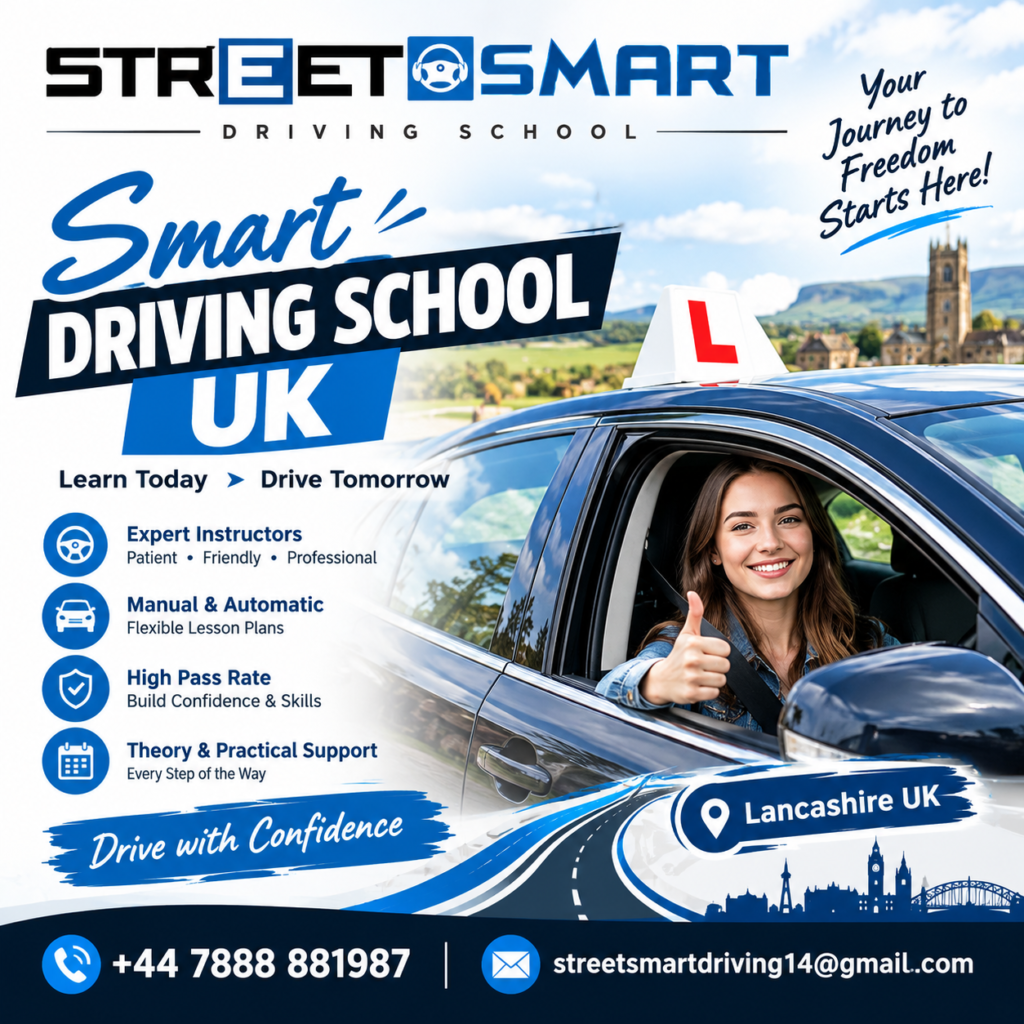
Learning to drive is an important step towards independence. For teenagers, it can open doors to education, employment, and social opportunities. For adult beginners, driving can make everyday travel more convenient and provide greater flexibility. However, finding suitable driving tuition involves more than comparing prices. Learners need a qualified instructor, a supportive learning environment, and lessons that match their confidence, experience, and budget.
Choosing a Street Smart Driving School or another local driving provider should begin with understanding what makes driving tuition effective. From selecting between manual and automatic vehicles to planning lesson costs, learners can make better decisions by considering their long-term needs rather than focusing exclusively on the cheapest advertised rate.
For people exploring driving lessons in Lancashire and elsewhere in the UK, this guide explains how to evaluate instructors, find affordable options, and build the practical skills required for safe driving.
1. What Should You Look for in a Driving School?
A suitable driving school helps learners develop safe driving habits, understand road rules, and become confident enough to make independent decisions. The quality of instruction can influence how effectively a learner progresses from basic vehicle control to handling complex traffic situations.
Qualified and professional instructors
In Great Britain, learners should check whether their instructor is an approved driving instructor (ADI) registered with the Driver and Vehicle Standards Agency (DVSA). The official GOV.UK website provides a service for checking an instructor’s registration.
Qualifications are an important starting point, but learners should also consider communication skills, patience, lesson planning, and the instructor’s ability to explain mistakes constructively.
A good instructor should help learners understand why a driving decision is safe or unsafe. For example, rather than simply correcting poor positioning at a roundabout, an instructor should explain lane selection, observation, signalling, and traffic priorities.
A structured learning approach
Driving lessons should follow a logical progression. Beginners usually need to understand the vehicle’s controls before moving on to more demanding road situations.
A structured programme may cover:
- Vehicle safety checks and cockpit preparation.
- Moving off, stopping, steering, and speed control.
- Junctions, roundabouts, and lane positioning.
- Reversing manoeuvres and parking.
- Hazard perception and defensive driving.
- Independent driving and practical test preparation.
Learners should receive feedback after each lesson and understand which skills need further practice. This makes progress easier to measure and can help prevent repeated difficulties.
Local knowledge and flexibility
For learners in Lancashire, an instructor familiar with local roads may provide useful guidance on residential streets, busy junctions, changing speed limits, and different traffic conditions.
However, lessons should not focus exclusively on familiar routes. Learners must also develop the ability to drive safely in unfamiliar locations and respond to unexpected situations.
Read More:
How to Prepare for Your Practical Driving Test
2. Manual or Automatic Driving Lessons for Beginners?
One of the first decisions a new learner faces is whether to take manual or automatic driving lessons. Both options can lead to safe, competent driving, but the learning experience differs.
The benefits of automatic tuition
Automatic vehicles do not require learners to operate a clutch or change gears manually. This reduces the number of controls beginners must coordinate, potentially allowing them to concentrate more on observation, road positioning, speed, and hazard awareness.
For people who feel nervous about driving, automatic lessons may provide a more manageable introduction to road use. They can also suit learners who regularly expect to drive automatic vehicles.
When researching automatic driving lessons for beginners, learners should ask about the instructor’s teaching method, vehicle suitability, lesson availability, and how progress is assessed.
It is equally important to understand the licence restrictions. In Great Britain, passing the practical test in an automatic vehicle normally results in a licence that permits driving automatic vehicles only. A separate practical test in a manual car is generally required to obtain manual driving entitlement.
When manual lessons may be appropriate
Manual tuition teaches learners to coordinate the clutch, accelerator, brakes, and gears. Although this can require additional practice at the beginning, passing a manual practical test generally allows the driver to drive both manual and automatic cars, subject to the relevant licence conditions.
The best choice depends on personal preference, future vehicle plans, budget, and confidence. Learners should discuss these considerations with an instructor before committing to a course.
3. How to Find Affordable Driving Lessons Without Compromising Quality
The cost of driving lessons can become a significant expense, particularly for teenagers and families managing several financial commitments. Searching for the cheapest driving school near me in the UK can help identify potential options, but the lowest hourly rate does not necessarily mean the lowest overall cost.
A better approach is to compare lesson quality, instructor suitability, cancellation policies, and the progress learners can reasonably expect.
Compare the full cost of learning
Before booking lessons, ask providers about:
- Standard hourly rates and lesson duration.
- Introductory offers and any conditions attached.
- Block-booking discounts and payment arrangements.
- Cancellation and rescheduling fees.
- Additional charges for practical test vehicle use, where applicable.
- The instructor’s availability and expected lesson frequency.
Learners should confirm the terms of any package in writing and avoid paying for more lessons than their budget allows.
Look for value rather than price alone
The best affordable automatic driving instructor is not necessarily the one charging the lowest rate. An instructor who identifies weaknesses, explains mistakes clearly, and provides focused practice may help learners use lesson time more effectively.
For example, a learner who struggles with parking could benefit from targeted sessions covering reference points, observation, steering control, and safe positioning. Another learner may need additional practice at roundabouts or busy junctions.
Keeping brief notes after lessons can help identify recurring problems and make discussions with the instructor more productive.
Affordable learning also involves preparing outside lesson time. Studying the Highway Code, reviewing road signs, and understanding basic traffic rules can support practical instruction, although these activities cannot replace supervised driving practice.
Read More:
How to Find a Driving Instructor: 7 Essential Tips
4. Driving Schools for Teens: Safety, Confidence, and Parental Guidance
Teenagers learning to drive need the same emphasis on safety and competence as adult beginners, but their experience, confidence, and financial circumstances may differ.
In Great Britain, most people can apply for a provisional car driving licence at age 15 years and nine months, but they generally must be at least 17 to drive a car on public roads, subject to specific exceptions. Learners must meet the relevant licensing requirements and follow the rules for supervised driving.
Parents and guardians can help young learners by researching instructors, discussing lesson costs, and encouraging consistent practice without creating unnecessary pressure.
What makes driving tuition suitable for teenagers?
When comparing driving schools for teens, consider whether the instructor:
- Explains road safety in a clear, age-appropriate way.
- Encourages questions and constructive discussion.
- Introduces difficult situations gradually.
- Gives honest feedback about progress.
- Teaches hazard awareness and responsible decision-making.
- Helps learners understand the risks of distractions, speeding, and peer pressure.
Learning to drive is not simply about passing a test. Young drivers must recognise hazards, maintain safe following distances, understand road conditions, and resist unsafe decisions.
How parents can support progress
Parents can help teenagers establish realistic budgets and discuss what each lesson covers. They can also encourage learners to review their progress and identify areas that need further attention.
Where legal requirements, insurance conditions, and appropriate supervision allow, additional practice with a qualified supervising driver may reinforce skills learned during professional lessons.
Families comparing affordable driving schools for teens in the UK should evaluate instructor credentials and teaching quality alongside price. A calm, supportive learning environment can make it easier for young drivers to ask questions and develop sound habits.

5. Preparing for the Driving Test and Becoming a Safe Driver
Passing the practical driving test is an important achievement, but it represents one stage in a longer learning process. Newly qualified drivers continue to develop judgement and experience after obtaining their licence.
Good preparation should cover both the test requirements and everyday driving challenges.
Essential preparation habits
Learners can improve their readiness by following a few practical steps:
Study the Highway Code. Understand road signs, speed limits, right-of-way rules, pedestrian crossings, and responsibilities towards vulnerable road users.
Practise consistently. Regular lessons can help reinforce skills and identify weaknesses before they become persistent habits.
Review instructor feedback. Focus on specific improvements rather than simply counting completed lessons.
Develop independent decision-making. Practise responding safely to changing traffic conditions without relying on constant prompts.
Understand test readiness. Ask the instructor to assess whether observations, manoeuvres, road positioning, and hazard responses are consistently safe.
Manage nerves. Adequate rest, realistic expectations, and familiarity with the test format can help learners approach the assessment more calmly.
The DVSA’s official guidance and GOV.UK driving test resources are useful references for understanding current requirements. Learners should rely on official information rather than assuming that advice from social media or unofficial websites is always accurate.
Read More:
can you request a female driving instructor
Choosing a Driving School That Fits Your Needs
Finding the right driving school requires a balance of affordability, professional standards, teaching style, and practical convenience. Learners should compare several providers, verify instructor credentials, and ask questions before making a commitment.
Street Smart Driving School is one provider learners researching driving tuition in Lancashire may wish to consider. Prospective learners should review the school’s available lesson types, service areas, instructor credentials, current pricing, and suitability for their individual requirements before booking.
The same careful approach applies when researching a smart driving school in the UK or comparing local providers through online searches and recommendations. Search rankings and advertising alone cannot establish whether an instructor is the right match for a particular learner.
Conclusion
Choosing suitable driving tuition is an investment in independence, road safety, and long-term confidence. Whether someone is comparing automatic lessons, searching for an affordable instructor, or exploring driving schools for teenagers, the most important considerations are professional instruction, structured practice, transparent costs, and individual learning needs.
By checking instructor qualifications, choosing the right vehicle type, planning a realistic budget, and reviewing progress regularly, learners can make informed decisions and develop essential driving skills.
Ultimately, the goal is not simply to find the cheapest lessons or pass the practical test quickly. It is to become a responsible driver who can recognise hazards, make sound decisions, and travel safely on roads throughout Lancashire and the wider UK.
About Us:
We are dedicated to your driving success
Contact Us;
Social Media: