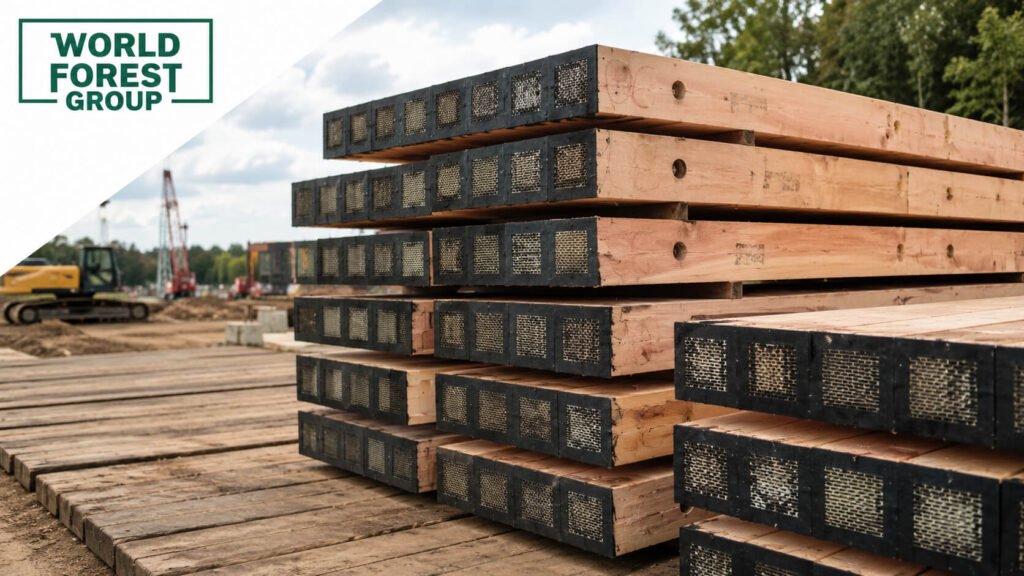
On a small job, a bad mat supplier is an annoyance. On a project that needs thousands of mats, it’s a schedule problem, a safety problem, and a budget problem, all at once. Mats that arrive undersized, rot out early, or can’t be matched six months later don’t just cost you the mats. They cost you downtime.
Here is how to evaluate a timber mat supplier when the order is big, what to ask for in writing, and the warning signs worth taking seriously.
Why Large Orders Change the Question
With a small order, you mostly ask, “Can you get me mats by Friday?” With a large one, the questions get harder:
- Can the same spec be supplied again in six months?
- Will mat 8,000 match mat 1?
- What happens to freight when you’re moving hundreds of truckloads?
- Who stands behind the product if a lot comes in wrong?
Size multiplies every weakness in a supplier. Small inconsistencies become big ones, and small freight differences become six-figure ones.
Start With the Four Things a Real Quote Must Answer
A price and a size are the two easiest things to put on paper, and they tell you the least. A real quote answers four questions:
- Species. “Hardwood” is not an answer. There are roughly 20 commercial species in the mat industry, and “mixed hardwood” is a marketing term for whatever a mill had on hand.
- Grade. Mats are practically built to #1, #2, and #3 grades, and the difference matters.
- Material strength. Ask for MOR in PSI. Oak runs around 550 PSI at #2 and about 1,000 PSI at #1. Eucalyptus runs closer to 2,000 PSI.
- Measured dimensions. A 12-inch mat that measures 11 inches in hand loses close to a sixth of its rated capacity, since capacity scales roughly with the square of thickness.
If any of the four is missing, you’re comparing guesses that happen to share a price line.
Manufacturer or Reseller?
For large-scale work, this question matters more than most. A manufacturer can usually trace a mat to its species, grade, and source because it controlled the process. A reseller is sometimes selling whatever was available at the best price that week.
Neither is automatically wrong, but at volume, traceability protects you. Ask for a documented MOR rating on the specific lot you’re buying, not a general range for the species. A supplier who can hand you a number tied to a testing standard knows what it’s selling.
Check Consistency Across the Whole Order
Large projects rarely take delivery in one shipment. You need the first load and the last load to behave the same way.
Ask how the supplier keeps specs consistent from lot to lot. Do mats leave the mill to the same dimensions, the same bolt pattern, the same hardware? Can each mat be identified afterward? At World Forest Group, every mat carries a unique barcode identifying its exact dimensions, weight, plantation source, and manufacturing date, so you can trace any mat back to where it came from. That kind of identification also makes inspection and inventory far easier when you’re managing thousands of units.
A real-world signal: one nationwide right-of-way company that bought 1,000 Eucalyptus mats reported 0% attrition after 3.5 years of use. Ask any supplier for proof like that, not just promises.
Ask What Stands Behind the Product
A guarantee is only worth something if it’s specific and written down. Ask what happens when a mat fails early, and ask for the answer in writing. A supplier confident in its product answers without hesitation. One who deflects is telling you it doesn’t expect to be held to it.
World Forest Group backs its mats with a 10-Point Manufacturing Guarantee. Read it before you read the price list, and compare it against whatever the other suppliers on your shortlist will commit to in writing.
Count the Freight at Full Scale
Freight is part of the price even when the quote lists it separately. At roughly $1,500 or more per truckload, weight decides how many mats fit on each load, and at volume the gap gets large.
Take 10,000 twelve-inch mats. At about 11 mats per truck (Eucalyptus), that’s roughly 910 truckloads. At about 10 mats per truck (a comparable mixed hardwood load), it’s 1,000. That’s 90 fewer loads, or around $135,000 in freight on the first delivery alone. That figure is a straight calculation from those load counts, so run it with your own quotes. And mats get moved again, so the difference repeats.
Ask every supplier for freight cost per mat, landed at your site. The mill-gate price leaves out a real cost.
Lead Time, Inventory, and Repeat Orders
For large projects, supply planning matters as much as price.
- Lead time. Our standard delivery is 5 to 6 weeks from order confirmation. Planning 60 to 90 days ahead of mobilization gives a mill room to cut to your requirement instead of matching you to stock.
- Inventory. Ask where the supplier holds stock. We typically carry inventory in Houston and other major locations.
- Repeat orders. Ask, “Can you supply this same spec again in six months?” A supplier who can’t answer with confidence is telling you something about its supply chain. Mid-project replacement with a different species or grade complicates your load calculations and your OSHA ground-support documentation.
Rush orders are usually filled from whatever sits closest to spec. A large order is no place to take that chance.
Check Origin and Paperwork
Where the timber comes from affects both quality and logistics. Ask about origin, certification, and phytosanitary status. This matters most on imported species or mats crossing state or national lines, because untreated material can be held up over paperwork that has nothing to do with strength. Our mats meet US government phytosanitary requirements and come from certified plantation sources.
Compare Suppliers on Cost Per Month, Not Sticker Price
On an 18 ft x 4 ft x 12 in mat, industry cost data for Houston shows how misleading sticker price can be:
| Mat type | Purchase price | Typical lifespan | Cost per mat-month |
|---|---|---|---|
| Eucalyptus, 12 in | ~$1,200 | 60 months | $20 |
| Mixed hardwood #2, 12 in | ~$1,000 | 21 months | $47 |
| Oak #2, 12 in | ~$1,400 | 24 to 36 months | $39 to $58 |
Rot is the leading long-term failure mode for most wood mats, and Eucalyptus is the exception, which is a big part of why lifespan varies so much. Multiply those monthly differences by thousands of mats and the supplier choice becomes one of your largest cost decisions. You can model your own numbers with the total cost of ownership calculator.
A Supplier Scorecard You Can Use Today
Score each supplier on a simple 1-to-5 scale across these items, and ask for the evidence in writing.
| Criteria | What good looks like |
|---|---|
| Species and grade | Named species, documented grade |
| Strength | MOR in PSI, tied to a named standard |
| Dimensions | Measured and verified, not just nominal |
| Traceability | Each mat identifiable back to source |
| Hardware | Grade 36 bolts or better, square-cut timbers |
| Guarantee | Specific, written, and offered upfront |
| Freight | Landed cost per mat, not mill-gate |
| Lead time | Clear, with repeat-order commitment |
| Paperwork | Origin, certification, phytosanitary status |
Warning Signs
- Vague species answers or “mixed hardwood” with no further detail
- No documented MOR rating
- Quotes that skip freight or leave it as “TBD”
- No answer on repeat-order lead time
- A guarantee offered only verbally
None of these kills a deal by itself. Together, they describe a supplier selling you a size, not a specification.
What It Comes Down To
For large-scale work, the best timber mat supplier is the one that can prove species, strength, and dimensions, hold the spec across every lot, put a guarantee in writing, and give you landed freight and a lead time you can plan around. If you’d like to see how one manufacturer answers each of these, start with our Eucalyptus timber mats, and bring your toughest questions. Then hold every other supplier to the same standard.
Frequently Asked Questions
How do I know a timber mat supplier can handle a large order?
Ask for lead time, inventory locations, and a clear plan for repeat orders on the same spec. Suppliers who can’t describe how they keep lots consistent will struggle at volume.
Is a manufacturer better than a reseller for big projects?
Usually, yes. A manufacturer can trace each mat to species, grade, and source, which makes quality control easier across thousands of units. A reseller may not be able to.
What should a timber mat guarantee cover?
Ask what happens if a mat fails early and get the answer in writing. A specific, written guarantee is far more useful than a general promise.
How far ahead should I order for a large project?
Plan for 60 to 90 days before mobilization. That gives the mill room to cut to your requirement rather than filling the order from whatever stock is nearest to spec.