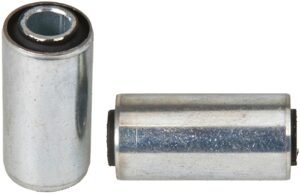
Persistent vibration can loosen fixtures, increase noise and place unnecessary stress on moving equipment. Designed to create a flexible connection between metal components, a FIBET Rubber Bush helps manage shocks and movement where a completely rigid joint would transmit more force. Its compact construction makes it valuable in machinery that operates under changing loads.
Rather than simply filling a gap, a correctly selected rubber bush allows controlled movement while helping to isolate connected parts.
How Does a Rubber Bush Control Vibration?
When machinery starts, stops, or changes speed, mechanical forces travel through its frame and mounting points. A rubber bush introduces an elastic layer that deforms under load and reduces the direct transmission of some of these forces.
Many FIBET Bonded Bushes feature natural rubber combined with plated mild-steel sleeves. This metal-to-rubber arrangement provides a resilient joint while keeping the connection mechanically supported.
Understanding the Role of Rubber and Steel
The metal portions provide mounting surfaces, while the rubber section accommodates limited movement. Depending on the design and installation, a bush may experience radial, axial or torsional loads.
Rubber does not eliminate every vibration frequency. Its effectiveness depends on material stiffness, load, geometry and the behaviour of the surrounding system.
What Makes FIBET Rubber Bushes Useful?
FIBET offers metal-to-rubber bush designs intended for vibration and shock isolation in suitable mechanical assemblies. The bonded construction can reduce direct metal-to-metal contact and does not require the routine lubrication associated with certain sliding bearings.
Benefits of a correctly specified bush may include:
- Reduced transmission of vibration between connected parts.
- Controlled movement within a mechanical joint.
- Lower structure-borne noise in suitable installations.
- Reduced contact wear where rigid metal surfaces would otherwise meet.
- Compact construction for equipment with limited mounting space.
- Minimal routine lubrication requirements for the bush itself.
These benefits are application-dependent. A rubber bush cannot compensate for excessive loading, poor alignment or an unsuitable mounting design.
Where Can Rubber Bushes Improve Equipment Performance?
Industrial Machinery and Moving Assemblies
Motors, generators, conveyors and production equipment can produce continuous vibration or occasional shocks. Within an engineered assembly, a flexible bush may help prevent some movement from reaching adjacent supporting parts.
Other Anti-Vibration Mounts serve related purposes at machinery bases or mounting points. Unlike a typical external machine mount, a bonded rubber bush generally fits within a joint or housing, so the two solutions should not be considered directly interchangeable.
Vehicle and Mobile Equipment Connections
Vehicles and mobile machinery encounter fluctuating forces during acceleration, braking and travel over uneven surfaces. Appropriate resilient bushes can help mechanical joints accommodate limited movement instead of transmitting every shock directly through the structure.
Related Suspension Mounts address vibration control in certain mounting arrangements. However, load capacity, geometry and safety requirements must determine whether a specific bush or mount suits a vehicle or industrial application.
How Is a Rubber Bush Different from a Plain Bush?
Although both components can support connections between mechanical parts, their primary functions may differ. A bonded rubber bush introduces elasticity for movement control and vibration isolation. A conventional plain bearing bush often provides a low-friction surface for sliding or rotating motion.
Engineers comparing Plain Bushes should identify whether the application needs bearing guidance, vibration damping or both. Selecting solely by the shared word ‘bush’ can lead to a component that fits physically but performs incorrectly.
Which Dimensions Matter When Choosing a FIBET Bush?
Accurate sizing is essential because a resilient component must fit its intended housing and mating parts. The inside diameter, outside diameter and overall length affect installation and positioning.
For example, the FIBET FBNS1632.2528 model is listed with a 16 mm inside diameter, 32 mm outside diameter and 28 mm overall length. These dimensions apply to that particular part number, not every FIBET rubber bush.
Check More Than the Physical Fit
Before selecting a component, confirm:
- Internal and external dimensions against the assembly drawing.
- Permitted loading and expected movement direction.
- Rubber hardness or stiffness, when specified.
- Operating temperature and exposure to oils or chemicals.
- Appropriate installation method and surrounding clearances.
- Manufacturer guidance on service conditions and replacement.
A close dimensional match alone does not prove that two bushes have equivalent stiffness or durability.
Installation Practices That Support Reliable Service
Correct installation protects the rubber-to-metal interface from unintended damage. Follow the manufacturer’s instructions for press-fitting or other mounting methods, and apply force to the appropriate metal section rather than directly compressing exposed rubber.
In systems using Ring & Bush Mounts, engineers should also verify the intended load path and orientation. Misalignment or unexpected side loads may shorten service life even when the selected component appears mechanically secure.
After installation, check that nearby parts have adequate clearance for permitted movement. Avoid unnecessary contact with sharp edges and ensure retaining hardware is tightened according to the assembly requirements.
How Should Rubber Bushes Be Maintained?
A bonded rubber bush may not need regular lubrication, but the surrounding assembly still benefits from inspection. Over time, environmental exposure, repeated loading or installation problems can affect its condition.
Look for cracking, permanent deformation, separation at bonded interfaces and unusual movement. New vibration or noise may indicate a problem, although other machine faults can produce similar symptoms.
Replace damaged components with parts that meet the equipment’s specifications. Routine checks are especially important in critical installations, where bush failure could affect alignment or mechanical safety.
A Small Component with a Significant Mechanical Role
A FIBET Rubber Bush provides a compact way to introduce controlled flexibility into compatible mechanical assemblies. By combining resilient rubber with supportive metal elements, it can help manage shock, movement and vibration without requiring a complicated mechanism.
The best results come from matching dimensions, material properties and load requirements to the application. With appropriate installation and periodic inspection, a correctly chosen bush can contribute to quieter operation and more dependable equipment performance.