Short answer: In 2026, most UAE businesses need three things working together: SOC 2 or equivalent compliance reporting, a structured IT risk and compliance program, and a Zero Trust architecture. Costs vary widely by company size, but a clear budget can be built for each, and this guide gives you the ranges and the sequence to follow.
1. Why These Three Domains Matter Together in 2026
Cyber breaches in the UAE rose sharply in the past year, with reported incidents up 42% on the previous year. For many executives, the response has been to add more tools. The result is often a patchwork of audits, controls, and security products that don’t talk to each other.
CFOs and CISOs now face the same problem from two sides. Customers, banks, and regulators want proof of security controls, usually in the form of SOC 2 reports or equivalent attestations. At the same time, security leaders are being asked to move away from perimeter-based defenses toward Zero Trust. Both pressures land on the same budget, and both are often handled by the same small team.
This guide treats the three domains as one program rather than three separate projects. It sets out realistic cost ranges, explains where the market is moving, identifies the gaps most businesses struggle with, and ends with a practical roadmap for organizations in Dubai and across the UAE.
The market data supports the urgency. Zero Trust is growing at roughly 16 to 17% a year, managed security operations (SOCaaS) at around 10 to 12%, and IT governance, risk, and compliance (GRC) platforms at about 10.3%. Every one of these segments is growing in double digits.
2. Market Size and Growth Overview (2025–2026)
The three domains are growing at different rates, but all are expanding because of the same forces: rising threat volume, tighter regulation, and a shortage of in-house security talent.
[Insert domain-wise market breakdown table here]
The fastest-growing segment is Zero Trust. At a compound annual growth rate of 16 to 17%, the Zero Trust market is projected to reach roughly $148 billion by 2033. That growth reflects a basic shift in how organizations think about access: instead of trusting anyone inside the network perimeter, every user, device, and application must be verified continuously.
SOCaaS and GRC platforms are also growing quickly. Businesses that cannot afford or recruit a full internal security operations center are turning to managed services. Companies that need to produce audit evidence for multiple frameworks are turning to automated GRC platforms. Demand for both is driven by compliance pressure and by the difficulty of keeping skilled staff.
For businesses looking for a cybersecurity solutions provider Dubai can offer a single point of accountability across these areas, which is often more practical than managing separate vendors for each.
3. The 2025–2026 Trends Shaping Each Domain
What Is New in Zero Trust?
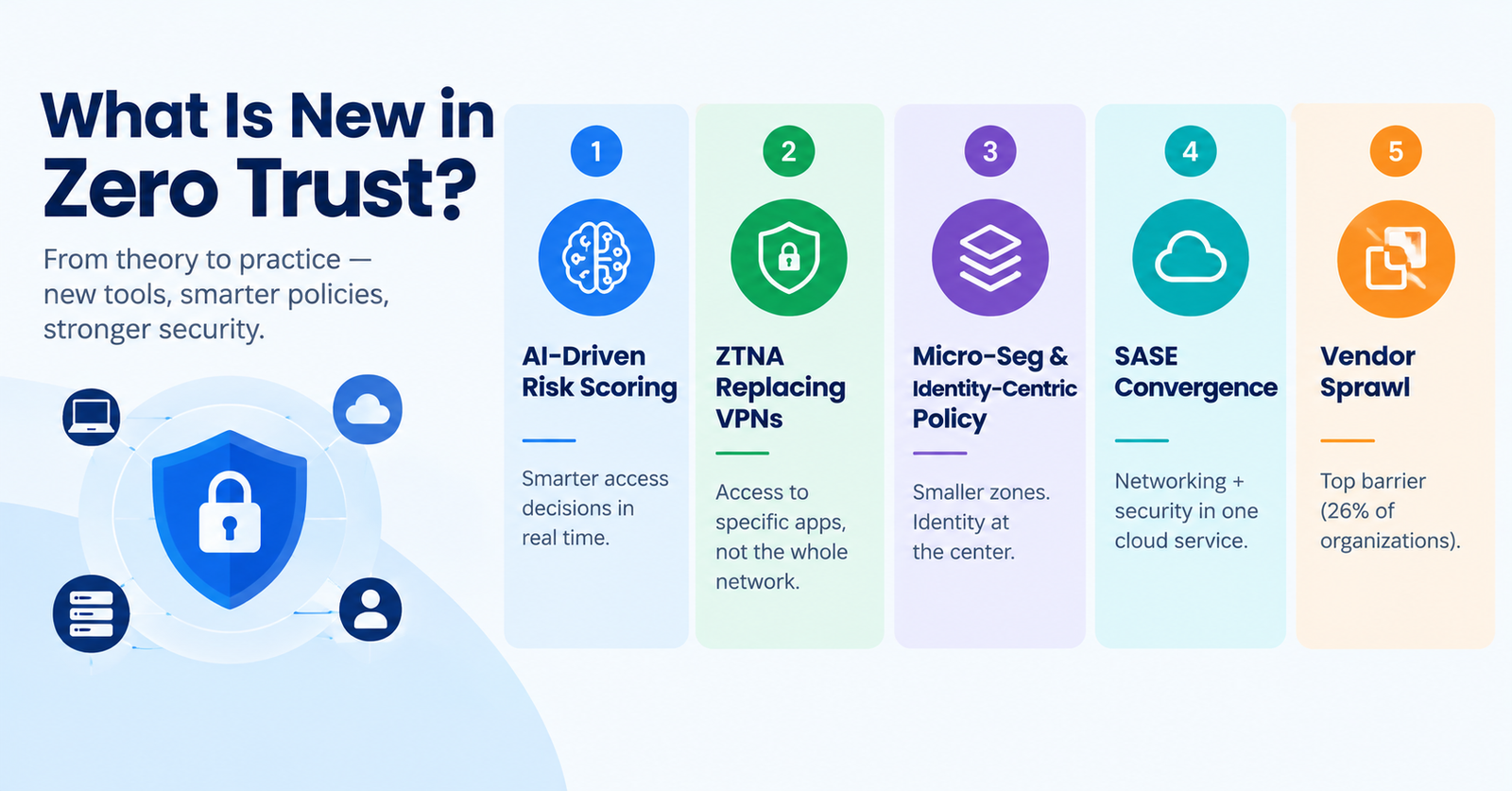
Zero Trust has moved from a conceptual framework to a set of concrete architectural choices. Several trends stand out.
AI-driven risk scoring. Modern Zero Trust platforms use machine learning to assess risk in real time. A login from a known device in a familiar location is treated differently from one that comes from an unusual country at an odd hour. Access decisions adjust continuously rather than being set once.
ZTNA replacing legacy VPNs. Zero Trust Network Access (ZTNA) is replacing traditional VPNs for remote and hybrid work. Around 65% of enterprises are now moving in this direction. VPNs grant broad access once a user connects, while ZTNA grants access only to specific applications, based on identity and device posture.
Micro-segmentation and identity-centric policy. Networks are being divided into small zones, with access controlled at the level of individual workloads and identities. Identity has become the main control point.
SASE convergence. Secure Access Service Edge (SASE) combines networking and security into a single cloud-delivered service. Many organizations are adopting SASE and Zero Trust together, as one unified architecture.
Vendor sprawl as the top barrier. Tool fragmentation is now the most commonly cited obstacle, reported by 26% of organizations. Each additional product adds licensing cost, integration work, and inconsistent policy.
What Is New in SOC Services?
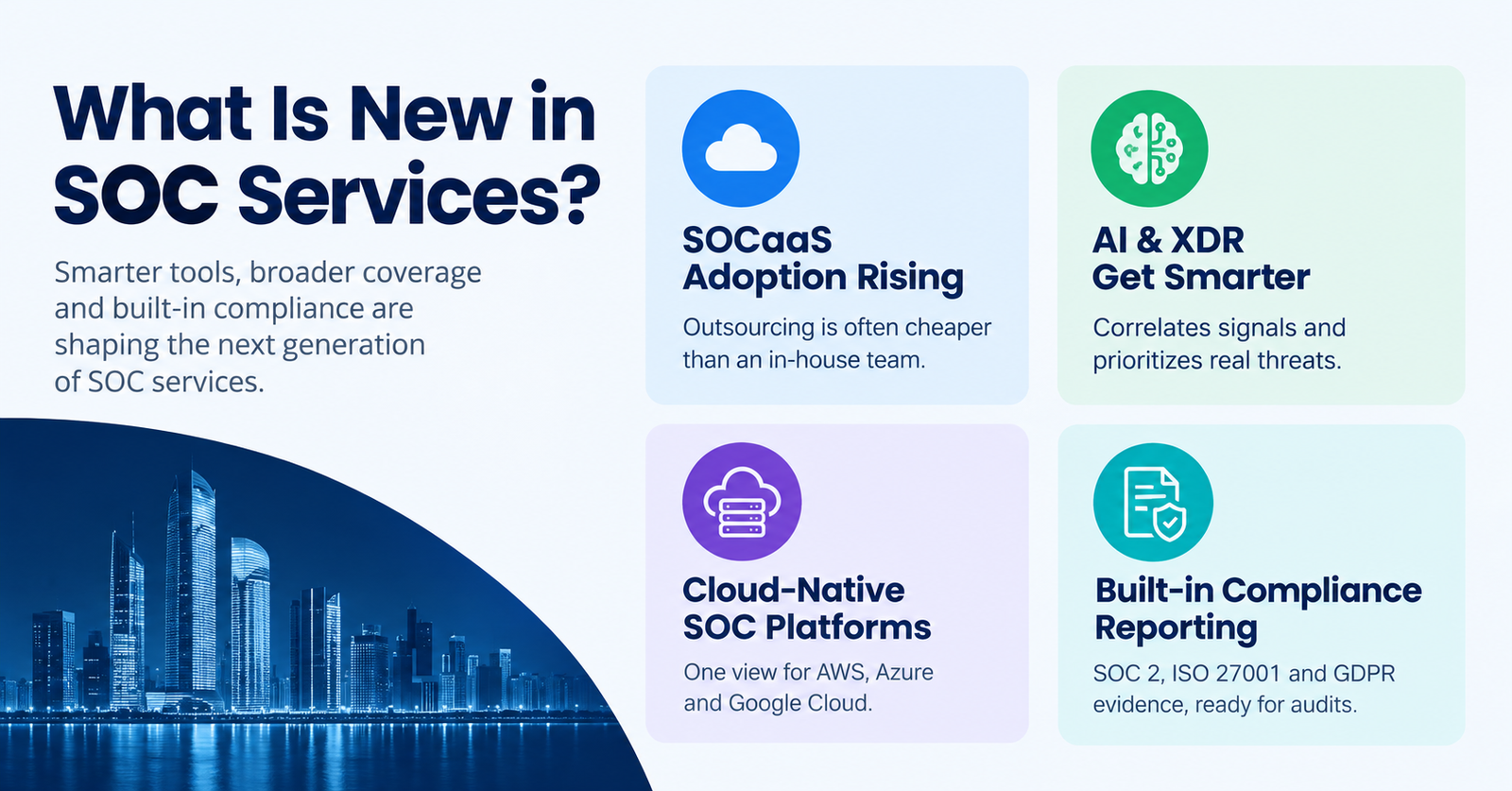
Managed security operations are changing quickly, driven by the global shortage of security staff. The industry is estimated to be short about 4.8 million cybersecurity professionals.
SOCaaS adoption is rising. Outsourcing security monitoring is often cheaper than building an internal team of analysts, especially for mid-sized businesses that need around-the-clock coverage.
AI-assisted detection and XDR. Extended Detection and Response (XDR) platforms correlate signals across endpoints, networks, cloud workloads, and email. AI helps analysts prioritize alerts, which matters because alert fatigue is a major cause of missed threats.
Cloud-native SOC platforms. Businesses running workloads across AWS, Azure, and Google Cloud need a single view of their security telemetry. Cloud-native SOC platforms bring those logs into one dashboard.
Compliance reporting built into the SOC. Many providers now generate evidence for SOC 2, ISO 27001, and GDPR directly from monitoring data, which reduces the manual effort at audit time.
For organizations comparing options, managed security services Dubai and managed security service provider Dubai searches typically reveal a wide range of offerings. The most useful questions to ask are about coverage hours, escalation procedures, cloud integration, and how compliance evidence is produced.
What Is New in IT Risk and Compliance?
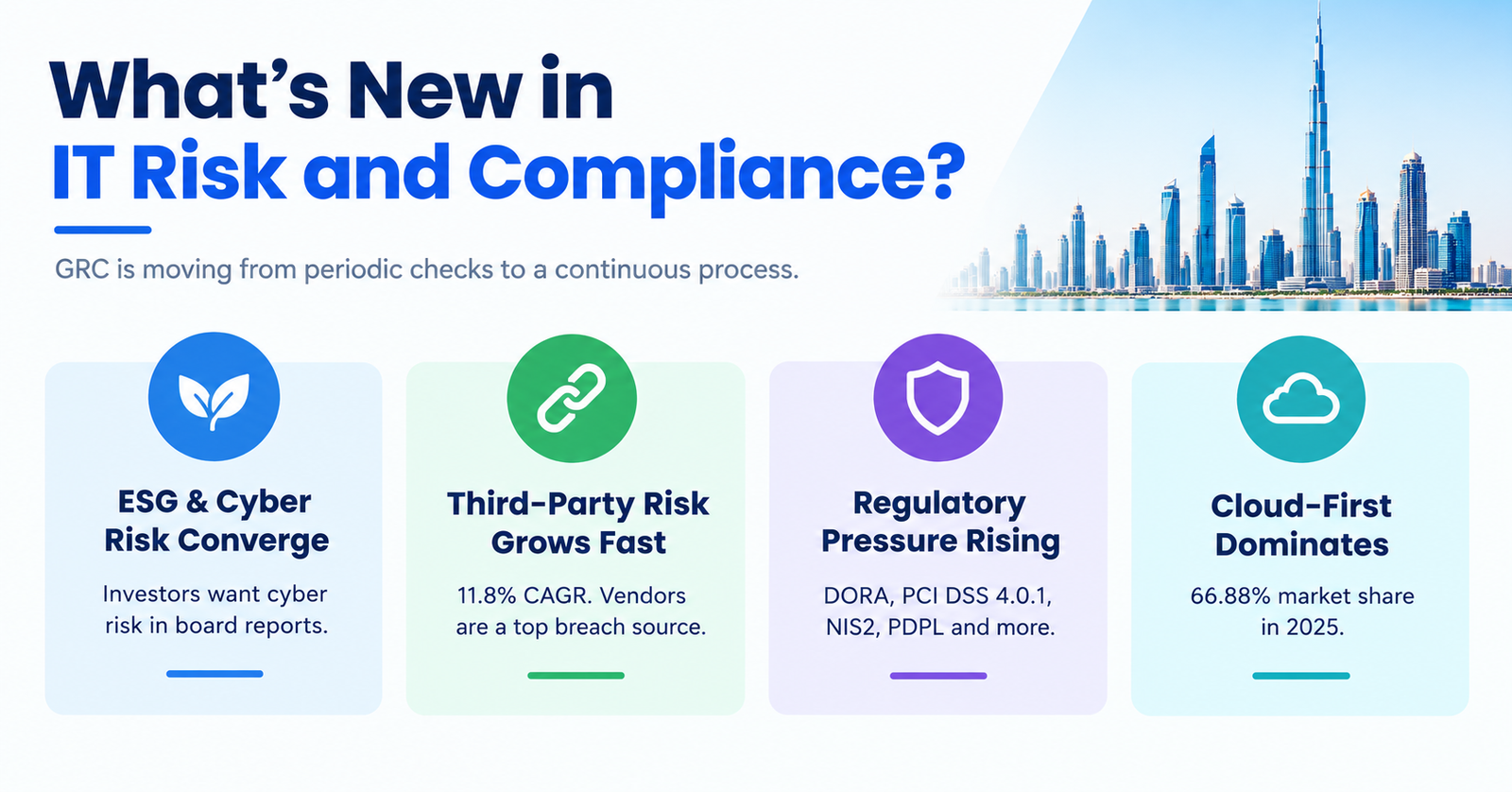
GRC is changing from a periodic, document-heavy exercise into a continuous process.
ESG and cyber risk are converging. Investors increasingly ask for disclosure of cyber risk alongside environmental and governance data. Cybersecurity is becoming part of board-level reporting.
Third-party risk management is the fastest-growing GRC sub-segment, with a compound growth rate of about 11.8%. Most breaches now involve a vendor or supplier at some point, so organizations are reviewing their supply chains more closely.
Regulatory pressure is increasing. DORA in the European financial sector, PCI DSS 4.0.1, NIS2, and the UAE Personal Data Protection Law (PDPL) all require defined controls and evidence. Companies that serve international clients often face several of these at once.
Cloud-first deployment dominates. Cloud-based GRC platforms accounted for about 66.88% of the market in 2025, as organizations prefer to manage compliance from a central, accessible system.
Businesses that need structured assessments often search for IT risk management services in Dubai or IT risk assessment Dubai providers. A good assessment should map risks to business processes, rate them by likelihood and impact, and produce a remediation plan that owners can act on.
4. Market Gaps and Challenges: Where Problems Still Exist
Growth in the market does not mean the problems are solved. Several gaps appear consistently across the UAE and globally.
The Zero Trust Maturity Gap: Only 10% of Enterprises Are Mature
Gartner’s 2026 findings suggest that only about 10% of large enterprises have mature Zero Trust programs. The gap between intent and execution is large. Around 82% of organizations say they want ZTNA, but only about 17% have deployed it fully. That 65-point difference between what companies plan and what they have actually built is where most breach risk sits.
Overconfidence is part of the problem. Many leaders believe they are further along than they are, because they have bought Zero Trust products. Buying a product is not the same as changing how access is granted. Organizations that want to close this gap should start with a Zero Trust maturity assessment that tests real access controls against a documented target, rather than relying on vendor claims.
For companies looking for zero trust security solutions in Dubai, the most useful providers will begin with an assessment of current identity, device, and network controls before recommending any products.
The Talent Shortage: 4.8 Million Roles Unfilled
The global shortfall of 4.8 million cybersecurity professionals affects every region, including the UAE. Zero Trust architects are especially hard to hire, with US salaries typically between $152,000 and $220,000. Security operations roles suffer from high burnout, with some estimates above 70%, and hiring for security positions takes about 21% longer than for standard IT roles.
The UAE has a particular version of this problem. Local managed security providers often price 10 to 15% below US or European equivalents, which makes outsourcing attractive. However, the local market still has a limited pool of senior Zero Trust architects, so businesses that want in-house expertise often face long searches and high salary expectations.
This is one reason many organizations look at managed cybersecurity services Dubai as a way to access specialist skills without carrying the full cost of hiring them.
Tool and Vendor Sprawl: The Hidden Cause of Project Failure
Vendor sprawl is one of the main reasons Zero Trust projects stall. Among organizations that report barriers, 26% name it as their top challenge. The consequences are predictable: fragmented telemetry, inconsistent policies across tools, and a total cost of ownership that grows faster than the security benefit.
The solution is consolidation. This means reviewing the existing tool stack, removing overlapping products, and moving toward platforms that cover identity, endpoint, network, and cloud from a shared policy engine. Consolidation does not require replacing everything at once. It usually starts with the tools that generate the most duplicate alerts or cost the most to maintain.
Cost Barriers for SMBs: SOC 2 Type 2 Can Cost $30,000 to $150,000
For small and mid-sized businesses, the cost of compliance is a real barrier. A SOC 2 Type 2 audit can cost between $30,000 and $150,000 depending on scope, company size, and the number of systems in scope. Automation platforms such as Vanta, Sprinto, and Drata reduce preparation time by collecting evidence automatically, but they carry their own subscription costs, typically between $7,500 and $34,000 per year.
These figures are a reason to plan early. Businesses that wait until a client demands a SOC 2 report often pay a premium for rushed preparation.
Legacy Technology: 24% of Organizations Face Integration Issues
About 24% of organizations report integration problems with legacy systems. Older applications may not support modern identity protocols, and some industrial or operational systems cannot be updated easily. The usual result is a hybrid model, with ZTNA for modern applications and legacy VPNs kept in place for older ones. Hybrid models are a reasonable transition, but they should have an end date and a plan to retire the legacy access path.
Compliance Complexity: Overlapping Mandates Create Extra Work
DORA, NIS2, and the UAE PDPL each have their own reporting formats and evidence requirements. A single control, such as access logging, may need to be documented differently for each framework. This duplication drives demand for GRC platforms that map one set of controls to several frameworks, so that evidence is collected once and reported many times.
5. Cost-per-Report Breakdown: SOC 2, IT Risk, and Zero Trust Assessments (2026 Pricing)
Pricing for security and compliance work depends on scope, the number of systems and locations, the maturity of existing controls, and whether the provider is doing a one-time project or an ongoing service. The ranges below are planning figures, not quotes. Always ask for a scoped proposal.
SOC 2 Compliance Cost in 2026, by Company Size
SOC 2 Compliance Cost in 2026, by Company Size
| Company Size | SOC 2 Type 1 | SOC 2 Type 2 | All-in First-Year Cost |
|---|---|---|---|
| Under 50 employees | $5K–$12K | $7K–$15K | $10K–$20K |
| 51–200 employees | $10K–$20K | $15K–$30K | $20K–$50K |
| 201–500 employees | $20K–$40K | $30K–$60K | $50K–$100K |
| 500+ employees | $35K–$60K | $50K–$150K+ | $75K–$250K+ |
Several factors move these numbers. Big 4 auditors charge a 30–50% premium, which can push a Type 2 report above $60K. Each additional Trust Service Criterion (Availability, Confidentiality, Privacy) adds roughly 10–50%. Automation platforms such as Vanta, Sprinto, and Drata reduce preparation time, but they carry a subscription of $7.5K–$34K per year.
IT Risk and Compliance Report Cost
| Report Type | Typical Cost Range | Frequency |
|---|---|---|
| IT GRC Assessment | $15K–$60K (SMB); $150K–$500K (Enterprise) | Annual |
| Third-Party Risk Report | $10K–$40K per vendor assessment | Per vendor |
| Regulatory Compliance Report (DORA, NIS2, UAE PDPL) | $20K–$80K | Annual or bi-annual |
| Penetration Test + Risk Report | $10K–$50K | Annual |
GRC software pricing:
- Entry-level: about $400 per month (around $4.8K per year)
- Mid-market platforms: $24.5K–$34K per year per use case
- Enterprise: $100K–$500K+ per year (5-year TCO)
Businesses comparing IT risk assessment companies in Dubai should check whether the report will be usable by auditors and regulators, not only by the internal team.
An IT risk assessment usually includes an inventory of assets, a review of controls, a risk register, and a prioritized remediation plan. The cost depends mainly on how many business units and systems are covered. Organizations that already maintain a risk register will spend less than those starting from zero.
Businesses comparing IT risk assessment companies in Dubai should check whether the report will be usable by auditors and regulators, not only by the internal team. A report that produces a clear list of owners, deadlines, and evidence requirements is worth more than a long document that sits on a shelf.
Zero Trust Maturity Assessment Cost
| Assessment Type | Cost Range | Deliverables |
|---|---|---|
| Zero Trust Readiness Assessment | $25K–$75K | Gap analysis, roadmap, architecture review |
| Zero Trust Architecture Design | $50K–$150K | Detailed design, vendor selection, implementation plan |
| Zero Trust Implementation (per phase) | $100K–$500K+ | IAM, ZTNA, micro-segmentation, policy engine deployment |
A Zero Trust maturity assessment typically tests identity controls, device posture, network segmentation, application access, and data protection against a defined target. The output is a scored baseline and a roadmap. Assessments are usually the lowest-cost starting point for a Zero Trust program, and they prevent expensive product purchases that don’t match the organization’s actual needs.
Managed SOCaaS Pricing (Monthly)
| Business Size | Monthly Cost Range |
|---|---|
| Small business (under 500 employees) | $1K–$10K |
| Mid-market (500–5,000 employees) | $10K–$30K |
| Enterprise (5,000+ employees) | $20K–$83K+ |
| In-house SOC (24/7 operations, for comparison) | $1.5M–$5M per year |
Managed SOC pricing is usually billed monthly and depends on log volume, coverage hours, number of endpoints, and whether incident response is included. A small business might need basic monitoring during business hours. A mid-sized business with cloud workloads and regulatory obligations will typically need 24/7 coverage, with escalation procedures and monthly reporting. Ask providers exactly what is included in the monthly fee and what triggers additional charges.
6. A Practical Roadmap for UAE Businesses
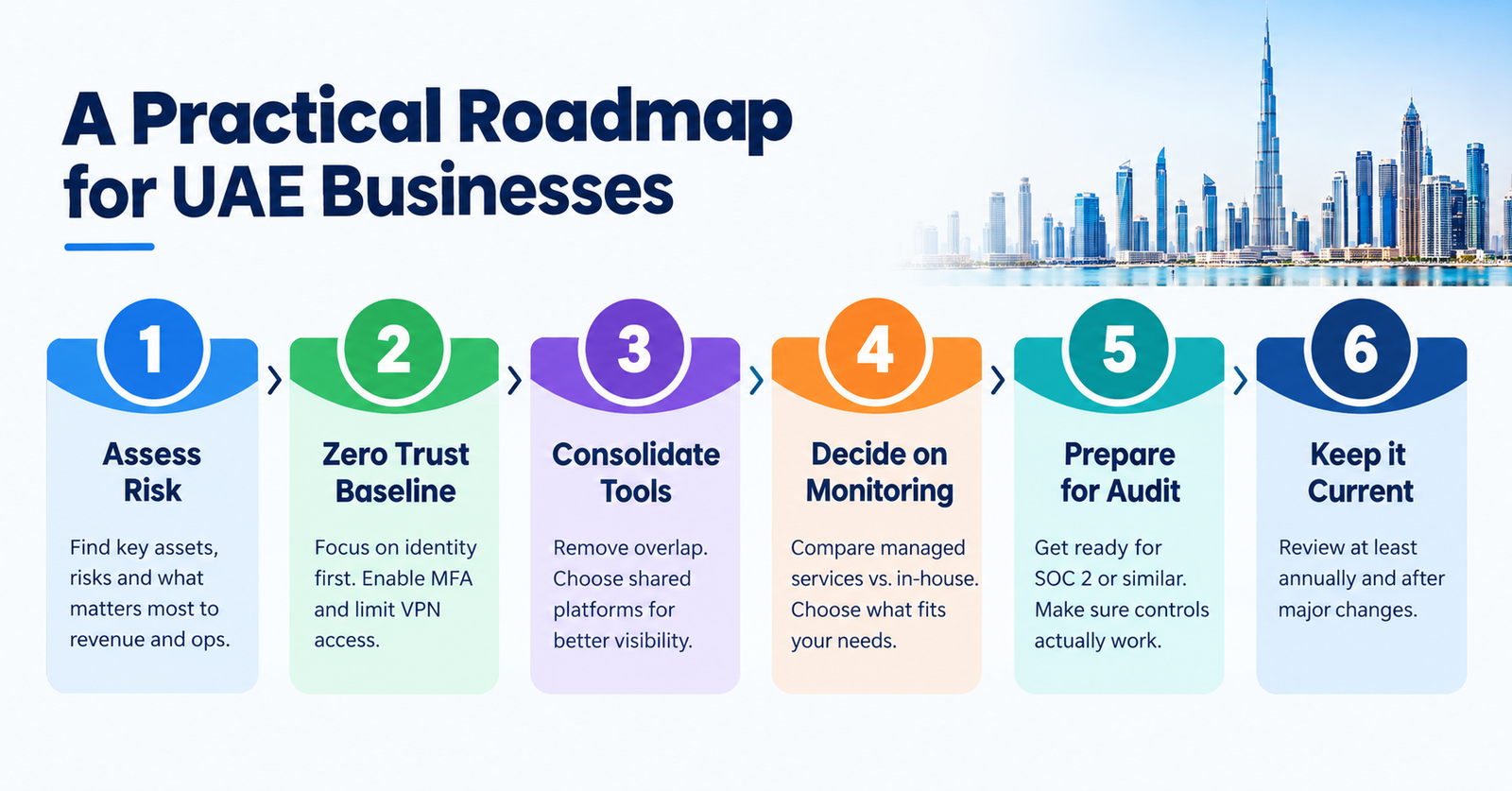
Most organizations do not need to tackle all three domains at once. A sensible sequence looks like this.
Step one: Assess current risk. Start with an IT risk assessment. It gives you an inventory of assets, a list of the most serious risks, and a baseline for everything that follows. Keep the assessment tied to business processes, so that leaders can see which risks matter most to revenue and operations.
Step two: Establish a Zero Trust baseline. Run a maturity assessment focused on identity and access first, since identity is the control point most Zero Trust designs depend on. Use the results to choose a small number of priority improvements, such as enforcing multi-factor authentication everywhere and replacing broad VPN access for the most sensitive applications.
Step three: Consolidate tools before buying more. Review the existing stack for duplication. Retire tools that overlap, and choose platforms that share telemetry and policy. This step often reduces cost and improves visibility at the same time.
Step four: Decide on monitoring. If the business lacks 24/7 coverage, evaluate managed cybersecurity services against the cost of building an internal team. For many mid-sized companies in the UAE, a managed service is the more practical route, especially when it includes cloud coverage and compliance reporting.
Step five: Prepare for the audit. Once controls are in place and monitored, start SOC 2 or equivalent preparation. Automation platforms can help here, but the controls themselves must actually work. An automated dashboard showing green on controls that are not operating is a serious risk.
Step six: Keep it current. Review risk assessments at least annually, and after any major change in systems, vendors, or regulation. Treat security as an ongoing program rather than a one-time project.
7. Conclusion
Cybersecurity, IT risk, and Zero Trust are often budgeted separately, but they depend on each other. Risk assessments show where controls are needed. Zero Trust defines how access should be granted. Compliance work proves that the controls operate as intended.
For businesses in Dubai and across the UAE, the practical path is clear: assess current risk, establish a Zero Trust baseline, consolidate tools, decide how monitoring will be delivered, and prepare for audit in that order. Costs are manageable when they are planned and phased, and they become much harder to control when they are driven by a client demand or a breach.
If your organization is starting this work, begin with a scoped assessment. It will tell you what you need, what it will cost, and what to do first.
Frequently Asked Questions
How much should a small business in Dubai budget for cybersecurity in 2026?
There is no single figure, because costs depend on size, data sensitivity, and regulatory obligations. A reasonable starting point is an IT risk assessment and a basic managed monitoring service, followed by compliance work as clients or regulators require it. Ask providers for scoped proposals so you can compare like with like.
Do I need SOC 2 if I only operate in the UAE?
SOC 2 is a US framework, but many UAE companies are asked for it by international clients, partners, or investors. If you handle data for overseas customers or work with global enterprises, a SOC 2 report can shorten security questionnaires and sales cycles. Local requirements such as the PDPL should be treated separately.
Is Zero Trust realistic for a mid-sized company?
Yes, if it is approached in stages. Start with identity controls and application-level access, and expand from there. Most companies do not need to replace their entire network at once.
Should I outsource security monitoring or hire internally?
For most mid-sized businesses, outsourcing is more practical. Round-the-clock internal coverage requires several analysts, and the talent market is tight. Outsourcing gives access to a team and tooling that would be expensive to build alone. Internal teams make more sense for large enterprises with specific needs and budgets.
What is the difference between an IT risk assessment and a compliance audit?
A risk assessment identifies and prioritizes risks to your business and produces a plan to address them. A compliance audit tests whether specific controls meet a defined standard, such as SOC 2 or ISO 27001. The two are related: a good risk assessment makes the audit easier.