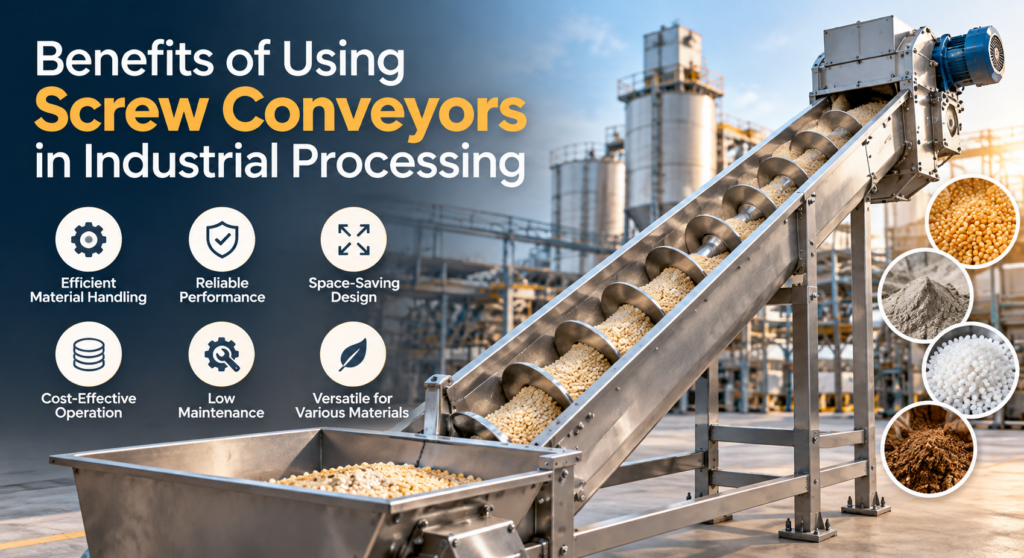
Industrial processing facilities rely on efficient material handling systems to move raw materials, ingredients, powders, granules, and other products between different stages of production. Among the various conveying technologies available, screw conveyors are widely used because of their practical design, versatility, and reliable performance. These systems use a rotating screw or helical flight inside a trough or tube to transport materials from one point to another. They can be adapted to different processing requirements and are suitable for a wide range of industries, including food processing, agriculture, chemicals, pharmaceuticals, construction, and manufacturing.
Understanding the benefits of screw conveyors can help businesses select an appropriate material handling solution that improves productivity while maintaining operational efficiency.
NOTE :- Businesses seeking dependable material handling equipment had relied on Screw Conveyors Suppliers in UAE for efficient conveying solutions. Al Jarah Industries had supplied robust screw conveyor systems that supported smooth material movement and reduced manual handling. Their solutions had been suitable for various industrial applications. Connect with Al Jarah Industries for more information.
Efficient Material Transportation
One of the primary benefits of screw conveyors is their ability to transport materials efficiently over short and medium distances. The rotating screw continuously moves material through the conveyor, providing a controlled and consistent flow.
This makes screw conveyors suitable for transporting materials such as powders, grains, pellets, flour, cement, chemicals, and other bulk products. Their enclosed design can also help reduce material loss and limit exposure to external contaminants, which is particularly important in processing environments where cleanliness and product quality are essential.
Flexible Design for Different Applications
Screw conveyors can be designed in various configurations to accommodate specific industrial requirements. Depending on the application, they can operate horizontally, at an incline, or in certain vertical conveying arrangements.
Manufacturers can also customize the conveyor’s length, diameter, capacity, material of construction, and screw configuration. Different screw designs can be selected depending on whether the application involves standard conveying, mixing, feeding, or handling materials with particular flow characteristics.
This flexibility allows industries to integrate screw conveyors into existing production lines without requiring extensive changes to their overall processing layout.
Compact and Space-Saving Construction
Industrial facilities often have limited floor space, especially where several processing machines and storage systems need to operate within the same area. Screw conveyors generally have a compact construction compared with some other bulk material handling systems.
They can be installed beneath equipment, between processing stages, or within confined production areas. Their ability to fit into relatively small spaces can help businesses make better use of available floor space while maintaining an organized material flow.
Controlled Material Flow
Precise control over material movement is another important advantage of screw conveyors. The rotational speed of the screw can be adjusted to regulate the rate at which material is transported.
This feature is useful in applications where a consistent supply of material is required for downstream equipment. For example, screw conveyors can act as controlled feeders for mixers, packaging machines, dryers, crushers, and other processing equipment. Maintaining a steady flow can help reduce interruptions and improve the consistency of production operations.
Reduced Material Handling Requirements
Automating material transportation can reduce the need for manual handling within industrial facilities. Instead of requiring workers to repeatedly move bulk materials between processing stages, a screw conveyor can perform the transportation continuously.
Reducing manual material handling can improve workflow efficiency and help minimize unnecessary physical effort for employees. It can also support better organization of production areas by creating a defined path for material movement.
Enclosed Operation and Improved Containment
Many screw conveyors operate within enclosed troughs or tubes. This construction can provide an important advantage when handling dusty, fine, or potentially sensitive materials.
An enclosed conveying system can help reduce the spread of dust and minimize the risk of foreign materials entering the product stream. In industries such as food processing, chemical manufacturing, and pharmaceuticals, controlled material containment can contribute to cleaner and more consistent processing environments.
The appropriate sealing and construction materials should be selected according to the specific material being conveyed and the applicable industry requirements.
Suitable for Multiple Processing Functions
Screw conveyors are not limited to simple material transportation. Depending on their design, they can also perform functions such as feeding, mixing, blending, cooling, heating, and controlled discharge.
For example, specially designed screw conveyors can combine materials during transportation, reducing the need for separate equipment in certain applications. Some systems can also incorporate heating or cooling arrangements when the process requires temperature control.
This multifunctional capability can make screw conveyors valuable components within integrated industrial processing systems.
Easy Maintenance and Reliable Operation
A relatively straightforward mechanical design makes many screw conveyors practical to maintain. Key components generally include the screw, shaft, bearings, drive system, trough or housing, and supporting structure.
Routine inspection, lubrication where required, alignment checks, and timely replacement of worn components can help maintain reliable performance. Proper maintenance can also reduce unexpected downtime and extend the operating life of the equipment.
Businesses should follow the manufacturer’s maintenance recommendations and select components that are appropriate for the operating environment.
Cost-Effective Material Handling
Screw conveyors can provide an economical solution for many bulk material handling applications. Their relatively simple construction and compact design can help control equipment, installation, and maintenance costs.
Operating costs can also be managed through appropriate motor selection, conveyor sizing, and speed control. However, the overall cost-effectiveness of a screw conveyor depends on factors such as material characteristics, conveying distance, required capacity, operating hours, and system configuration.
Improved Production Efficiency
By providing continuous and controlled material movement, screw conveyors can contribute to smoother production processes. Materials can be transferred automatically between storage units, processing machines, and packaging systems without frequent manual intervention.
A well-designed conveyor system can reduce material transfer delays and support better coordination between different stages of production. This can be particularly valuable in facilities where consistent throughput and uninterrupted processing are important.
Conclusion
Screw conveyors offer several practical benefits for industrial processing, including efficient material transportation, flexible installation, controlled flow, compact construction, and reduced manual handling. Their enclosed design can also support better material containment, while customized configurations allow them to perform additional functions such as feeding and mixing.
The right screw conveyor should be selected based on material properties, required capacity, conveying distance, temperature, environmental conditions, and specific processing requirements. With proper design, installation, and maintenance, screw conveyors can become a dependable part of an industrial material handling system and contribute to efficient, consistent, and organized production operations.
For More Insightful Articles Related To This Topic, Feel Free To Visit: https://xuzpost.com/