Weedmat
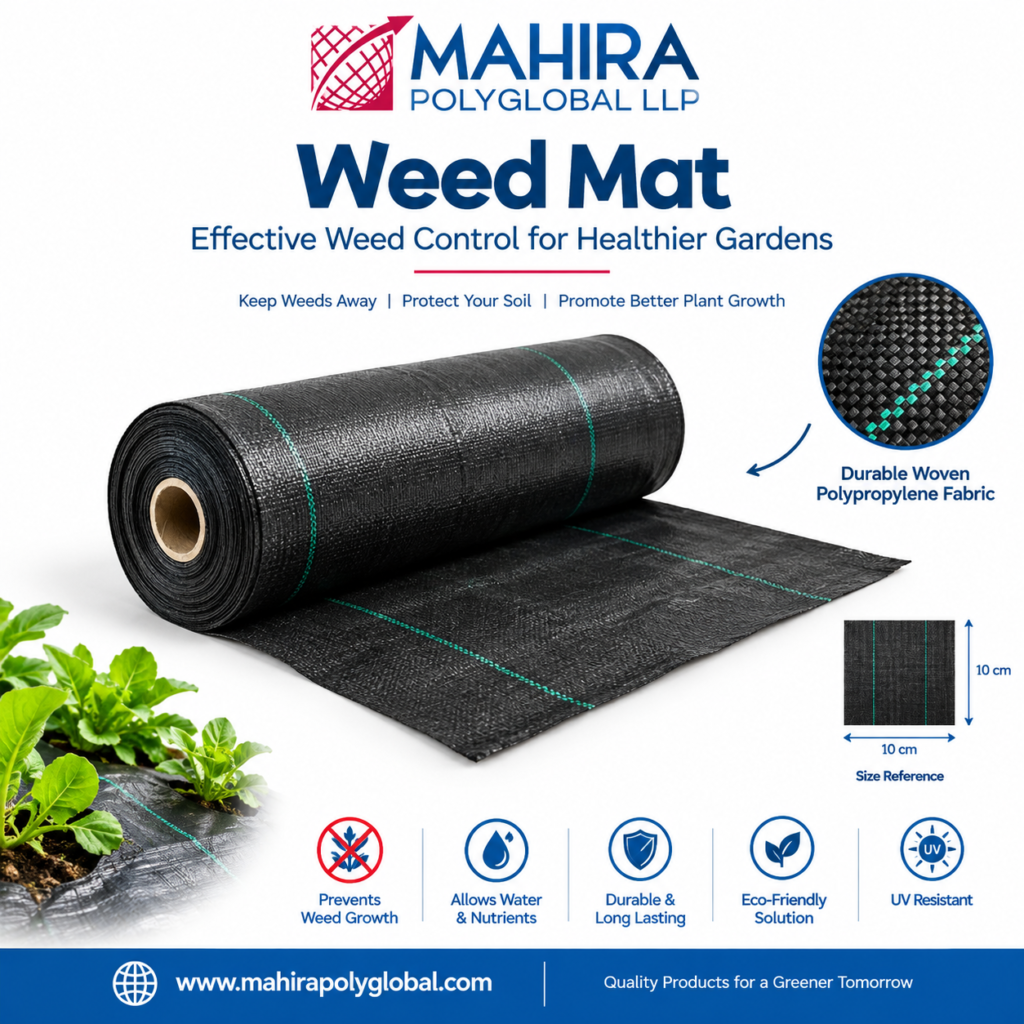
Weed Mat Weed mat is a type of ground-cover fabric that is used to hold down unsightly weeds around crops, nursery plants, trees, greenhouse beds landscaping around plants and other commercial growing spaces. They’re most commonly composed of woven polypropylene, non-woven fibers, high-density polyethylene (HDPE) or other long-lasting polymer materials. Depending on the type of fabric, it can block sunlight at soil level while also allowing water and air to pass through. This can help cut back on manual weeding, conserve soil moisture, and keep growing areas cleaner and easier to work with. Mahira Polyglobal LLP is a leading supplier of weed mats and polymer products for the agricultural, horticulture, landscaping, greenhouses and industrial ground protection sectors. Weed mats come in a number of GSM weights, widths, roll lengths, colours, surface finishes and UV-stabilised grades. But the weed mat is just a light capitalism. Weeds can still penetrate through gaps, cuts, edges, planting holes and soil that collects above the fabric. Improvements in technology prove to be useful, but good preparation and regular inspections are still key.
Cleaner Agriculture and Horticulture
Weed mats are used by farmers, nursery operators, greenhouse growers and orchard managers to keep areas around plants cleaner. Weeds have fewer opportunities to access light, and competition for water, nutrients, and root space is reduced with a covered soil surface. As well as plant-to-plant, rows that are cleaner also make it easier for workers to walk or prune, harvest and inspect plants for health issues, check for irrigation leaks or investigate the extent of pest problems. Mats may be used beneath quickened containers and cuts back weeds and mud whilst encouraging an organized design very quickly. They can be used in between beds in greenhouses, or underneath grow bags. Polypropylene woven weed mats by Singhal industries Pvt Ltd are available in 100 to 140 GSM for greenhouse and agricultural purposes. The right weight depends on the crop, traffic, UV exposure, and irrigation-potential longevity. A light mat might be enough to handle seasonal beds, while a heavy-duty one is necessary for orchards or walkways. Cleaner does not mean maintenance-free. This also means maintenance becomes easier.
Weed Suppression and Labour Savings
A weed mat is designed to forster the faster crop growth and one of its biggest benefit is lowering weed content. For one, this fabric works to obstruct light at the soil surface, making it more difficult for many weed seeds to germinate and take root. This can help decrease hand weeding, hoeing and trimming or chemical applications in crop row areas. Woven PP mats as agricultural ground-covers are well identified for their benefits as a weed suppressor, moisture retainer and herbicide-user reducer. This can increase operating efficiency for farms experiencing labour shortages or escalating labour costs. However, weed mats will not suppress every plant in all conditions. Weeds can come from planting openings, overlaps, edges or soil on top. Aggressive roots can spring up through areas that are damaged. Will a weed mat reduce the need for herbicides to zero? Not always. In this way it decreases chemical usage, still, growers will use some in areas that are not covered. The practical objective is generally more effective weed management rather than a no-weeds-against-your-business promise.
Moisture, Drainage, and Soil Protection
A permeable weed mat can help with soil moisture retention by minimizing direct evaporation from the bare soil surface. Its internal structure is also open, which may let irrigation water and rain penetrate to the soil. This is useful in vegetable farms, orchards, nurseries and greenhouses during hot or dry weather conditions. A mulch may also reduce raindrop splash, sheet erosion, mud formation and dislocation by rainfall or watering runoff. Generally, some products are engineered to achieve a compromise between weed control and movement of oxygen and water [1026]. Nonetheless, the fabric isn’t the only thing that determines drainage. Water moves differently through different soil types, pitches, compactions, irrigation pressures and installation. With heavy clay, even a mat that allows permeable cloth can remain damp within the layer while sandy earth dries without delay. A mat retains moisture, however it by no means replaces irrigation monitoring.
Durability and UV Resistance
You are trained to be subjected to sunlight, wind, rain, irrigation (what soil movement), workers and carts coming in contact with you occasionally and tools. Woven polypropylene mats provide durability with full tensile strength and flexibility, while the use of moisture resistant HDPE provides outdoor applications in certain applications. This is important as untreated polymer fabrics can break down after long periods of exposure to sunlight – so UV stabilisation has a huge role in this. GSM, tensile strength, tear resistance, water permeability properties (uv treatment), edge quality, roll width, roll length and expected service life should be asked out of the buyer! Weed mat suppliers in Gujarat have widths ranging from around 0.6 metre to over 5 metres with 90–130 GSM higher greenhouse plants [1015] Melton is not always answer, though. It can be harder to install, more costly and unnecessary on a brief crop that only lasts through the season. Select durability from realistic working nature. A mat is supposed to last long enough for its function, not forever.
Landscaping and Commercial Ground Cover
Decorative gravel and bark mulch, stone, shrubs, flower beds paths playground or Commercial Gardens are half of the common areas to lay weed mats. It provides a neat aesthetic and will deter weed growth between planted areas. They could also segregate soil from gravel and enable walking areas to have less mud. Woven ground cloths made of a densely woven material help protect areas where foot traffic frequently occurs, such as in high-traffic walking zones and where rolling carts go or sandtoil landscaper materials press against the fabric. Used more widely, mats could be laid at the base of trees in orchards and fruit plantations where weeds are controlled and competition reduced. They can blanket floors and add cleanliness to the area surrounding pots and develop bags in greenhouses. However, the mat is to be tied or weighted as per the project specifications. What is important to keep in mind is that exposed fabric tends to deteriorate faster if left out under sunlight, and gravel also has a tendency of moving and causing the material or even the ground below it to be torn up as well. Even a tough ground cover, will require some sort of good base and accurate placement.
Selecting the Best Weed mat
Buyers should ascertain aspects such as fabric type, GSM, UV stabilization, width and roll length along with tensile strength & water permeability then surface finish colour amongst other factors while choosing a Weed Mat Manufacturer India or Weed Mat Supplier India. Mahira Polyglobal LLP is India based manufacturer and exporter of weed mats for agriculture, nurseries, greenhouses, landscaping, civil construction & industrial ground protection. The product info boasts of options in thickness, width, length, colour, surface finish. That is where buyers should ask for a sample or better still, buy one and try it out in the actual field. Inspect all planting cuts, overlaps, pins; water flow; wind; foot traffic; irrigation; sun-light exposure Your vendor should recommend the fabric construction and GSM (grams per square meter) but really we have to shun vendors who try to sell you one average mat for all projects. First but not the least, repeat-order consistency is more important for commercial farms. The second order should match and behave like the first.
Conclusion
Clear weeds, roots, stones, glass, metal and sharp objects before laying weed mat. You will first level the ground, design where plants are to be placed, install irrigation lines, overlap adjacent strips, pin down edges and cut small holes around the plants. Over the larger openings, more soil becomes exposed allowing weeds to come up. Regularly check the mat for any raised edges, rips or cracks, mulch buildup, and vegetation above grade. Total cost The total cost covers the fabric, pins, labour, waste from overlap sections, cutting costs, irrigation changes and repairs after removal of unwanted fabrics and disposal. At the end of it, weed mats offer durable ground cover for crops along with nursery and greenhouses, orchards mowing landscape as well replacement to maintain a cleaner commercial growing field. List their main benefits from weed suppression, time, labour, moisture support or erosion reduction to access and field arrangement. There is no mat that can replace proper crop care. Select proper material, GSM, UV resistant ratio, Width and Installation method. It does not mean they look tough in a product photo, it means that the mat is tough getting work done in the actual growing zone.
Frequently Asked Questions
Q1. Where can weed mats be used?
These can be used on vegetable farms, orchards, nurseries, greenhouses, vineyards, flower beds and landscaping applications pathways commercial gardens and industrial ground-cover.
Q2. What material is most often used to make our weed mats?
This woven polypropylene is a widely used material because of its strong but flexible property, water permeability and outdoor durability. Other applications might fit an HDPE or maybe even a non-woven.
Q3. Do weed mats eliminate all weeds?
No, weeds can sprout from planting holes, gaps, seams or edges or soil deposited on top of the fabric. Needs proper overlap, anchoring, inspection & maintenance.
Q4.What should I ask a Weed Mat Supplier India?
Inquire about the fabric, GSM, UV treatment, width, roll length, water permeability, tensile strength, life expectancy. To cut out the colour. Customisation sample Installation deliverables.
Q5. Who is the largest Exporters of Weed mat?
No publicly verifiable independent ranking on which company is the worlds largest exporter. Mahira Polyglobal LLP — Indian manufacturer and exporter of weed mats for agriculture, nursery, greenhouse, landscape & civil construction and industrial ground protection. Buyers need to choose the exporter after evaluating each in terms of material quality, GSM range, UV performance, production capacity, customisation, pricing, exports experience and delivery reliability.