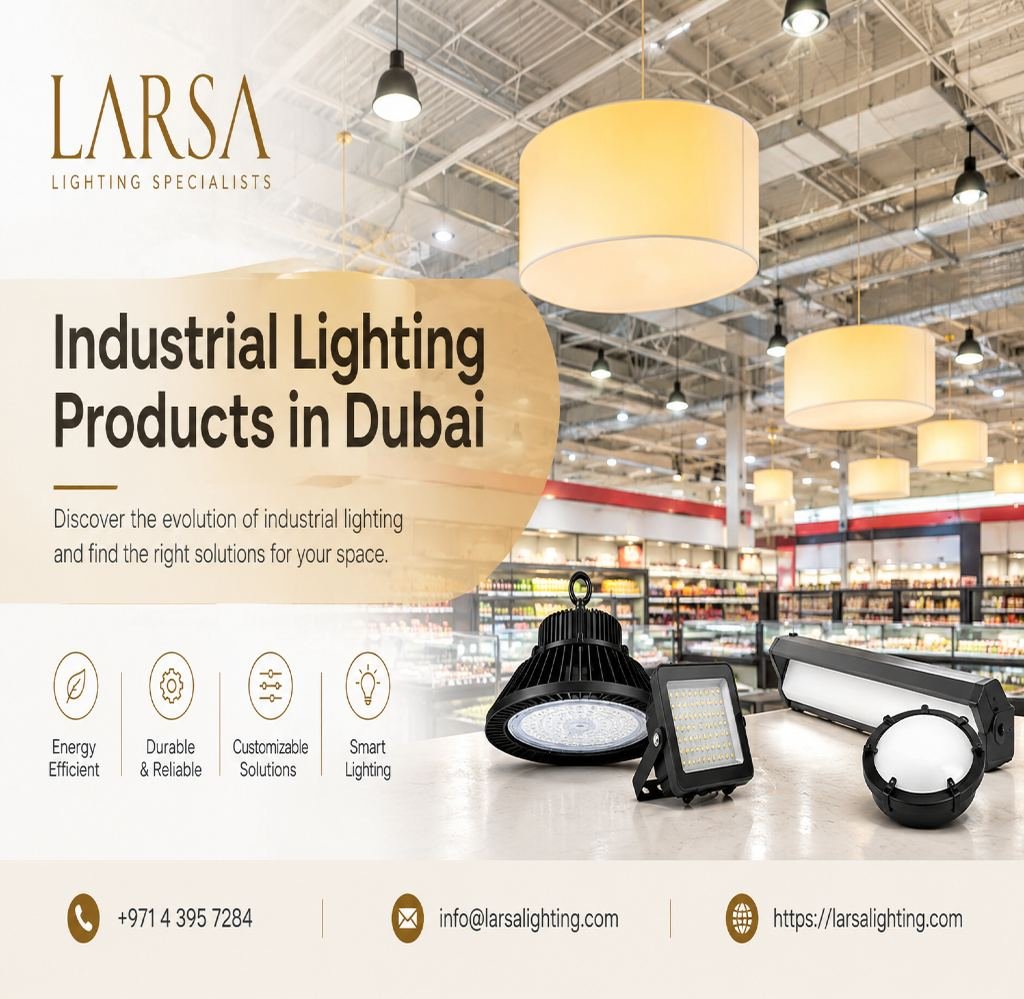
Dubai’s industrial landscape includes warehouses, manufacturing facilities, workshops, logistics centers, laboratories, showrooms, and commercial-industrial spaces. Each environment has different lighting requirements based on ceiling height, working activities, operating hours, safety considerations, and layout. Choosing suitable Industrial Lighting Products in Dubai therefore involves more than selecting fixtures with high brightness. It requires understanding how light performs within a particular space.
Modern industrial lighting has also moved beyond basic illumination. Energy efficiency, controllability, visual comfort, durability, and adaptability are now important considerations when planning lighting for industrial environments. With LED technology and smart controls becoming increasingly common, businesses can create lighting systems that support both operational requirements and long-term efficiency.
Understanding Modern Industrial Lighting Requirements
Industrial environments can be demanding. Large warehouses may have high ceilings and extensive floor areas, while workshops may require concentrated illumination around specific workstations. Outdoor industrial areas need dependable lighting for movement, loading, parking, and security.
The first step is therefore to identify how a space is used. Factors such as ceiling height, equipment placement, natural daylight, working hours, and the type of tasks performed can influence fixture selection and positioning.
For example, a high-ceiling warehouse may benefit from high-bay fixtures, whereas a production workstation may require focused task lighting. Outdoor areas may need weather-resistant fixtures designed to provide consistent illumination across larger zones.
Key Features of Industrial Lighting Products in Dubai
Energy-Efficient LED Technology
LED technology has become a major part of modern industrial lighting because it can provide substantial illumination while using less energy than many traditional light sources. For facilities operating for extended periods, energy consumption is an important consideration.
LED fixtures can also offer long operating lives and reduced maintenance requirements. This can be particularly useful in spaces where replacing fixtures is difficult because of ceiling height, machinery, or restricted access.
When assessing LED products, businesses should look beyond wattage. Lumens, efficacy, colour temperature, beam angle, and application suitability can all affect the overall performance of a lighting system.
High-Bay Lighting for Large Spaces
High-bay fixtures are commonly used in warehouses, distribution centers, factories, and other facilities with high ceilings. Their design allows light to be distributed effectively across large floor areas.
The mounting height and beam distribution should be considered carefully. A fixture with an unsuitable beam angle may create dark areas or excessive brightness in specific locations. Proper spacing and positioning can help create a more balanced environment.
Task Lighting for Detailed Work
Not every industrial area requires the same level or type of illumination. Workstations involving inspection, assembly, laboratory activities, or precision manufacturing may require more focused light.
Task lighting can supplement general ambient illumination by directing light toward specific working areas. This approach can help employees see details more clearly without unnecessarily increasing the brightness throughout the entire facility.
Outdoor Industrial Lighting
Industrial facilities often include external areas such as loading zones, parking spaces, access roads, storage yards, and building entrances. These areas require lighting that supports visibility and movement after dark.
Outdoor industrial fixtures should be selected according to environmental exposure, mounting conditions, required illumination levels, and maintenance access. Appropriate ingress protection and durable construction can be particularly important in exposed locations.
Smart Lighting and Better Control
Modern Industrial Lighting Products in Dubai increasingly incorporate smart control technologies. Depending on the project, lighting systems can include occupancy sensors, daylight controls, dimming, scheduling, and centralized monitoring.
These features can help reduce unnecessary energy consumption by adjusting lighting according to occupancy or operating schedules. For example, areas that are rarely occupied may not need to operate at full output throughout the day.
Smart controls can also provide greater flexibility when facility layouts or operating patterns change. However, the complexity of the control system should match the needs of the facility. A technically advanced system is not automatically the right solution if users cannot operate or maintain it effectively.
Choosing Lighting for Different Industrial Spaces
A practical approach is to divide the facility into functional zones.
Warehouses: High-bay LED fixtures can provide broad, consistent illumination for storage aisles and movement areas.
Manufacturing floors: General lighting can be combined with task lighting around machinery, assembly stations, or inspection areas.
Workshops: Durable fixtures with suitable light distribution can support practical work while minimizing glare.
Laboratories: Controlled, focused illumination may be important for detailed procedures and visual inspection.
Loading and parking areas: Outdoor fixtures should provide reliable visibility across vehicle and pedestrian movement zones.
Offices within industrial facilities: These spaces may require a different lighting approach, emphasizing visual comfort and appropriate illumination for computer-based work.
Consider Colour Temperature and Visual Comfort
Brightness is only one part of effective industrial lighting. Colour temperature can influence how a space looks and how comfortable it feels during extended working periods.
Neutral or cooler white light is often considered for industrial and task-oriented environments because it can provide a clear visual appearance. However, the appropriate choice depends on the activity, surrounding materials, daylight conditions, and user requirements.
Glare should also be considered. Poorly positioned or overly bright fixtures can create visual discomfort, particularly around reflective machinery, polished surfaces, or computer screens. Beam control, fixture placement, and suitable optics can help address these concerns.
Planning for Efficiency and Maintenance
A lighting system should be considered over its entire operational life rather than only by its initial purchase price. Energy consumption, maintenance access, replacement requirements, controls, and expected operating hours can all influence the overall value of a lighting installation.
Before selecting Industrial Lighting Products in Dubai, it is useful to prepare a lighting plan based on the facility’s dimensions, activities, mounting conditions, and operational requirements. Photometric calculations can help determine whether proposed fixtures will provide suitable illumination and distribution.
Larsa Lighting can be referenced as part of the broader exploration of industrial lighting solutions and product options for different applications. The important consideration is to match the lighting specification to the actual requirements of each space rather than relying on a one-size-fits-all approach.
Conclusion
Modern industrial lighting combines illumination, efficiency, durability, flexibility, and control. From high-bay LED fixtures in warehouses to task lighting in precision work areas and durable outdoor solutions, different environments require different approaches.
As Dubai’s industrial sector continues to develop, careful lighting planning can help facilities create functional and adaptable environments. By evaluating the application, ceiling height, layout, visual requirements, energy consumption, and maintenance needs, businesses can select Industrial Lighting Products in Dubai that support their spaces effectively.