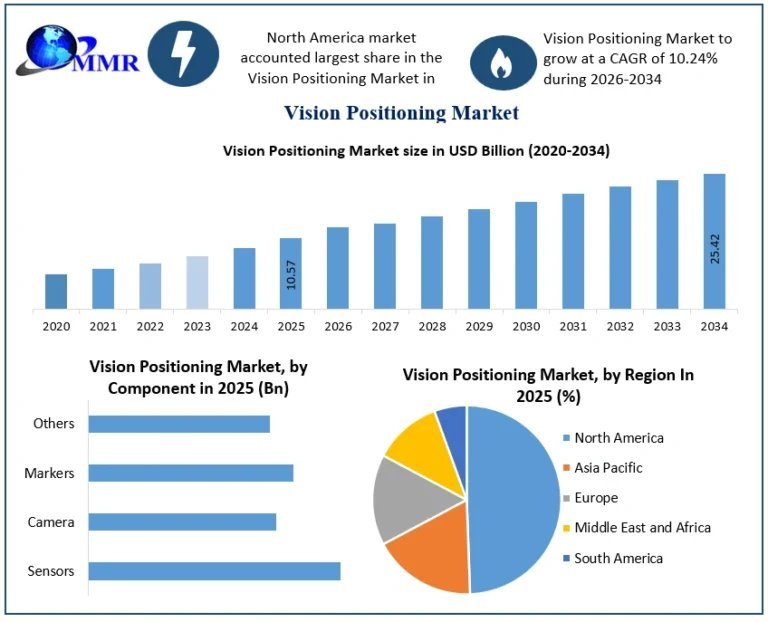
Vision Positioning Market to Reach USD 25.42 Billion by 2034, Driven by Industrial Automation, Robotics and GPS-Denied Navigation
The Vision Positioning Market is entering a growth phase as manufacturers, drone developers, logistics operators, automotive companies and defense organizations increasingly require positioning in complex environments. The Vision Positioning Market was valued at USD 10.57 billion in 2025 and is projected to grow at a CAGR of 10.24% from 2026 to 2034, reaching nearly USD 25.42 billion by 2034. Vision positioning combines cameras, sensors, image processing and algorithms to determine location, movement and surroundings, supporting autonomous operation in GPS-limited environments.
Market Estimation, Growth Drivers and Opportunities
Growth is supported by the accelerating adoption of industrial automation, autonomous mobile robots, unmanned aerial vehicles, automated guided vehicles and manufacturing systems. Vision positioning enables machines to interpret their environment, improve navigation and maintain accuracy in indoor or GPS-limited locations. Demand for productivity, safer operations and monitoring is encouraging integration of vision sensors, cameras, 3D imaging and sensor-fusion technologies. Opportunities are expanding through artificial intelligence, edge computing, machine vision, digital twins, autonomous logistics and robotics. Another opportunity is GPS-denied navigation for drones, aircraft, defense platforms and industrial vehicles, where visual information can provide an additional positioning layer and improve operational resilience.
Download a Free Sample of the Market Report : https://www.maximizemarketresearch.com/request-sample/31137/
United States Market: 2025 Trends and Investment
The United States remained a major innovation center for vision-based positioning during 2025, particularly across robotics, defense and autonomous systems. In March 2025, Tera AI emerged from stealth with USD 7.8 million in seed funding to develop visual navigation software for autonomous robots. In July 2025, RealSense completed its spinout from Intel and secured USD 50 million in early-stage funding to expand AI vision and 3D depth-camera technologies for robotics. U.S. defense innovation also supported the segment: a 2025 U.S. Air Force SBIR award provided USD 1.25 million for a GPS-independent visual positioning system using computer vision, AI and 2D/3D terrain data. These investments highlight demand for vision-based navigation.
Market Segmentation: Largest Share
By component, Cameras held the largest market share, accounting for more than 65% of market revenue in 2024. Cameras are fundamental to vision positioning because they capture images and movement information that positioning systems use to determine location and guide automated equipment. The adoption of cameras, 2D vision systems, optical sensors and imaging technologies is reinforcing camera demand across automation, robotics, drones and industrial applications. Improvements in image resolution, low-light performance, 3D perception and edge-based processing are expected to support continued growth.
Competitive Analysis
The competitive landscape includes Parrot SA, Senion, LOCATA Corporation Pty. Limited, Pepperl+Fuchs GmbH and DJI among the key companies identified in the market study. Parrot has continued investing in AI-enabled micro-UAV capabilities and strengthened its portfolio with ANAFI UKR, designed for challenging electronic-warfare environments, and R&D. Senion contributes indoor positioning and navigation expertise based on sensor fusion for GPS-limited environments. LOCATA is advancing terrestrial positioning through its TimeLoc technology, which synchronizes ground-based transmitters to provide precise positioning without depending solely on satellites. Pepperl+Fuchs is expanding industrial vision capabilities through 2D and 3D vision, stereo vision and time-of-flight technologies; in 2025, its partnership with MVTec improved interoperability between machine-vision software and sensor hardware. DJI continued strengthening vision-enabled positioning through its enterprise drone portfolio. Its 2025 Matrice 4 Series combined AI computing, enhanced sensing and GNSS-plus-vision fusion, while the Matrice 400 added LiDAR, millimeter-wave radar and vision sensors for complex operations. These innovations can accelerate adoption.
Regional Analysis
United States: The U.S. represents a major share of North America’s vision positioning revenue. North America held close to 34% of the market in 2024, supported by adoption of UAVs, automated guided vehicles, industrial robots and space-related systems. Innovation programs and defense research into GPS-denied navigation are creating additional demand for resilient positioning technologies.
China: China represents a growth market within Asia Pacific because of its robotics, drone, manufacturing and electronics ecosystem. Government initiatives during 2025 promoted AI, robotics, industrial applications and BeiDou-enabled positioning, including integration with inertial navigation and high-precision vision technologies. China also introduced a national standard for three-dimensional vision-guided systems for industrial robots, supporting standardization and adoption.
Japan: Japan’s manufacturing and robotics ecosystem provides an application base. In 2025, Japanese research strategy emphasized Physical AI, integrating AI, sensors and robotics to develop adaptive AI-robot systems. This direction supports demand for perception and positioning technologies in factories and service robotics.
Key Players
Parrot SA; Senion; LOCATA Corporation Pty. Limited; Pepperl+Fuchs GmbH; DJI; OMRON Corporation; infsoft GmbH; ADTECH (SHENZHEN) TECHNOLOGY CO., LTD.; Seegrid Corporation; and SICK AG.
Why This Market Matters Now
Vision positioning is becoming increasingly important as autonomous systems move from controlled environments into warehouses, factories, cities, farms, transportation networks and security-sensitive locations. Dependence on GPS alone can create operational limitations indoors or during signal interference, while vision systems can deliver contextual information about objects, movement and surrounding environments. The convergence of AI, cameras, LiDAR, radar, inertial sensors and edge computing is creating multi-sensor positioning platforms with capabilities. As enterprises seek automation, efficiency and safer autonomous operations, investment in vision positioning can support the next generation of intelligent machines, robotics and navigation systems.
Explore More Related Reports:
System in Package Market https://www.maximizemarketresearch.com/market-report/global-system-in-package-market/7185/
Railway System Market https://www.maximizemarketresearch.com/market-report/railway-system-market/183999/
About Maximize Market Research
Maximize Market Research Pvt. Ltd. (MMR) is a global market research and consulting company that provides reliable, data-focused, and practical business insights. The firm serves a wide range of industries, including healthcare, pharmaceuticals, technology, automotive, electronics, chemicals, personal care, and consumer goods. Through market forecasts, competitive analysis, strategic consulting, and industry impact assessments, MMR helps organizations understand changing market conditions, identify growth opportunities, and make informed business decisions for long-term success.
Contact Us
2nd Floor, Navale IT Park Phase 3
Pune Banglore Highway, Narhe
Pune, Maharashtra 411041, India
+91 9607365656
sales@maximizemarketresearch.com