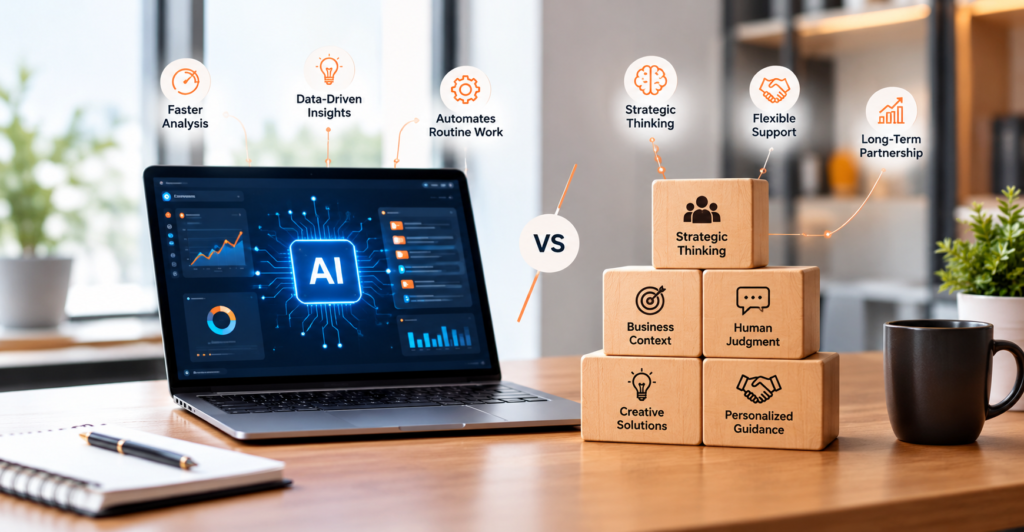
An AI development company builds working AI software – chatbots, prediction models, and automation tools. AI consulting companies decide what to build with your data, goals, and budget to shape a roadmap. If you already know the problem, hire developers. If you don’t, start with a consultant.
The two get mixed up constantly. From the outside, AI consulting firms and development shops look the same, with the same case studies and very similar websites.
Pick wrong and you’ll either pay for a strategy deck nobody can act on, or a finished model that solves a problem you didn’t really have. Here’s how to tell which one you need.
What Does an AI Development Company Do?
Development teams write code, train models, and ship working software. Think recommendation engines, document processing, demand forecasting, or computer vision inside an existing product.
Their deliverable is something you can run. That’s the whole point.
This route makes sense when the problem is already clear. “Sort 5,000 support tickets a day by urgency” is a development brief. So is “add product recommendations to our checkout page.”
If that sounds like your situation, a team offering AI development services is where you’d start.
What Do AI Consulting Firms Do?
AI consulting firms can work earlier in the process. They look at your data, workflows, and goals, then help you identify where AI would earn its keep and where it wouldn’t.
A good consultant will assess data readiness, rank use cases by likely return, and compare building against buying. They’ll also flag privacy, bias, and compliance risks before those become expensive.
You will walk away with clarity, usually a roadmap. Not code.
That’s valuable when leadership is excited but unfocused, when three departments are pitching three different ideas, or when nobody’s sure the data is usable. If that’s you, AI consulting services are the most sensible first call.
The Difference At A Glance
The comparison of AI Development Company and AI Consulting Company is given below.
| Dimension | AI Development Company | AI Consulting Company |
| Main Output | Working software or models | Strategy, roadmap, recommendations |
| Best Stage | Problem is defined, data exists | Problem is fuzzy or priorities compete |
| Typical Team | Engineers, ML specialists, data scientists | Strategists, analysts, domain experts |
| Success Looks Like | A system in production | A confident, prioritized decision |
| Main Risk | Building the wrong thing well | A plan that never gets built |
Signs You Should Start With A Consultant
- You can’t describe the problem in one sentence.
- You don’t know where your data lives, and how clean it is.
- Nobody has defined what “success” means in numbers.
- Stakeholders disagree on priorities.
- It hasn’t been determined yet if you should create, purchase, or connect to an already existing API.
If you nodded at two or more, a few weeks of discovery will probably save you months later.
Signs You Are Ready For a Development Company
- The problem is specific, and the data already exists.
- You have an internal strategy, or a prototype that worked.
- You need something in production by a real deadline.
- Your team knows what “done” looks like
In these cases, adding a consulting phase mostly adds delay.
Can One Company Handle Both Consulting And Development?
Plenty of projects need both, in order. Consult first, build second.
Some AI consulting companies also build, and some development shops also advise. The Mad Brains offers both under one roof, which keeps handoffs smooth. Still, ask one thing: would they ever tell you not to build? A consultant who also sells the build has a reason to say yes to everything. Honest firms will admit when a simpler tool or a process fix does the job.
Questions Worth Asking Before You Sign
- Who will actually do the work, and who’s only on the sales call?
- Can you walk me through a similar project and what happened after launch?
- Who owns the models, code, and data when we’re done?
- How will we measure success, and when?
- What happens after go-live?
The last one gets skipped surprisingly often. Models drift as real-world data changes, so a system that works well in March can quietly get worse by September.
Final Thought
Start with the question, not the vendor. If you’re unsure what to build, you need a consultant. If you know what to build, you need an AI development company. If you fall somewhere in between, don’t hesitate to tell your listener.
Not sure which side of the line you’re on? Get in touch with the team and talk it through. A short conversation usually makes the answer obvious.