Commercial hydroseeding services
Commercial properties often include large areas of exposed soil after construction, grading, utility work, or landscape development. Leaving these surfaces unprotected can increase the risk of erosion, uneven vegetation, and costly landscape repairs. Commercial hydroseeding services provide an efficient way to distribute seed, mulch, water, and other selected materials across large areas. When properly planned and maintained, the process can support uniform vegetation establishment while helping protect disturbed soil.
What Are Commercial Hydroseeding Services?
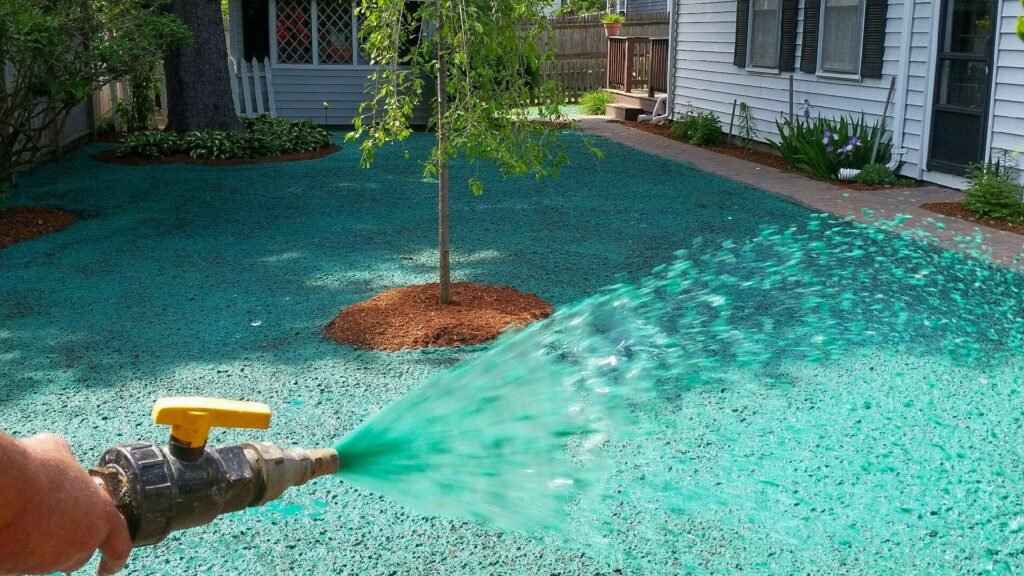
A typical slurry can contain grass seed, fiber mulch, water, fertilizer, tackifiers, and soil amendments selected according to site requirements. Commercial hydroseeding services is a hydraulic seeding method designed for projects where efficient and consistent vegetation establishment is important. The mixture is sprayed over prepared soil using specialized equipment, creating broad and relatively uniform coverage. This approach can be particularly useful for developments, industrial properties, common areas, infrastructure projects, slopes, and other large landscapes.
Unlike conventional broadcast seeding, hydraulic application can help distribute seed and mulch together across difficult or expansive surfaces. The mulch helps retain moisture around the seed and can reduce the impact of rainfall and surface runoff during early establishment. TxDOT identifies hydromulch as a hydraulically applied erosion-control material that can be used with seed and tackifying agents. However, successful results still depend on proper soil preparation, suitable seed selection, application timing, and post-installation care.
Step 1: Evaluate the Commercial Property
The first stage should be a detailed assessment of the area that needs vegetation. Contractors typically consider the site’s size, soil condition, slope, drainage patterns, existing vegetation, accessibility, sunlight, intended use, and erosion concerns. Commercial properties can contain several different microenvironments, so applying one identical mixture everywhere may not produce the best outcome. A site evaluation helps determine where standard hydroseeding is appropriate and where additional preparation or erosion-control measures may be required.
Project specifications should also be reviewed before work begins. Construction schedules, landscape plans, municipal requirements, stormwater controls, and other project documents may establish specific seed varieties or application standards. Sloped areas deserve particular attention because increasing slope can increase the potential for sheet erosion. Careful planning at this stage allows the contractor to develop an application strategy that supports both vegetation establishment and the property’s broader construction or landscaping objectives.
Step 2: Prepare the Soil and Surface
Good soil preparation provides the foundation for a successful hydroseeding project. Construction equipment can leave soil heavily compacted, uneven, or covered with rocks and debris, making it difficult for new roots to develop. Depending on site conditions, preparation may include clearing debris, removing unwanted vegetation, loosening compacted soil, fine grading, improving topsoil, and correcting minor surface problems. The goal is to create a stable seedbed that provides suitable contact between seed and soil.
Drainage should be considered before the hydroseed mixture is applied. Water that moves too quickly across a surface can carry seed and mulch away before vegetation becomes established. Similarly, standing water can create unfavorable conditions for many grass varieties. Addressing grading and drainage concerns beforehand can reduce the likelihood of washouts and patchy growth. On challenging commercial sites, hydroseeding may need to be combined with blankets, bonded fiber matrix, drainage improvements, or other erosion-control measures.
Step 3: Select the Right Seed and Materials
Seed selection should be based on the actual conditions and purpose of the commercial property. Factors such as sunlight, soil characteristics, expected foot traffic, irrigation availability, drought tolerance, seasonal conditions, and desired appearance can influence the appropriate grass or vegetation mixture. A high-traffic commercial lawn may have different requirements from a detention pond slope, roadside corridor, or naturalized area. Choosing the correct seed is therefore an important part of achieving durable coverage.
The mulch and supporting materials are equally important. Fiber mulch can help retain moisture and protect seed during germination, while tackifiers can improve the mixture’s ability to remain in place. Fertilizers or soil amendments may be included when site conditions justify their use. On erosion-prone slopes, a more robust hydraulic mulch system may be appropriate. TxDOT guidance notes that hydraulically applied mulches can have different application requirements depending on soil type and slope, reinforcing the importance of matching materials to site conditions.
Step 4: Mix the Hydroseeding Slurry
After the site plan and materials have been selected, the components are combined inside specialized hydroseeding equipment. The mixture is designed to remain sufficiently uniform for application while delivering seed and protective materials across the prepared surface. The proportions can vary according to the seed type, mulch product, project specifications, soil conditions, and intended purpose. Proper mixing is important because inconsistent slurry can contribute to uneven material distribution.
Professional equipment also allows crews to reach large areas efficiently. The tank and pumping system move the slurry through hoses or spray equipment, allowing operators to apply material across open ground and certain difficult-to-access locations. The application should be performed according to the selected product requirements and project specifications. Careful preparation of the mixture helps ensure that the material reaching the soil contains the intended combination of seed, mulch, and supporting components.
Step 5: Apply the Mixture Evenly
Application technique has a direct influence on coverage quality. Operators should work systematically to create consistent coverage while paying attention to boundaries, slopes, transitions, and areas that may receive more runoff. Thin spots can lead to uneven vegetation, while excessive application can waste material and potentially create undesirable surface conditions. Experienced crews understand how to adjust their spraying technique according to terrain and equipment access.
Commercial hydroseeding can be particularly valuable when large areas must be treated within a limited construction schedule. Hydraulic equipment can cover broad surfaces more efficiently than many manual seeding methods, making it suitable for developments, commercial lots, road corridors, and other expansive projects. However, speed should not replace accuracy. The objective is controlled and appropriate coverage that supports establishment rather than simply completing the application as quickly as possible.
Benefits of Commercial Hydroseeding Services
One major benefit is efficient coverage across large properties. Instead of manually distributing seed and mulch over every section, hydraulic equipment allows a prepared slurry to be applied across extensive areas. The combination of seed and mulch can also provide better consistency than methods where materials are distributed separately. For developers and contractors working with large disturbed surfaces, this efficiency can make vegetation establishment easier to coordinate with the overall project schedule.
Another advantage is moisture retention and early-stage surface protection. The mulch layer can help keep seed moist and reduce exposure to some wind and rainfall effects while vegetation begins developing. Once roots become established, growing vegetation can provide stronger long-term soil stabilization. Hydroseeding can therefore serve both landscape and erosion-control objectives when the correct materials and techniques are used for the site.
Step 6: Follow a Proper Maintenance Program
Hydroseeding does not end when the spraying equipment leaves the property. Newly treated areas require appropriate moisture and protection while seeds germinate and roots develop. Watering should be sufficient to maintain favorable moisture without producing runoff that can disturb the mulch or seed. The exact maintenance schedule depends on weather, soil type, grass selection, slope, and irrigation capabilities, so project-specific instructions should always take priority.
Commercial property managers should inspect newly hydroseeded areas after significant rainfall, especially when the property contains slopes or drainage channels. Signs such as exposed soil, displaced mulch, concentrated runoff, or thin germination should be addressed promptly. Foot traffic and equipment movement should also be minimized until the vegetation is sufficiently established. Once the lawn or vegetation becomes established, regular mowing, irrigation, fertilization when appropriate, and seasonal maintenance can support long-term performance.
Residential Hydroseeding vs. Commercial Applications
The basic principles of hydroseeding remain similar whether the property is residential or commercial, but project scale and complexity can differ considerably. Residential hydroseeding near me searches often relate to new lawns, lawn renovations, bare patches, acreage, or areas disturbed by construction. Commercial projects may involve multiple acres, construction deadlines, erosion-control requirements, specifications, inspections, and coordination with several contractors. These differences can affect equipment, scheduling, material selection, and project management.
Residential and commercial properties can both benefit from customized applications rather than generic treatment plans. A small backyard may require a relatively straightforward seed and mulch mixture, while a commercial development may need multiple seed blends and different erosion-control materials across separate sections. In either situation, soil preparation and aftercare remain essential. The size of the project changes the logistics, but the fundamentals of establishing healthy vegetation remain consistent.
How to Choose a Commercial Hydroseeding Contractor
When comparing commercial hydroseeding providers, property owners, developers, and contractors should look beyond price alone. Experience with similar commercial properties, knowledge of local growing conditions, appropriate equipment, material selection, and clear project communication are all important considerations. Ask how the contractor evaluates soil, selects seed, prepares the surface, handles slopes, and manages areas vulnerable to erosion. A professional provider should be able to explain the reasoning behind its recommendations in practical terms.
It is also helpful to request a detailed proposal that identifies preparation work, seed mixtures, mulch materials, application areas, maintenance expectations, and any additional erosion-control measures. Clear documentation can help project managers coordinate hydroseeding with construction schedules and other site activities. Contractors should also be familiar with applicable project specifications when work is connected to municipal, infrastructure, or regulated construction. A thoughtful selection process can reduce avoidable problems and create better conditions for long-term vegetation establishment.
Final Thoughts
Commercial hydroseeding services offer an efficient approach to establishing vegetation across large or disturbed properties while supporting temporary soil protection during the early growth period. The process begins with site evaluation and preparation, followed by material selection, slurry mixing, controlled application, and consistent aftercare. Each stage matters because successful vegetation depends on more than the spraying process itself. Soil conditions, weather, seed selection, drainage, maintenance, and erosion risk all influence the final outcome.
For commercial property owners and project managers, the strongest results come from treating hydroseeding as part of the overall landscape and site-stabilization plan. A properly prepared surface, carefully selected materials, professional application, and suitable maintenance program can help create healthier and more uniform vegetation. Whether the goal is a finished commercial landscape, construction-site stabilization, or large-scale lawn establishment, understanding the complete process makes it easier to plan the work and protect the investment.