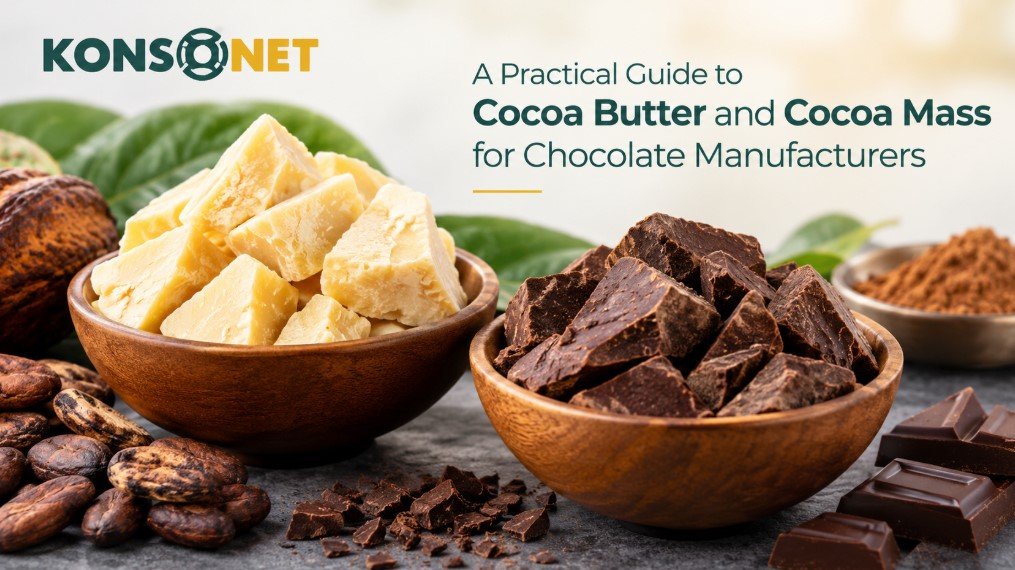
Chocolate manufacturers work with many cocoa ingredients, but two have an especially important influence on the final product: cocoa butter and cocoa mass. Understanding how they differ, how they behave during processing, and when to use each can make formulation and purchasing decisions much easier.
For manufacturers researching Cocoa butter and Mass in Turkish, the terminology is also useful to understand when communicating with Turkish suppliers and reviewing technical specifications. In Turkish, cocoa butter is commonly referred to as kakao yağı, while cocoa mass is commonly called kakao kitlesi or kakao likörü.
Key Takeaway: Cocoa mass provides much of the chocolate’s cocoa solids and natural cocoa fat, while cocoa butter is primarily used to control fat content, texture, flow, melting behavior, and mouthfeel. The right balance depends on the chocolate recipe and manufacturing process.
Konsonetas can be a useful reference point for businesses researching cocoa ingredients and international sourcing requirements. The most important step, however, is to evaluate every ingredient against the technical needs of the finished chocolate rather than choosing based on terminology or price alone.
What Are Cocoa Butter and Cocoa Mass?
Although both ingredients originate from cocoa beans, they are not interchangeable.
Cocoa Mass
Cocoa mass is produced by grinding roasted cocoa beans into a thick paste. It naturally contains both cocoa solids and cocoa butter.
Depending on the processing method and specification, cocoa mass can contribute:
- Cocoa flavor and aroma
- Cocoa solids
- Natural cocoa fat
- Color
- Bitterness and acidity
- Body and depth to chocolate
Because cocoa mass contains the complete fat-and-solids component of the cocoa bean, it is an important foundation for many chocolate formulations.
Cocoa Butter
Cocoa butter is the fat naturally present in cocoa beans. It is separated from cocoa mass through pressing and further processing.
Its main functions in chocolate include controlling:
- Viscosity
- Melting characteristics
- Snap and texture
- Mouthfeel
- Gloss
- Flow during processing
- Overall fat balance
Pure cocoa butter is particularly important when a manufacturer needs to adjust the physical behavior of a chocolate without adding additional cocoa solids.
Cocoa Butter and Mass in Turkish: Understanding the Terminology
When sourcing cocoa ingredients from Turkey or communicating with Turkish manufacturers and suppliers, knowing the relevant terminology can prevent misunderstandings.
The common terms include:
| English | Turkish |
| Cocoa butter | Kakao yağı |
| Cocoa mass | Kakao kitlesi |
| Cocoa liquor | Kakao likörü |
| Cocoa beans | Kakao çekirdeği |
| Cocoa powder | Kakao tozu |
| Chocolate | Çikolata |
| Cocoa solids | Kakao kuru maddesi |
Therefore, a search for Cocoa butter and Mass in Turkish may relate not only to translation but also to ingredient sourcing, product specifications, technical communication, or understanding Turkish cocoa terminology.
For international purchasing teams, it is worth confirming the exact ingredient represented by a Turkish term before placing an order. Terms such as cocoa mass and cocoa liquor may be used differently depending on the supplier, market, or technical documentation.
Cocoa Mass vs Cocoa Butter: What Is the Difference?
The simplest way to understand the difference is to look at what each ingredient contributes to a recipe.
| Characteristic | Cocoa Mass | Cocoa Butter |
| Main composition | Cocoa solids + cocoa fat | Cocoa fat |
| Cocoa flavor | Strong | Mild |
| Cocoa solids | Yes | Essentially no |
| Fat contribution | High | Very high |
| Main role | Cocoa base and flavor | Fat and texture adjustment |
| Typical use | Dark, milk and other chocolate formulations | Chocolate, coatings, fillings and formulation adjustment |
| Effect on flavor | Significant | Relatively neutral compared with cocoa mass |
| Effect on flow | Influences it | Strongly influences it |
This distinction becomes especially important when adjusting a chocolate recipe.
If a manufacturer adds more cocoa mass, the formulation generally receives more cocoa solids as well as cocoa fat. If the manufacturer adds cocoa butter, the fat level increases without adding the same level of cocoa solids.
That means the two ingredients can produce very different results even when both increase the cocoa-derived fat component.
Why Cocoa Mass Matters in Chocolate Manufacturing
Cocoa mass is one of the most direct ways to build cocoa character into chocolate.
A manufacturer choosing cocoa mass should consider several factors.
1. Flavor Profile
Cocoa mass carries the natural characteristics of the cocoa beans from which it was produced. Bean origin, fermentation, roasting, and processing can all influence the resulting flavor.
Two cocoa masses can therefore behave differently in the same formulation.
One may produce deeper roasted notes, while another may deliver more fruity, nutty, earthy, or intense cocoa characteristics.
2. Cocoa Content
Because cocoa mass contains cocoa solids, it directly contributes to the cocoa content of a chocolate recipe.
This makes it particularly important when developing products with specific cocoa-content targets.
3. Color
Cocoa mass can influence the color of the finished chocolate. The effect depends on the characteristics of the raw material and the rest of the formulation.
4. Fat Contribution
Cocoa mass naturally contains cocoa butter. This means manufacturers need to account for its fat contribution when calculating the overall recipe.
Ignoring this can make later adjustments more difficult.
The Role of Cocoa Butter in Chocolate Formulation
Cocoa butter is not simply an ingredient added to increase fat. It is a functional component that can influence how chocolate behaves throughout production and consumption.
Improving Flow
Chocolate must have suitable viscosity for refining, conching, tempering, moulding, enrobing, or depositing.
Additional cocoa butter can help adjust flow properties when the existing formulation is too thick for a particular process.
However, more is not automatically better. Excessive fat can change the intended texture and eating characteristics.
Controlling Mouthfeel
Cocoa butter contributes to the characteristic melting sensation associated with chocolate.
A well-balanced formulation can produce a clean melt rather than an overly heavy or waxy sensation.
Supporting Texture
Cocoa butter plays a central role in the structure of tempered chocolate. Its crystallization behavior affects properties such as firmness, snap, gloss, and stability.
This is why the quality and consistency of cocoa butter matter beyond its basic fat content.
How to Choose Between Cocoa Mass and Pure Cocoa Butter
The decision should start with the formulation objective.
Ask what the product needs.
Need more cocoa flavor and solids?
Cocoa mass may be the more appropriate ingredient.
Need more cocoa fat without significantly increasing cocoa solids?
Pure cocoa butter may be more suitable.
Need to adjust chocolate flow?
Cocoa butter can be evaluated as part of the fat adjustment strategy.
Need stronger cocoa character?
The choice and specification of cocoa mass become especially important.
Need to change the recipe while maintaining a particular cocoa-solid balance?
Reviewing the contribution of cocoa mass and cocoa butter separately can make formulation changes more predictable.
The best choice is therefore not simply “butter versus mass.” It is about understanding what each ingredient contributes to the complete formulation.
Cocoa Mass for Chocolate Manufacturing: Practical Considerations
Manufacturers evaluating cocoa mass for chocolate manufacturing should look beyond the product name.
Check the Technical Specification
A supplier’s specification should provide enough information to assess whether the ingredient is suitable for the intended application.
Depending on the ingredient, relevant information may include:
- Cocoa fat content
- Moisture
- Cocoa solids
- Particle characteristics
- Flavor profile
- Processing method
- Microbiological parameters
- Packaging
- Storage conditions
- Shelf life
Exact specifications should always be confirmed with the supplier because they can vary by product.
Consider the Final Application
The requirements for a premium dark chocolate may differ significantly from those for a compound-style coating, filling, bakery application, or industrial chocolate.
Before selecting cocoa mass, define the intended use.
Evaluate Consistency
For commercial chocolate production, consistency from batch to batch is often as important as the nominal specification.
Changes in flavor, fat content, acidity, or physical behavior can require adjustments elsewhere in the recipe or process.
Turkish Cocoa Butter and International Sourcing
The phrase Turkish cocoa butter can refer to cocoa butter sourced from suppliers operating in Turkey, products marketed for the Turkish market, or searches conducted by buyers looking for cocoa butter through Turkish supply channels.
For international manufacturers, geography alone should not determine ingredient selection.
Instead, compare the actual product specifications, including:
- Fat characteristics
- Purity
- Flavor
- Physical form
- Packaging
- Storage requirements
- Traceability information
- Food safety documentation
- Consistency between batches
- Commercial terms and delivery requirements
A supplier located in a particular country may offer several grades or specifications, so the country of origin should not replace technical evaluation.
What Should Manufacturers Ask a Cocoa Ingredients Supplier?
When comparing a cocoa ingredients supplier in Turkey or another international market, buyers can use a structured checklist.
Product Questions
Ask:
- What exact cocoa ingredient is being supplied?
- Is it cocoa mass, cocoa butter, cocoa powder, or another cocoa derivative?
- What is the declared cocoa fat content?
- What processing method is used?
- What is the expected flavor profile?
- What packaging formats are available?
Quality Questions
Also confirm:
- Certificate of Analysis availability
- Microbiological specifications
- Allergen information
- Food safety documentation
- Traceability
- Shelf life
- Storage conditions
Commercial Questions
For larger manufacturing operations, commercial details can be equally important:
- Minimum order quantity
- Available shipment sizes
- Lead time
- Packaging options
- Delivery terms
- Batch consistency
- Documentation supplied with shipments
This process helps buyers compare suppliers on more than price.
Common Mistakes When Buying Cocoa Ingredients
Even experienced purchasing teams can make avoidable mistakes when evaluating cocoa ingredients.
Mistake 1: Treating Cocoa Mass and Cocoa Butter as Substitutes
They perform different functions. Replacing one with the other can alter cocoa solids, fat balance, flavor, viscosity, and texture.
Mistake 2: Choosing Only by Price per Kilogram
A cheaper ingredient may not be more economical if it creates formulation problems, inconsistent processing, or additional adjustments.
The correct comparison is based on the ingredient’s contribution to the complete product.
Mistake 3: Ignoring the Specification Sheet
Product names can sound similar while specifications differ considerably.
Always compare technical data before making a purchasing decision.
Mistake 4: Focusing Only on Origin
Country of origin can be relevant, but it should be considered alongside processing, specification, quality controls, logistics, and suitability for the application.
Mistake 5: Forgetting Storage Conditions
Cocoa butter and cocoa mass need appropriate storage to maintain their intended characteristics. Buyers should understand the supplier’s recommended storage conditions before receiving commercial quantities.
How Cocoa Butter and Cocoa Mass Affect Chocolate Processing
Ingredient selection does not end when the raw materials arrive.
Both ingredients interact with other components during manufacturing.
A typical chocolate production process can involve:
- Ingredient preparation
- Mixing
- Refining
- Conching
- Fat adjustment
- Tempering
- Moulding or depositing
- Cooling
- Packaging
The exact process varies according to the chocolate type and manufacturing system.
Changes in cocoa mass or cocoa butter can therefore affect downstream processing. A recipe that works with one cocoa ingredient specification may require adjustment when switching suppliers or raw materials.
This is one reason manufacturers should conduct controlled trials before making large-scale changes.
A Simple Decision Framework for Manufacturers
When selecting between cocoa mass and cocoa butter, use this five-step approach.
Step 1: Define the Product
Identify whether you are producing dark chocolate, milk chocolate, couverture, coating, filling, bakery chocolate, or another cocoa-based product.
Step 2: Define the Desired Cocoa Profile
Determine how much cocoa flavor, cocoa solids, bitterness, color, and aroma the product should deliver.
Step 3: Calculate the Fat Contribution
Account for cocoa butter already present in cocoa mass and other fat-containing ingredients.
Step 4: Review Processing Requirements
Consider viscosity, refining, conching, tempering, moulding, enrobing, and final texture.
Step 5: Validate With a Trial
Before changing a commercial recipe, run a controlled test and compare the finished product against the existing formulation.
This approach reduces the risk of making a purchasing decision based on a single specification or price.
Why Ingredient Language Matters in Global Cocoa Sourcing
International sourcing creates another challenge: the same ingredient can appear under different names.
For example, a buyer searching for Cocoa mass in Turkish may encounter terms such as kakao kitlesi or kakao likörü. A buyer looking for cocoa butter may encounter kakao yağı.
Understanding these terms can make supplier communication easier, particularly when reviewing:
- Product catalogues
- Technical data sheets
- Certificates
- Quotations
- Packaging labels
- Import documentation
- Emails with suppliers
For businesses working across multiple markets, keeping an internal ingredient glossary can be a simple but useful way to reduce communication errors.
Konsonetas can serve as a starting point for businesses researching cocoa ingredients and developing a clearer understanding of international cocoa sourcing. Before purchasing, manufacturers should still match the product specification with their own technical and quality requirements.
When Should You Change Your Cocoa Ingredient Supplier?
Changing suppliers should not be based on price alone.
A change may be worth investigating when there are recurring issues with:
- Batch consistency
- Product availability
- Documentation
- Lead times
- Technical support
- Packaging
- Quality specifications
- Commercial reliability
However, switching suppliers should be treated as a controlled change.
Compare the existing and proposed ingredients, conduct trials, evaluate the finished product, and document the results before moving to full-scale production.
How to Compare Two Cocoa Ingredients Properly
Suppose a manufacturer receives two cocoa butter options.
Instead of asking only, “Which one costs less?”, compare:
Technical:
Does each product meet the required specification?
Sensory:
Does either product introduce an unwanted flavor or aroma?
Processing:
Does the chocolate behave consistently during production?
Finished product:
Does the final chocolate have the required texture, gloss, snap, and melt?
Supply:
Can the supplier provide consistent quantities when required?
Commercial:
What is the true delivered cost after considering packaging, shipping, minimum order quantities, and potential formulation adjustments?
The same approach can be applied when comparing two cocoa mass products.
Frequently Asked Questions
1. What is cocoa mass used for?
Cocoa mass provides both cocoa solids and naturally occurring cocoa fat. It is widely used as a fundamental cocoa ingredient in chocolate formulations and contributes substantially to flavor, color, and cocoa character.
2. Is cocoa mass the same as cocoa butter?
No. Cocoa mass contains cocoa solids and cocoa butter, while cocoa butter is primarily the fat portion extracted from cocoa beans. They therefore have different functions in chocolate production.
3. What is cocoa butter called in Turkish?
Cocoa butter is commonly called kakao yağı in Turkish.
4. What is cocoa mass called in Turkish?
Cocoa mass is commonly referred to as kakao kitlesi. The term kakao likörü may also be encountered for cocoa liquor, depending on the product and context.
5. Why is pure cocoa butter important in chocolate?
Pure cocoa butter can help manufacturers control fat content, viscosity, texture, melt, and other physical properties without adding the same amount of cocoa solids that would come with cocoa mass.
6. Can cocoa butter replace cocoa mass?
Generally, they should not be treated as direct substitutes. Replacing cocoa mass with cocoa butter changes the cocoa-solid and flavor contribution of the formulation and may significantly alter the finished chocolate.
7. What should I check when buying cocoa mass?
Check the complete technical specification, including fat content, moisture, flavor characteristics, processing information, quality parameters, microbiological requirements, packaging, storage conditions, and shelf life.
8. How should manufacturers compare cocoa suppliers?
Compare suppliers using technical specifications, quality documentation, consistency, availability, logistics, minimum order quantities, lead times, and total delivered cost rather than price alone.
9. Does the country of origin determine cocoa ingredient quality?
Not by itself. Origin can be relevant, but the actual quality and suitability of a cocoa ingredient depend on factors such as bean characteristics, processing, specification, quality management, storage, and supply consistency.
Conclusion
Understanding the difference between cocoa mass and cocoa butter makes chocolate formulation and ingredient sourcing much more straightforward. Cocoa mass delivers cocoa solids, flavor, color, and natural cocoa fat, while pure cocoa butter provides a concentrated cocoa-fat component that can help manufacturers manage texture, flow, melt, and overall formulation balance.
For businesses researching Cocoa butter and Mass in Turkish, learning terms such as kakao yağı and kakao kitlesi can also make international supplier communication more efficient.
The most reliable approach is to start with the finished product requirements, compare technical specifications, evaluate processing behavior, and validate any significant ingredient change through controlled trials. For further cocoa ingredient research and sourcing considerations, businesses can explore Konsonetas and use the available information alongside their own technical requirements.
Want better chocolate starts with better ingredient decisions—compare the specification, understand the function, and choose cocoa ingredients that fit the process.