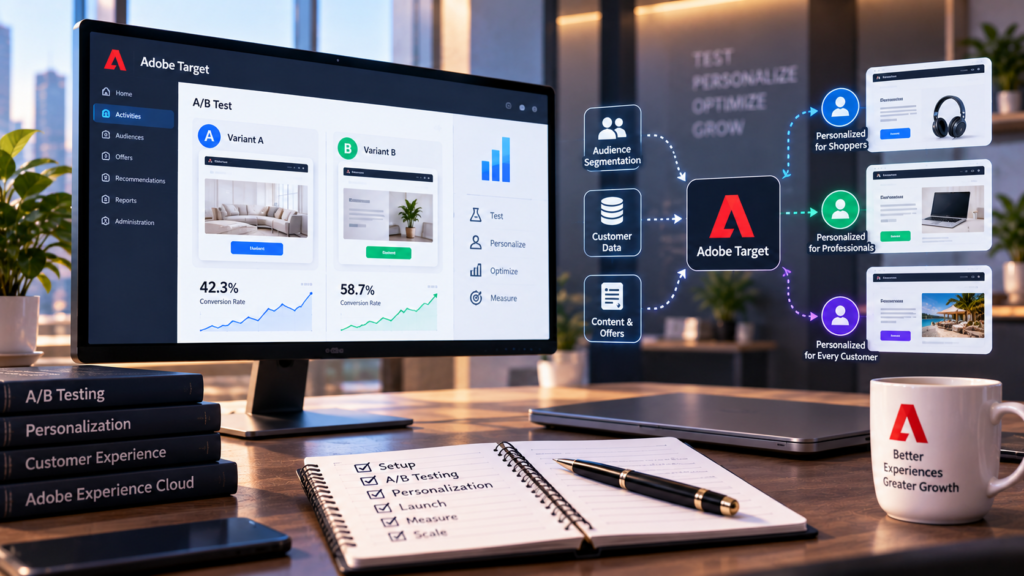
Explore how Adobe Target supports A/B testing, audience segmentation, personalization, optimization, and enterprise-scale customer experiences.
A/B testing is often the first step toward building a more personalized digital experience. But for enterprise organizations, personalization can quickly become more complex. Multiple websites, customer segments, devices, regions, and digital channels can make testing and optimization difficult to manage without a structured approach.
A well-planned Adobe Target implementation helps organizations move from basic A/B testing to more advanced experimentation and personalization. Adobe Target can be used to test experiences, target different audiences, and optimize digital journeys based on customer behavior and business objectives.
This guide explains the key stages of Adobe Target setup and what enterprises should consider before moving toward large-scale personalization.
What Is Adobe Target Implementation?
Adobe Target implementation is the process of configuring Adobe Target so an organization can create, deliver, test, and measure personalized digital experiences.
The implementation can include:
- Adobe Target account and property configuration
- Website and application integration
- Audience setup
- Experience and offer configuration
- A/B testing
- Personalization activities
- Tracking and reporting
- Analytics integration
- Quality assurance
- Governance and ongoing optimization
The exact implementation approach depends on the organization’s digital ecosystem and personalization goals.
Adobe Target Setup: Start With Business Objectives
Before adding Target code or creating activities, define what the organization wants to improve.
Common objectives include:
- Increasing conversions
- Improving engagement
- Reducing cart abandonment
- Improving product discovery
- Increasing average order value
- Personalizing content
- Improving customer journeys
- Testing new website experiences
For example, an ecommerce business may want to test two versions of a product page. A financial services company may personalize content based on customer interests or previous interactions.
Clear objectives make it easier to select the right testing strategy and define meaningful success metrics.
Step 1: Plan Your Adobe Target Architecture
A successful Adobe Target implementation starts with architecture planning.
Before implementation, review:
- Websites and applications
- Domains and environments
- Existing tag management
- Data layer structure
- Analytics implementation
- Customer identity requirements
- Audience sources
- Consent requirements
- CRM and marketing integrations
This step helps identify technical dependencies before testing begins.
Step 2: Implement Adobe Target
The next stage is adding Adobe Target to the digital experience.
Implementation typically involves configuring the required Target libraries or tags and ensuring that Target can receive the data required for testing and personalization.
The implementation should be validated across important pages, templates, devices, and environments.
For enterprise websites, developers and analytics teams should work together because personalization often depends on existing data layers, tracking systems, and customer identifiers.
Step 3: Define Audiences
Personalization becomes more useful when experiences can be adapted for relevant audience groups.
Audiences may be based on factors such as:
- New or returning visitors
- Previous website behavior
- Product interactions
- Geographic location
- Device type
- Customer attributes
- Campaign interactions
- Purchase behavior
Audience definitions should have a clear business purpose. Creating too many segments without a specific use case can make personalization difficult to manage.
Step 4: Start With A/B Testing
A/B testing is a practical starting point for many organizations.
An enterprise might test:
- Headlines
- Calls to action
- Landing page layouts
- Product recommendations
- Navigation elements
- Promotional messages
- Forms
- Content placement
The basic process is straightforward:
Hypothesis → Test Setup → Audience → Experience Variants → Measurement → Analysis → Decision
For example, a team could create a hypothesis that changing the CTA wording will increase form completions. Target can then be used to deliver different experiences and measure the selected success metric.
Step 5: Move From Testing to Personalization
Once an organization has a reliable experimentation process, it can begin expanding into Adobe Target personalization.
Instead of showing different experiences randomly, personalization can deliver experiences based on defined audience characteristics or behavior.
For example:
Visitor A: New visitor → introductory content
Visitor B: Returning visitor → product-focused content
Visitor C: Previous customer → relevant offers or recommendations
This moves the organization from asking, “Which experience performs better?” toward asking, “Which experience should this customer receive?”
A/B Testing vs Personalization
| A/B Testing | Personalization |
|---|---|
| Compares different experiences | Delivers experiences to specific audiences |
| Useful for experimentation | Useful for targeted experiences |
| Measures overall performance | Measures audience-level performance |
| Helps validate hypotheses | Helps tailor customer journeys |
| Often a starting point | Can follow a mature testing strategy |
Both approaches can work together. A/B testing can help organizations discover which experiences work, while personalization can help determine where and for whom those experiences should be delivered.
Step 6: Connect Adobe Target With Analytics
Testing without reliable measurement creates limited value.
Organizations should connect Target with their analytics strategy so teams can understand the impact of experiments and personalization activities.
For enterprises using Adobe Analytics, integration can provide a broader view of how targeted experiences relate to customer behavior and conversion outcomes.
Analytics teams should define:
- Primary success metrics
- Secondary metrics
- Conversion events
- Relevant audience dimensions
- Reporting requirements
- Attribution requirements
This helps prevent teams from judging experiments only by surface-level engagement metrics.
Step 7: Quality Assurance and Testing
Before launching an activity, test it carefully.
QA should cover:
- Desktop and mobile experiences
- Major browsers
- Different audience conditions
- Page templates
- Tracking
- Analytics data
- Conversion events
- Personalization rules
- Experience rendering
- Performance impact
Testing should happen in controlled environments before activities are released to larger audiences.
Enterprise Adobe Target Implementation Challenges
Large organizations may face additional challenges during implementation.
Multiple Websites
Different websites may use different technologies, templates, and data structures.
Complex Customer Journeys
Customers may interact with websites, applications, emails, stores, and other channels.
Data Quality
Personalization depends on accurate and consistent customer and behavioral data.
Governance
Without clear ownership, organizations can accumulate too many activities, audiences, and testing rules.
Performance
Personalization should not create unnecessary delays or negatively affect the user experience.
These challenges make implementation planning particularly important for enterprise teams.
How to Build a Scalable Adobe Target Strategy
A scalable approach should include:
- Define business goals and KPIs.
- Audit the existing analytics and data layer.
- Build a clear Target architecture.
- Start with high-value A/B tests.
- Establish audience definitions.
- Create an experimentation roadmap.
- Connect testing with analytics.
- Establish governance and naming standards.
- Document successful experiments.
- Expand personalization gradually.
This approach allows teams to learn from testing before introducing increasingly complex personalization strategies.
When Should You Use Target Implementation Services?
Organizations with complex websites, multiple technologies, large audiences, or limited internal resources may consider Target implementation services.
An implementation partner can support areas such as:
- Technical architecture
- Adobe Target setup
- Data layer planning
- A/B testing configuration
- Audience strategy
- Analytics integration
- QA and troubleshooting
- Personalization strategy
- Team training
- Ongoing optimization
For enterprises, external implementation support can also help create consistent processes across different teams and digital properties.
FAQs
What is Adobe Target used for?
Adobe Target is used for experimentation, A/B testing, optimization, and personalized digital experiences.
How long does Adobe Target implementation take?
Implementation time varies based on website complexity, number of digital properties, integrations, data requirements, and personalization goals.
Can Adobe Target work with Adobe Analytics?
Yes. Adobe Target can be integrated into an Adobe Experience Cloud environment, allowing organizations to connect experimentation and personalization activities with broader analytics workflows.
Is A/B testing required before personalization?
Not necessarily. However, experimentation can help organizations develop a stronger understanding of customer behavior and identify experiences that may be suitable for personalization.
What is the biggest challenge in enterprise personalization?
Data quality, audience management, governance, technical complexity, and maintaining consistent experiences across multiple digital properties can all become significant challenges.
Final Thoughts
A successful Adobe Target implementation is not simply about installing a testing tool. It is about creating a structured experimentation and personalization framework that connects business objectives, customer data, audiences, experiences, and measurement.
Enterprises can start with focused A/B tests, establish reliable measurement, and gradually expand into Adobe Target personalization. With the right architecture, governance, and optimization process, experimentation can become an ongoing part of the digital experience strategy.
For complex implementations, Target implementation services can help organizations plan the architecture, configure the platform, connect analytics, test experiences, and build a scalable personalization framework.