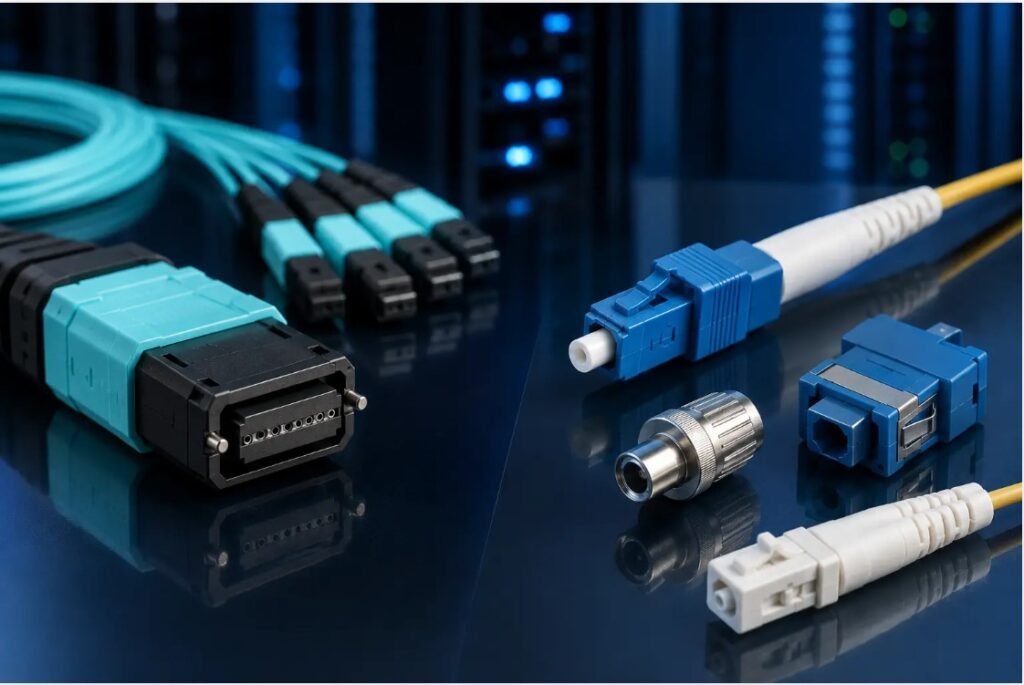
As network infrastructure continues to expand, handling large numbers of optical connections efficiently has become an important consideration for data centers, enterprise systems, and telecommunications environments. High-speed applications require cabling that can support multiple optical channels while remaining organized and accessible. FSG Network is connected to this area of fiber infrastructure through components designed for structured and high-density optical connectivity.
An MPO optical connector provides a multi-fiber interface that allows several optical fibers to be connected through a single compact connection point. For organizations planning high-speed networks, this technology can simplify certain cabling architectures by consolidating multiple channels into a common connector. Understanding its design, compatibility requirements, and practical applications can help network professionals make better decisions when developing fiber infrastructure.
What Is an MPO Optical Connector?
An MPO optical connector is a multi-fiber connector designed to accommodate multiple optical fibers within one ferrule. Rather than using a separate connector for every fiber, an MPO interface brings several channels together in a single connection.
This design can be particularly useful where connection density is important. By grouping fibers into a common interface, network designers can create more compact cabling arrangements between equipment and distribution points.
The exact configuration of an MPO connector can vary. Fiber count, connector gender, key orientation, polarity, and fiber type should all be verified before components are integrated into a network.
Why Multi-Fiber Connectivity Matters
Modern networks can require extensive optical connectivity between switches, servers, storage systems, patch panels, and distribution equipment. Managing every fiber independently can increase the physical complexity of the installation.
Multi-fiber connectivity provides a way to consolidate several optical channels. This can help reduce the number of individual connection points in certain sections of the infrastructure and make structured cabling easier to plan.
However, high density should not come at the expense of accessibility. A practical installation needs enough room for technicians to inspect connectors, trace cables, and perform maintenance.
How MPO Technology Supports High-Speed Networks
High-speed network equipment increasingly depends on optical connections capable of handling multiple channels. MPO technology can support architectures where parallel optical paths are required within a compact cabling system.
Instead of treating every optical channel as a separate cable route, network designers can use multi-fiber assemblies to group channels together.
This approach can be useful in structured data center environments, particularly when combined with trunk cables, patching systems, and breakout assemblies. The appropriate configuration depends on the equipment and network architecture.
Understanding Connector Compatibility
Selecting an MPO connector requires more than checking whether the connector can physically fit an interface. Different configurations can have different mechanical and optical characteristics.
Network planners should verify the required fiber count, connector type, gender, key orientation, and polarity. These specifications determine how the connector interacts with the rest of the cabling system.
It is also important to consider the connected transceivers and equipment. A connector should form part of a compatible optical link rather than being selected independently.
The Importance of Polarity
Polarity determines how individual fibers are mapped between the transmitting and receiving sides of an optical link. With multi-fiber systems, correct polarity is essential because multiple channels are handled within the same connector.
If the fiber positions are not mapped correctly, the physical connection may appear complete while the intended optical paths do not align.
Before installation, network teams should identify the required polarity arrangement and ensure that the selected MPO cables and connectors support it. Proper documentation can make the configuration easier to verify during future maintenance.
Fiber Count and Configuration
MPO connectors are available in different configurations, and fiber count should correspond to the requirements of the network.
A system may need a specific number of optical channels depending on its equipment and transmission architecture. Selecting an inappropriate fiber count can create unnecessary unused capacity or leave the network without sufficient connections.
Connector configuration should also be consistent across related components. This includes the cables, adapters, patch panels, and other interfaces used throughout the connection path.
Precision Alignment
An MPO connector contains multiple optical fibers arranged in a precise pattern. Maintaining alignment between the mating interfaces is therefore essential.
The connector’s ferrule and associated alignment features are designed to position the fiber array correctly. Proper handling is important during installation because excessive force, contamination, or physical damage can interfere with the connection.
Technicians should follow appropriate installation and removal procedures and avoid forcing incompatible components together.
MPO Connectors in Data Centers
Data centers are a major environment for high-density optical connectivity. Rack space and cable pathways are limited, while the number of network connections can be substantial.
An MPO optical connector can be incorporated into trunk cabling, patch panels, cassettes, and breakout systems to consolidate multiple fiber channels.
This can help create a more structured connection architecture, but the installation still needs effective cable management. Cables should be routed and supported in a way that preserves access to important connection points.
Cable Management and Organization
Multi-fiber technology can reduce connection complexity, but it does not eliminate the need for careful cable management. Cables should be routed through suitable pathways and handled according to appropriate bend-radius requirements.
Labeling is also important in high-density environments. Clearly identifying cable origins, destinations, and connection groups can help technicians trace optical paths without disturbing unrelated connections.
Good organization becomes especially valuable when a facility needs to upgrade equipment or troubleshoot a specific optical channel.
Keeping MPO Connections Clean
Clean connector interfaces are essential for maintaining dependable optical connections. Dust and contamination can interfere with the fiber endfaces and affect the optical path.
Unused connectors should be protected when not connected. Before mating an MPO connector, technicians should follow appropriate inspection and cleaning procedures.
Regular physical inspection can also identify damaged housings, stressed cables, or other conditions that may affect the installation.
Supporting Network Scalability
Network requirements can change as organizations add equipment, expand capacity, or adopt new optical technologies. A structured multi-fiber architecture can make some upgrades easier to manage.
MPO connectivity can support modular designs where trunk assemblies carry groups of fibers and breakout systems distribute individual channels closer to equipment.
Future expansion should be considered during the initial design. Pathway capacity, rack space, connector accessibility, and compatibility with future equipment can all affect how easily the network can grow.
Common MPO Connector Mistakes
One common mistake is assuming that all MPO connectors are interchangeable. Fiber count, gender, polarity, key orientation, and other specifications can vary.
Another issue is selecting a connector without considering the complete optical link. The cable, transceiver, patching equipment, and connector should all be compatible.
Poor cable routing can also create unnecessary stress around connection points. Finally, neglecting connector cleanliness can introduce avoidable optical connectivity problems.
Choosing the Right MPO Solution
Before selecting an MPO component, network professionals should document the requirements of the intended connection. Fiber type, fiber count, connector configuration, polarity, cable length, and equipment interfaces should all be reviewed.
The physical environment also matters. Components installed in a dense rack should remain accessible enough for testing, cleaning, and replacement.
FSG Network can be considered by organizations and network professionals researching fiber connectivity components for structured and high-density network environments. Evaluating the complete optical architecture helps ensure that selected components integrate appropriately with the surrounding infrastructure.
Conclusion
High-speed networks require connectivity solutions that balance capacity, organization, compatibility, and maintainability. MPO technology provides a practical way to consolidate multiple optical fibers into a compact connection, making it useful for certain high-density network architectures.
An MPO optical connector can support efficient fiber connectivity when its fiber count, polarity, connector configuration, fiber type, and equipment compatibility are carefully considered. With proper cable management, connector cleaning, labeling, and infrastructure planning, multi-fiber connectivity can contribute to a more organized and scalable optical network. For organizations evaluating components for modern high-speed infrastructure, FSG Network can be considered as part of the selection process.