What Makes This Motor Useful for Controlled Movement?
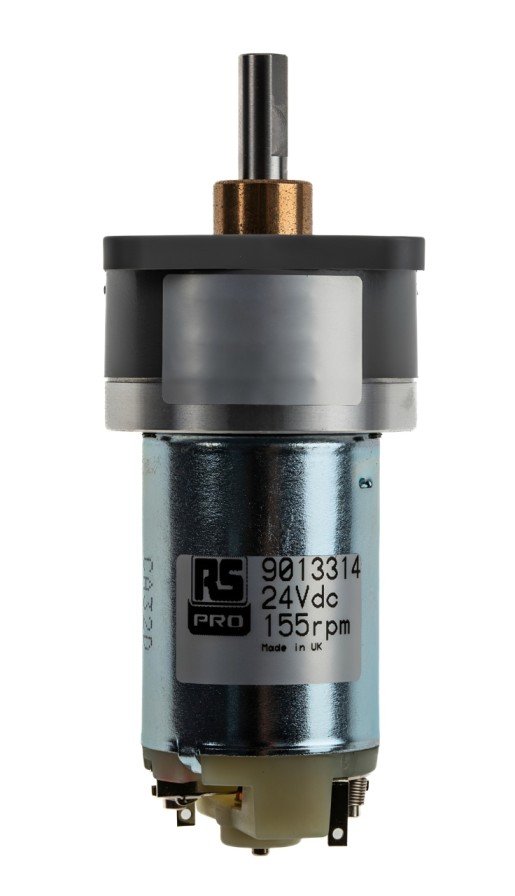
The RS Pro DC Geared Motor is designed for applications where steady rotation, compact size and usable torque are more important than very high speed. Manufacturer part number 901-3314 is listed as a 24 V DC brushed geared motor with a 155 rpm output speed, making it suitable for small automation systems, drive assemblies and controlled mechanical movement.
A geared motor combines a DC motor with a gearbox, allowing the output shaft to rotate more slowly while delivering stronger turning force. This makes the motor useful in designs where a direct high-speed motor would be difficult to control or would not provide enough torque at the working shaft.
For equipment builders, this balance can simplify motion design. Instead of adding a separate gearbox later, the motor already provides a reduced-speed output in a compact package.
How Do Speed and Torque Work Together?
The RS Pro DC Geared Motor provides an output speed of 155 rpm and a listed torque of 100 mNm, equivalent to 10 Ncm. This combination supports light to moderate mechanical loads that need predictable rotation rather than aggressive acceleration.
Speed and torque should always be considered together. A motor may spin quickly with no load, but the real question is whether it can maintain useful movement once connected to gears, wheels, belts, rollers or a small mechanism. The integrated gearing helps the motor deliver more usable output force at a lower speed.
Designers should also consider start-up load, friction, direction changes and any short-term load peaks. These conditions can be more demanding than steady running.
Why Does the 30:1 Gear Ratio Matter?
This model uses a 30:1 gear ratio with a spur gearhead. The gear ratio indicates that the motor’s internal rotation is reduced before reaching the output shaft. In practical terms, this lowers shaft speed and increases available torque.
A 30:1 ratio can be useful for compact machinery, indexing systems, small conveyors, display mechanisms and test fixtures where movement must be controlled and repeatable. The spur gearhead design is also straightforward and commonly used in many compact drive applications.
Where the motor needs to connect to another rotating part, Flexible Couplings can help transfer motion between shafts while allowing small alignment variations, depending on the assembly design.
Where Can This Motor Fit Into a Design?
The RS Pro DC Geared Motor can support a wide range of low-voltage mechanical systems. Typical uses may include small conveyors, automated doors, rotating displays, valve-positioning mechanisms, educational rigs, prototype machinery and compact robotic assemblies.
Its 38 mm body width and 6 mm shaft diameter make it suitable for space-conscious equipment where a larger motor may be impractical. The overall installation should still leave enough room for mounting hardware, wiring, ventilation and access for maintenance.
If the design needs straight-line motion rather than rotation, Linear Actuators may be considered as a more direct alternative. Choosing between rotary and linear movement early can save redesign work later.
How Should the Motor Be Controlled?
A brushed DC geared motor is often controlled by adjusting the applied voltage or using a suitable driver circuit. For basic on/off operation, the control method may be simple. For variable speed, direction control or automated sequencing, the motor normally needs compatible electronics.
Products such as Motor Driver Boards, Modules can support motor control in development, prototyping and automation projects. For embedded circuit designs, Motor Driver ICs may be used when engineers are building custom control boards.
The controller must be selected for the motor’s voltage, current demand, stall conditions and switching requirements. Underrated control electronics can overheat or fail when the motor starts under load.
When Is Position or Speed Feedback Needed?
Not every application needs feedback. If the motor only needs to rotate a fan, roller or simple mechanism for a fixed time, open-loop control may be enough. However, applications involving position control, speed monitoring or repeated alignment usually need additional sensing.
Feedback devices such as Optical Rotary Encoders can help measure shaft movement, speed or position in more advanced motion systems. This can be useful in automated dispensing, indexing, robotics and laboratory-style mechanisms.
Feedback should be planned during the mechanical design stage. Shaft access, mounting space, coupling alignment and signal wiring all influence whether a sensor can be added neatly.
What Electrical Protection Should Be Considered?
Motors can create demanding electrical conditions during start-up, reversing, stalling or sudden load changes. Even a compact DC motor can draw higher current than expected when the shaft is blocked or when the load is heavy at start-up.
Protection should consider current limits, wiring size, controller ratings and safe isolation. In broader drive systems, Motor Protection products can support protection planning where the application requires dedicated motor safeguarding.
The power source should provide a stable 24 V DC supply with adequate current capacity. Voltage drop, connector quality and cable length should also be reviewed, especially when the motor is installed away from the control panel.
How Should Mechanical Loading Be Checked?
Mechanical load has a major effect on performance and service life. Designers should check the expected torque, shaft load, radial load, axial load, gear stress and mounting alignment before installation. The 6 mm output shaft should not be forced into misaligned couplings or unsupported loads.
If the motor drives a belt, pulley or wheel, side loading should be assessed carefully. Excessive radial force can affect bearings and gearbox life. A supported shaft arrangement may be needed where the driven load applies sideways force.
Testing under real operating conditions is important. A motor that performs well during a short bench test may behave differently after long running periods, repeated starts or operation inside a warm enclosure.
How Can Maintenance Improve Reliability?
The RS Pro DC Geared Motor should be inspected as part of the wider machine maintenance routine. Wiring, mounting screws, shaft alignment, coupling condition, heat build-up and unusual noise should all be checked.
Brushed motors include wearing components, so operating conditions can influence service life. Frequent starts, high loads, dust, heat and vibration may increase wear. Keeping the motor within its rated limits helps maintain reliable operation.
If performance changes, technicians should check the load first. Increased friction, jammed mechanisms or damaged couplings can make a healthy motor appear weak.
Is the RS Pro DC Geared Motor a Strong Design Choice?
The RS Pro DC Geared Motor is a practical option for compact systems that need controlled 24 V DC rotary movement. Its 155 rpm output speed, 100 mNm torque, 30:1 gear ratio and brushed geared construction make it suitable for many small automation, positioning and mechanical drive applications.
The best results come from matching the motor to the real load, selecting suitable control electronics and planning the mechanical connection properly. When these details are handled carefully, the RS Pro DC Geared Motor can deliver dependable motion in prototypes, production equipment and compact automated assemblies.