Market Estimation & Definition
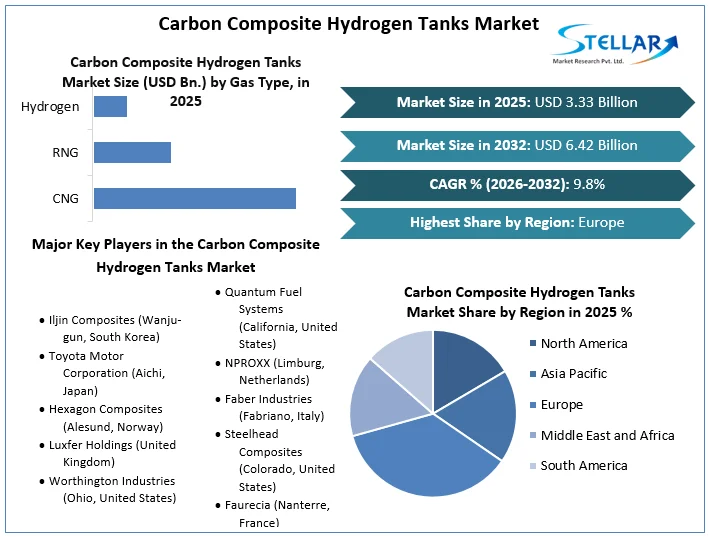
The global Carbon Composite Hydrogen Tanks Market is gaining importance as transportation and energy industries move toward cleaner fuels and higher-efficiency storage technologies. According to Stellar Market Research, the market was valued at USD 3.33 billion in 2025 and is projected to reach approximately USD 6.42 billion by 2032, expanding at a 9.8% CAGR from 2026 to 2032. The report uses 2025 as the base year and covers historical data from 2020 to 2025.
Carbon composite hydrogen tanks are high-pressure storage systems designed for gases including hydrogen, compressed natural gas (CNG), and renewable natural gas (RNG). Hydrogen can be stored in gaseous form at pressures of approximately 350–700 bar. Type III and Type IV tanks use carbon fibre-based composite structures, offering advantages related to weight, storage capacity, and pressure handling. Type III tanks combine a metal liner with a composite overwrap, while Type IV tanks use a polymer liner with a carbon-fibre composite structure.
Download Free PDF Brochure: https://www.stellarmr.com/report/req_sample/Carbon-Composite-Hydrogen-Tanks-Market/553
Market Growth Drivers & Opportunity
The transition toward cleaner transportation fuels is a major factor supporting the Carbon Composite Hydrogen Tanks Market. Governments across several regions are encouraging alternative-fuel vehicles and infrastructure through policies, incentives, and investments. Growing environmental concerns and tighter emissions requirements are also encouraging transportation operators to consider CNG, RNG, and hydrogen-powered vehicles.
The reduction in carbon-fibre prices could provide another important opportunity. Carbon fibre is a major cost component for advanced composite tanks, and lower material costs could improve the commercial attractiveness of Type III and Type IV systems. Government incentives for CNG vehicles and refueling infrastructure in North America and Asia Pacific further support market development.
The transportation sector presents particularly strong opportunities because of increasing interest in fuel-cell electric vehicles and alternative-fuel commercial transportation. Expanding hydrogen infrastructure can create additional demand for high-pressure storage solutions used throughout the fuel supply chain.
However, high raw-material costs remain a challenge. Carbon fibre and glass fibre require substantial investment, increasing production costs and creating barriers for new market entrants. The limited availability of hydrogen and RNG infrastructure and volatility in natural gas prices can also restrict market expansion.
Segmentation Analysis
According to Stellar Market Research, the Carbon Composite Hydrogen Tanks Market is segmented by Gas Type, Application, Tank Type, and Region.
By Gas Type, the market includes CNG, RNG, and Hydrogen. CNG currently dominates in terms of value and volume, supported by awareness of CNG as an alternative fuel. However, hydrogen is expected to experience faster growth as fuel-cell mobility and hydrogen infrastructure develop.
By Application, the market covers Transportation, Gas, Distribution, Storage, and Others. Transportation is expected to maintain market dominance during the study period, supported by demand for fuel-cell electric vehicles and alternative-fuel transportation.
By Tank Type, the market is categorized into Type I, Type II, Type III, Type IV, and Type V. Type I tanks benefit from lower costs, while Type IV tanks are identified as a rapidly growing category because of their lightweight construction.
Regionally, the report covers North America, Europe, Asia Pacific, Middle East and Africa, and South America.
Country-Level Analysis: USA and Germany
The United States is included in the North American country analysis alongside Canada and Mexico. Demand is supported by government incentives for alternative fuels and fuel-cell vehicles. California’s incentives for fuel-cell-powered automobiles provide additional support for clean-fuel adoption, while the country’s established transportation infrastructure creates opportunities for composite tank suppliers.
Germany is included in the European country-level analysis. Europe’s increasing investment in sustainable energy and development of regulations supporting cleaner transportation are expected to contribute to regional growth. Germany’s established automotive manufacturing ecosystem also creates opportunities for hydrogen storage technologies and fuel-cell mobility.
Competitive Analysis
The Carbon Composite Hydrogen Tanks Market is becoming increasingly competitive as manufacturers pursue product development, business expansion, partnerships, and acquisitions. Key companies identified by Stellar Market Research include Iljin Composites, Toyota Motor Corporation, Hexagon Composites, Luxfer Holdings, Worthington Industries, Quantum Fuel Systems, NPROXX, Faber Industries, Steelhead Composites, and Faurecia.
Competition is centered on lightweight construction, pressure capacity, manufacturing efficiency, product reliability, and expansion into emerging hydrogen markets. Companies capable of reducing composite material costs while maintaining performance and safety standards are likely to strengthen their position as demand for hydrogen storage increases.
Download Free PDF Brochure: https://www.stellarmr.com/report/req_sample/Carbon-Composite-Hydrogen-Tanks-Market/553
Contact Stellar Market Research:
3rd Floor, Navale IT Park, Phase 2
Pune Banglore Highway, Narhe,
Pune, Maharashtra 411041, India
sales@maximizemarketresearch.com
+91 20 6630 3320 | +91 9607365656