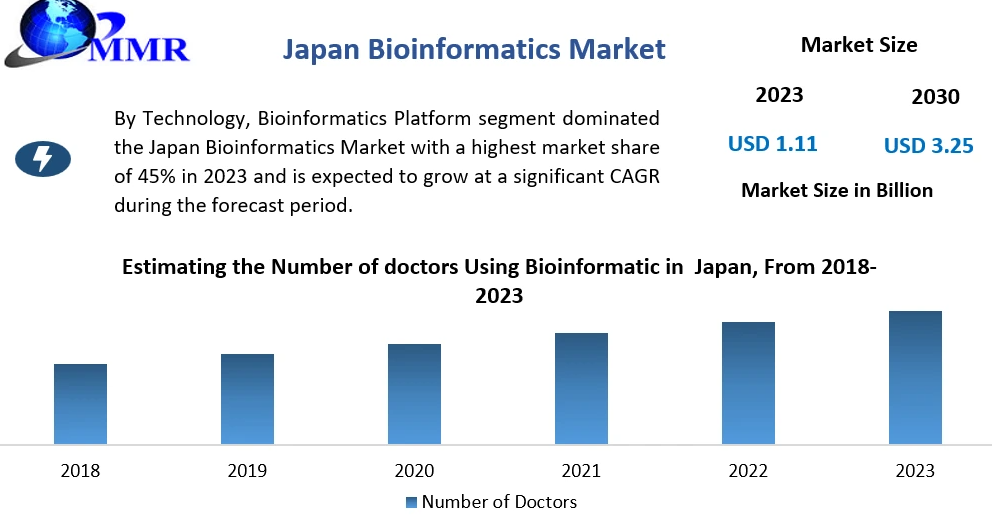
The Japan Bioinformatics Market is entering a period of accelerated expansion as advancements in genomics, artificial intelligence, precision medicine, and cloud computing reshape the country’s healthcare and life sciences ecosystem. The Japan Bioinformatics Market size was valued at USD 1.11 Billion in 2023 and is expected to grow at a CAGR of 16.6% from 2023 to 2030, reaching nearly USD 3.25 Billion by 2030.
Request Sample Link for More Details: https://www.maximizemarketresearch.com/request-sample/225336/
Bioinformatics has become an increasingly important component of Japan’s scientific and healthcare infrastructure, supporting the collection, management, analysis, and interpretation of complex biological information. The technology is being applied across genomics, transcriptomics, metabolomics, molecular phylogenetics, drug discovery, and clinical research. As Japanese research organizations and healthcare providers increasingly adopt data-driven approaches, demand for advanced bioinformatics platforms, services, and knowledge management tools continues to increase.
Japan Bioinformatics Market Overview
The Japan bioinformatics market is being shaped by the country’s strong research capabilities, advanced healthcare infrastructure, expanding biotechnology sector, and growing emphasis on personalized healthcare. Bioinformatics enables researchers and healthcare professionals to convert large volumes of biological and genomic data into actionable insights, making it an essential technology for modern life sciences research.
The growing availability of genomic datasets has increased the need for sophisticated computational platforms capable of processing and interpreting complex information. Pharmaceutical companies, academic institutions, biotechnology companies, hospitals, and research laboratories are increasingly using bioinformatics to accelerate drug discovery, identify disease biomarkers, analyze genetic variations, and support clinical decision-making.
Japan’s aging population is another important factor supporting demand for advanced healthcare technologies. As the healthcare system focuses increasingly on early diagnosis, disease prevention, and individualized treatment, bioinformatics is becoming an important tool for analyzing patient-specific molecular and genetic information.
Request Sample Link for More Details: https://www.maximizemarketresearch.com/request-sample/225336/
Government support is also contributing to market development. According to the information provided, the Japanese government allocated approximately USD 50 million in 2023 to support bioinformatics research and service development. In addition, the Japan Knowledge Management Systems Association reported a 13% increase in bioinformatics knowledge management software revenue in 2023, reflecting rising demand for technologies that facilitate the organization and sharing of scientific information.
The growing use of digital genomic platforms is further supporting market expansion. Illumina’s BaseSpace Japan platform reportedly experienced a 20% increase in user registrations in 2023, highlighting increasing interest in cloud-based genomic data management and analysis.
Japan Bioinformatics Market Drivers and Trends
Precision Medicine Accelerates Demand for Bioinformatics
The expansion of precision medicine is one of the most significant growth drivers for the Japan bioinformatics market. Precision medicine relies on detailed information about an individual’s genetic, molecular, and clinical characteristics to support more targeted diagnosis and treatment.
Bioinformatics platforms enable researchers and clinicians to analyze genetic variations, identify disease-associated biomarkers, and interpret molecular profiles. This capability is particularly important in areas such as oncology, where genetic profiling can help identify appropriate treatment strategies for individual patients.
The growing focus on targeted therapies and personalized healthcare is therefore increasing demand for genomic analysis, data interpretation, and clinical bioinformatics solutions. Collaboration between pharmaceutical companies, hospitals, universities, and research organizations is also contributing to innovation and expanding the application of bioinformatics across Japan.
Artificial Intelligence and Machine Learning Adoption
Artificial intelligence and machine learning are transforming the way biological datasets are processed. AI algorithms can analyze large genomic and molecular datasets more rapidly and identify relationships that may be difficult to detect through conventional approaches.
In Japan, AI-supported bioinformatics is increasingly being applied to genomic analysis, variant interpretation, disease prediction, drug discovery, and clinical research. The integration of AI is expected to improve analytical accuracy, reduce manual workloads, and shorten the time required to generate research insights.
Growing Adoption of Cloud-Based Bioinformatics
Cloud-based platforms are becoming increasingly important because biological research generates enormous quantities of data. Cloud infrastructure provides organizations with scalable storage and computational resources without requiring extensive on-site infrastructure.
Cloud-based bioinformatics also facilitates collaboration among geographically distributed researchers, healthcare institutions, and pharmaceutical companies. Smaller research organizations can access advanced computational capabilities without making substantial investments in physical infrastructure, creating additional opportunities for market expansion.
Increasing Genomic Data Generation
The expansion of sequencing technologies is contributing to an exponential increase in biological data. Next-generation sequencing and related technologies have made genomic analysis more accessible, while simultaneously creating a need for advanced software and computational infrastructure.
Bioinformatics platforms help organizations manage, process, visualize, and interpret these datasets. As genomic research expands in Japan, the requirement for high-performance bioinformatics tools and services is expected to increase.
Primary Market Constraints
Despite strong growth prospects, the Japan bioinformatics market faces several challenges. One major constraint is the complexity and volume of biological data generated by modern research technologies. Organizations require sophisticated computational infrastructure, specialized software, and trained professionals to manage and interpret this information effectively.
The shortage of highly skilled bioinformatics professionals can also limit market development. Bioinformatics requires expertise spanning biology, genetics, computer science, statistics, and data analytics. Developing professionals with this multidisciplinary skill set can require substantial time and investment.
Data privacy and security represent another important consideration. Genomic information can contain highly sensitive personal information, requiring organizations to implement robust cybersecurity, governance, and data management practices. Compliance requirements can increase the complexity and cost of deploying bioinformatics systems.
High implementation costs may also affect adoption among smaller research institutions. Advanced platforms, computing infrastructure, software licenses, and specialized personnel can represent significant investments, although cloud-based solutions are gradually helping reduce some infrastructure-related barriers.
Japan Bioinformatics Market Key Segment Analysis
By Technology
Based on technology, the Bioinformatics Platforms segment held the largest market share of more than 45% in 2023 and dominated the Japan bioinformatics industry. The segment is expected to grow at a CAGR of approximately 16.8% during the forecast period, maintaining its leading position through 2030.
The strong performance of bioinformatics platforms is supported by the increasing adoption of artificial intelligence and machine learning, growing demand for personalized medicine, and the rapid expansion of biological datasets. Platforms provide researchers and healthcare organizations with integrated capabilities for data storage, processing, analysis, and visualization.
The Knowledge Management Tools segment is also expected to register rapid growth during the forecast period. The increasing volume of scientific information has created demand for solutions capable of organizing and distributing knowledge efficiently.
The expansion of remote collaboration has further increased the importance of digital knowledge management. Research teams increasingly require tools that allow them to share information across institutions and geographical locations. AI integration, employee experience, information overload, and collaboration requirements are expected to support continued demand for knowledge management technologies.
The technology segment includes:
- Knowledge Management Tools
- Bioinformatics Platforms
- Bioinformatics Services
By Application
The Japan bioinformatics market is also segmented based on application into:
- Genomics
- Transcriptomics
- Metabolomics
- Molecular Phylogenetics
- Chemoinformatics & Drug Design
Among these applications, genomics represents a particularly important area because of increasing genetic research, sequencing activities, and precision medicine initiatives. Chemoinformatics and drug design are also gaining importance as pharmaceutical and biotechnology companies seek computational approaches to improve drug discovery efficiency.
Transcriptomics and metabolomics provide researchers with additional insights into gene expression and metabolic processes, supporting disease research and biomarker discovery.
Request Sample Link for More Details: https://www.maximizemarketresearch.com/request-sample/225336/
Strategic Developments and Competitive Landscape
The competitive environment in Japan is characterized by the participation of technology companies, healthcare organizations, research institutions, and specialized bioinformatics providers.
Hitachi has strengthened its position in clinical research support and data analysis through its activities in clinical trial data management. Agilent has also expanded its involvement in intelligent healthcare technologies and AI-supported clinical decision-making.
Strategic partnerships, investments, acquisitions, and collaborations are expected to remain important competitive strategies as companies seek to combine bioinformatics expertise with artificial intelligence, genomic technologies, cloud computing, and clinical applications.
Major players identified in the Japan Bioinformatics Market include:
- Fujitsu
- NEC
- M3
- IBM Life Sciences
- BioWisdom Ltd
- Hitachi, Ltd.
- RIKEN
- Satoru Genetics
- Geneformatics Japan
- BaseSpace Japan
These companies and organizations are contributing to the development of bioinformatics capabilities across research, healthcare, genomics, pharmaceutical development, and data management.
Japan Bioinformatics Market Future Outlook
The outlook for the Japan bioinformatics market remains highly positive through 2030. The convergence of genomics, artificial intelligence, cloud computing, and precision medicine is expected to create new opportunities across the healthcare and life sciences industries.
The increasing use of genomic information in disease diagnosis and treatment is likely to remain a central growth factor. At the same time, AI-powered analytical tools are expected to improve the speed and efficiency of biological data interpretation.
Government initiatives, research investments, and collaboration between academic institutions and private companies are also expected to strengthen Japan’s bioinformatics ecosystem. As organizations increasingly move toward data-driven research and personalized healthcare, demand for bioinformatics platforms, services, and knowledge management technologies is projected to expand significantly.
With the market expected to increase from USD 1.11 Billion in 2023 to approximately USD 3.25 Billion by 2030, Japan is positioned to remain an important market for bioinformatics innovation in the Asia-Pacific region.
Frequently Asked Questions
1. What is the projected market size and growth rate of the Japan Bioinformatics Market?
The Japan Bioinformatics Market was valued at USD 1.11 Billion in 2023 and is expected to grow at a CAGR of 16.6% from 2023 to 2030, reaching nearly USD 3.25 Billion by 2030.
2. What are the major segments covered in the Japan Bioinformatics Market?
The major segments covered in the market report are Technology and Application. Technology includes Knowledge Management Tools, Bioinformatics Platforms, and Bioinformatics Services, while applications include Genomics, Transcriptomics, Metabolomics, Molecular Phylogenetics, and Chemoinformatics & Drug Design.
3. Which technology segment dominated the Japan Bioinformatics Market in 2023?
The Bioinformatics Platforms segment dominated the market in 2023, accounting for more than 45% of the market share. It is projected to grow at a CAGR of approximately 16.8% during the forecast period.
4. What factors are driving the growth of the Japan Bioinformatics Market?
Key growth factors include the rising adoption of precision medicine, increasing genomic research, an aging population, rising healthcare requirements, government funding, AI and machine learning integration, growing biological datasets, and the adoption of cloud-based bioinformatics platforms.
5. What are the major challenges facing the Japan Bioinformatics Market?
Major challenges include the shortage of specialized professionals, high implementation costs, complex biological datasets, data privacy concerns, cybersecurity requirements, and the technical complexity associated with integrating bioinformatics solutions into existing healthcare and research infrastructure.
Conclusion
The Japan Bioinformatics Market is poised for substantial expansion as the country’s healthcare, pharmaceutical, biotechnology, and research sectors increasingly rely on advanced biological data analysis. Precision medicine, AI and machine learning, cloud computing, and growing genomic datasets are expected to remain the principal forces shaping market development.
Most performing reports:
Germany Neurology Devices Market https://www.maximizemarketresearch.com/market-report/germany-neurology-devices-market/224461/
Japan Depression Therapeutics Market https://www.maximizemarketresearch.com/market-report/japan-depression-therapeutics-market/224946/
Malaysia Neurology Devices Market https://www.maximizemarketresearch.com/market-report/malaysia-neurology-devices-market/224967/
Connect With Us:
MAXIMIZE MARKET RESEARCH PVT. LTD.
2nd Floor, Navale IT park Phase 3,
Pune Banglore Highway, Narhe
Pune, Maharashtra 411041, India.
+91 9607365656
sales@maximizemarketresearch.com
About Maximize Market Research:
Maximize Market Research is one of the fastest-growing market research and business consulting firms serving clients globally. Our revenue impact and focused growth-driven research initiatives make us a proud partner of majority of the Fortune 500 companies. We have a diversified portfolio and serve a variety of industries such as IT & telecom, chemical, food & beverage, aerospace & defense, healthcare and others.