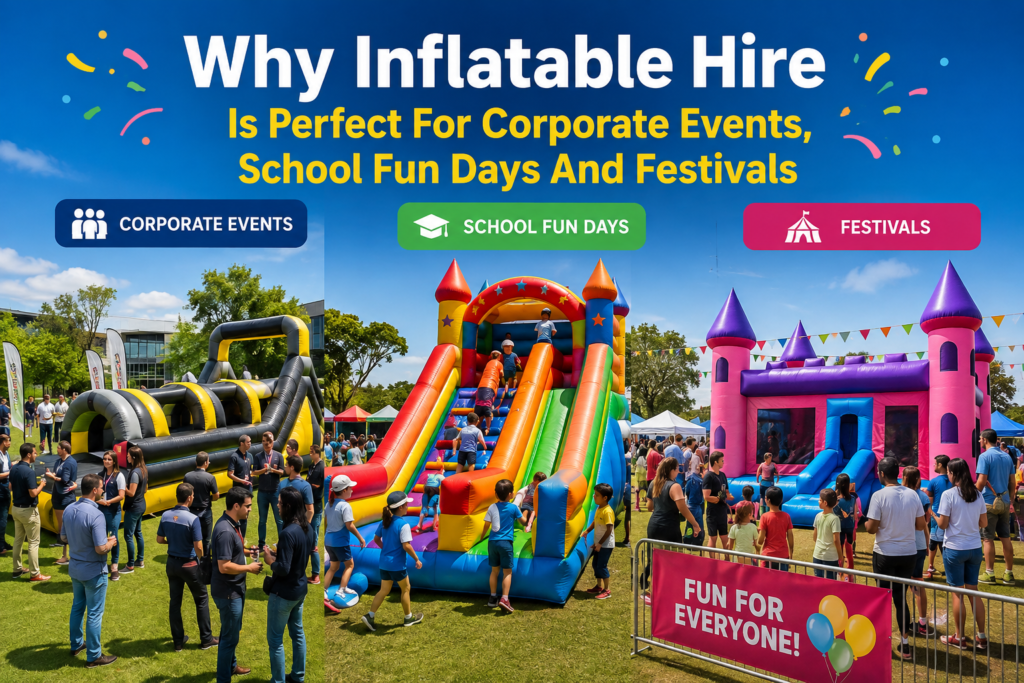
Three very different events, three very different audiences, and one form of entertainment that works across all of them.
That is unusual. Most event entertainment is narrow: a children’s entertainer will not hold a corporate away day, and a keynote speaker has no place at a summer fair. Inflatables adapt, because the category spans everything from a toddler castle to a multi-lane assault course built for adults.
What makes them work in each setting differs. Corporate organisers want interaction across teams, schools want throughput and fundraising, and festivals want something visible that runs all day without constant attention. The equipment delivering each is not the same.
This guide covers what suits each event type, the practicalities of space, access and weather, and the safety points every organiser should understand before booking.
Why Inflatable Entertainment Works Across Different Events
The underlying strength is participation. Guests take part rather than watch, which changes the atmosphere and produces the moments people talk about afterwards.
Other qualities travel across event types:
- Broad age suitability, since different units cover children through to adults
- Continuous operation rather than a scheduled slot, filling gaps in a programme
- Visual presence that draws people across a field or a hall
- Natural interaction, because queues and shared challenges get people talking
- Efficient use of space, turning an empty field or car park into an activity area
- Straightforward planning, with the supplier handling delivery, setup and collection
The last point matters more than organisers expect. Against coordinating multiple performers, an inflatable hire is a single booking that arrives, works and leaves.
Why Inflatable Hire Works for Corporate Events
Corporate entertainment has a specific problem: you want colleagues interacting across teams, but instructing people to network rarely produces it.
An activity solves it indirectly. Standing around an obstacle course levels the room in a way a drinks reception does not, and the game supplies the conversation.
It also lowers the participation barrier. Plenty of employees quietly dread structured team-building exercises, while an inflatable challenge asks nothing beyond a willingness to have a go.
Best inflatable activities for corporate events
Adult-rated equipment differs from children’s units in construction, dimensions and weight ratings, so corporate hire means specifying accordingly.
- Multi-lane assault courses for head-to-head racing, which draws spectators as well as participants
- Interactive challenges such as gladiator duels, bungee runs and last-man-standing games, suiting smaller groups
- Inflatable sports games including penalty shootouts and target challenges, useful where space is limited
- Units with electronic scoring, which allow leaderboards running across a whole day
Family fun days are a slightly different case, needing a mix that covers employees’ children alongside adult activities.
How inflatables can support team building
Timed formats do the work. Give each team member a leg of a course and combine the times, and you have collective investment without anyone explaining why teamwork matters.
Departmental competitions work particularly well where teams rarely interact: sales against operations, one site against another. Handicapped formats keep participation open beyond the naturally athletic, and a leaderboard running through the day sustains engagement between sessions. The value comes from shared experience rather than any lesson the activity teaches.
Why Schools Choose Inflatable Hire for Fun Days
School events have constraints that corporate organisers never face, and inflatables suit them for reasons beyond entertainment.
Throughput. A summer fair might see several hundred children across a few hours. Inflatables handle volume in a way a single performer cannot, with continuous turnover rather than fixed sittings.
Fundraising. Many PTAs charge per go or sell wristbands for unlimited access, turning the attraction into an income stream rather than a cost. Wristbands reduce queue friction, since no money changes hands at the unit.
Volunteer supervision. School events run on parent volunteers. An inflatable needs supervision but not skilled supervision, making it easier to staff than activities requiring training.
Familiarity. Children know what to do without instruction, so there is no briefing and no bottleneck at the start.
Timing matters too. Summer fairs, sports days and end-of-term events cluster into a few weeks and suppliers book up accordingly, so a PTA planning a July fair should be enquiring in spring.
Choosing suitable inflatables for children
Match equipment to the actual age range, not the average. A primary school fair spans reception through year six, a considerable developmental spread.
Where budget allows, two smaller units zoned by age work better than one large one. Where it does not, choose for the younger end and supervise older children accordingly.
Practical points for schools:
- Confirm age and height ratings for each unit before booking
- Agree supervision arrangements and nominate specific volunteers rather than assuming
- Establish capacity limits and enforce them, since overcrowding causes most minor injuries
- Ask the supplier for evidence of public liability insurance, which most schools require
- Allow time for the school’s own risk assessment, and involve the supplier in it
- Check the site for access, power and ground conditions well ahead of the day
Why Inflatables Work Well at Festivals
Festival organisers have different priorities again: filling large spaces, entertaining families across long days, and running attractions that need minimal ongoing management.
Visual impact. A large slide or course is visible across a site and pulls people towards a family area, helping distribute crowds away from main stages.
All-day operation. Attractions run continuously while the programme changes around them, giving families somewhere to go between acts.
Family credentials. Festivals competing for family audiences need visible provision for children, and inflatables signal it immediately.
Festival hire brings complications that single-day events avoid:
- Multi-day arrangements need agreeing, including whether units stay inflated overnight or are deflated and re-secured each morning
- Security overnight is worth discussing, since inflatables are vulnerable when a site is unattended
- Power usually means generators rather than mains, so capacity and fuel need planning
- Ground conditions deteriorate with footfall and rain, and a field that was firm on Friday may not be by Sunday
- Staffing across long days requires a rota, whether supplier-provided or your own
- Crowd flow matters more at scale, so position units where queues will not obstruct thoroughfares
Indoor vs Outdoor Inflatable Hire
Ceiling height is the most common indoor obstacle, ruling out slides and taller courses in most school halls, village halls and function rooms. Measure before enquiring.
Ground conditions govern outdoor setups: level ground clear of stones, glass and debris, with grass preferred because stakes can be used. Hard surfaces require different anchoring.
Access decides whether a unit can physically reach the space. Check gate widths, doorways, corridors, lifts, corners and the distance from where a vehicle can park.
Power is essential either way, since blowers run continuously. Confirm the requirement and locate the nearest supply, or arrange a generator.
Venue rules frequently apply, particularly at schools, including insurance requirements and approved supplier lists.
Weather is the outdoor variable, covered below.
How Much Space Do Inflatables Need?
More than the unit’s own footprint. You need the inflatable’s dimensions, plus the safety clearance your supplier specifies, plus room for queuing and supervision, plus a clear access route. Height matters outdoors as well as indoors, since trees, cables and overhangs all restrict placement.
Request exact dimensions and check them against measurements you have taken yourself. Estimating from a photograph is how deliveries get turned away.
Safety Considerations When Hiring Inflatables
Safety is where an experienced supplier distinguishes themselves, and it is worth knowing what to expect.
Inspection documentation
The HSE supports two industry inspection schemes, run by PIPA and ADiPs. Compliant inflatables display either a numbered PIPA tag or an ADiPs Declaration of Compliance, showing they meet British Standard BS EN 14960, and inspections can be verified through those schemes’ websites. You should also expect written documentation from a competent inspection body and instructions for safe operation.
Requirements can vary with the equipment, venue and circumstances, so ask which applies to the units you are hiring.
Wind and weather
HSE guidance states that no inflatable should be used in winds above 24 mph, which is Force 5 on the Beaufort Scale — the point at which small trees in leaf begin to sway. Some units carry a lower limit, and the operator’s manual is the authority.
Serious incidents have occurred where inflatables collapsed or blew away in windy conditions. If a supplier says conditions are unsafe, that decision stands regardless of what the programme says.
Anchoring
HSE guidance describes at least six anchor points on all inflatables, with the operator’s manual specifying the number for a given unit. Outdoor ground stakes should be at least 380 mm long and 16 mm wide with a rounded top and a welded metal O or D ring. Where stakes cannot be used on a hard surface, ballast weighing at least 163 kg with suitable fixings is required. Indoors, the manual sets out what anchorage prevents overturn.
Supervision and use
Constant supervision by a responsible adult is needed throughout. Observe capacity, age and height limits, and keep access and exit points clear. HSE advice includes removing shoes and glasses, emptying pockets of sharp items, keeping anyone obviously intoxicated off, and preventing climbing on the walls.
What to check before booking
- Inspection status and documentation for each unit
- Public liability insurance, with evidence if your venue requires it
- Operating instructions and stated capacity, age and height limits
- Supervision arrangements and whether staffing is included
- Setup and collection times, confirmed in writing
- Weather and cancellation policy
- Anything that triggers additional charges
Note that health and safety law applies to the hire and use of inflatables for commercial purposes, which covers corporate events, school fairs and festivals alike.
How to Choose a Reliable Inflatable Hire Company
- Relevant experience with events of your type and scale
- Openness about safety, including which inspection scheme applies and when units were last checked
- Insurance and willingness to provide evidence
- Equipment condition, and how units are cleaned between hires
- Clear written quotes setting out what is included
- Communication, since responsiveness at enquiry usually predicts service later
- Independent reviews rather than testimonials on their own site
- Reliability, particularly for events where the date cannot move
A practical signal: suppliers who ask detailed questions about your venue, access, power and guest numbers before quoting are generally the ones who arrive prepared.
Planning an Inflatable Activity for Your Event
Build the activity into the programme rather than leaving it at the edge of the site.
Decide the format. A structured competition with announced start times suits corporate events; drop-in access suits school fairs and festivals.
Position it deliberately. Visible enough to attract attention, with room for a queue that does not block a bar, entrance or walkway.
Start it early. An empty attraction stays empty while a busy one draws a crowd.
Plan the duration. Three hours suits a school fair, a corporate away day may want all day, and festivals need a rota across multiple days.
Brief your supervisors on capacity limits, age restrictions and when to stop use, and agree setup and collection windows with your venue.
Final Checklist for Event Organisers
- Event type, date and duration confirmed
- Expected attendance and age range established
- Units selected and age or height ratings checked
- Space measured, including clearance and height
- Access route checked from parking to setup position
- Power supply confirmed, or generator arranged
- Ground conditions assessed and anchoring method agreed
- Venue rules and insurance requirements checked
- Inspection documentation confirmed (PIPA tag or ADiPs Declaration of Compliance)
- Public liability insurance evidenced
- Supervision arranged and briefed
- Risk assessment completed where the venue requires it
- Setup and collection times agreed in writing
- Weather and cancellation policy understood
- Written quote received with full inclusions
Frequently Asked Questions
What types of events are suitable for inflatable hire?
Corporate fun days, away days and summer parties, school fairs and sports days, festivals, community events, fetes, fundraisers and private celebrations. The equipment differs considerably between them, so match units to the audience.
Is inflatable hire suitable for corporate events?
Yes, particularly for fun days, away days and team-building sessions. Adult-rated assault courses and competitive challenges work best, and timed team formats encourage interaction across departments. It suits formal dinners and awards evenings less well.
Can schools hire inflatables for fun days?
Commonly. Most schools require evidence of public liability insurance and will complete their own risk assessment, so allow time for that and involve the supplier. Age-appropriate units and clear supervision arrangements are essential.
Are inflatables suitable for festivals?
Yes, and they suit family areas particularly well. Multi-day hire needs discussion of overnight arrangements, security, generator power, staffing rotas and how ground conditions may change across the weekend.
Can inflatables be used indoors?
Many can, though ceiling height usually determines what fits and rules out taller units in most halls. Anchoring follows the operator’s manual indoors, and floor protection may be required.
How much space is needed for an inflatable?
The footprint plus safety clearance on all sides, plus room for queuing and supervision. Request exact dimensions and check them against your own measurements rather than estimating.
Are inflatables safe for children?
When properly inspected, correctly anchored and constantly supervised, they have a strong record. Check for a PIPA tag or ADiPs Declaration of Compliance, observe capacity and age limits, and ensure adults are watching throughout.
What should I check before hiring an inflatable?
Inspection documentation, insurance, dimensions against your space, access and power, supervision arrangements, setup and collection times, and the weather and cancellation policy.
How far in advance should I book inflatable hire?
As soon as your date and venue are settled. Summer weekends, the end of the school year and festival season fill early, and larger units are held by fewer suppliers.
What happens if the weather is unsuitable for an outdoor inflatable?
Suppliers will not operate above 24 mph winds, and heavy rain makes surfaces unsafe. Read the cancellation policy before booking, ask what happens if the supplier cancels on safety grounds, and plan a fallback.
Bringing It Together
Inflatable hire suits these three settings for different reasons. Corporate organisers get interaction across teams without forced networking. Schools get throughput, fundraising potential and volunteer-friendly supervision. Festivals get a visible, all-day attraction that anchors a family area.
What they share is the planning. Measure space and access honestly, sort power and ground conditions, confirm inspection documentation and insurance, arrange supervision, and understand the weather policy before committing.
Speak to a professional inflatable hire company with your attendance figures, age range and venue measurements to hand. A conversation grounded in those details produces a far more useful recommendation than browsing equipment photographs.