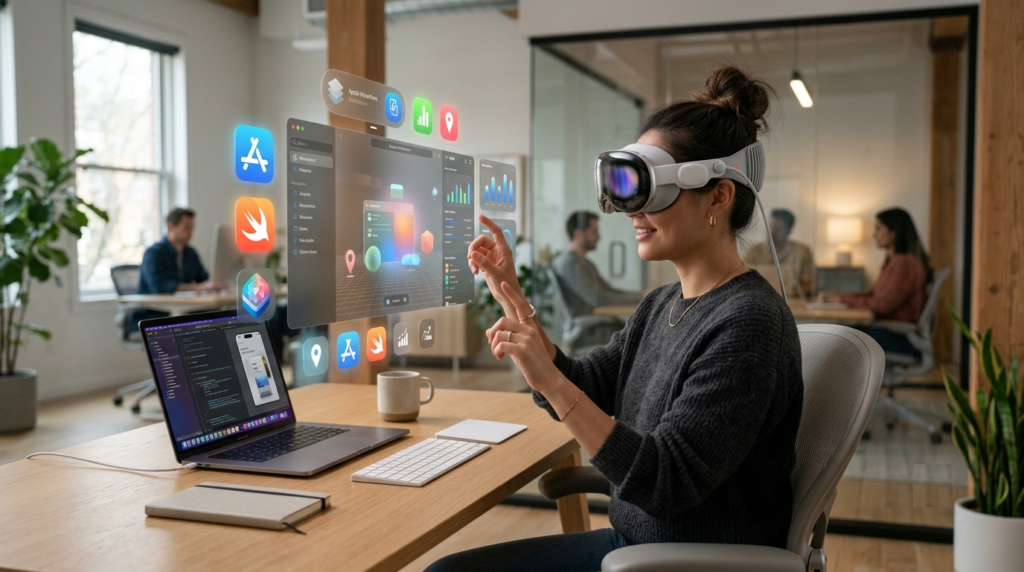
The definition of a mobile application is changing. Spatial iOS app development reflects a broader shift from interfaces that simply display information to experiences that place information into a user’s environment.
Apple Vision Pro and visionOS provide developers with windows, volumes, and immersive spaces, allowing applications to move between familiar 2D interfaces and interactive 3D experiences.
For companies investing in custom iOS software, this creates an important strategic question: should the next generation of their application remain entirely screen-based?
Why Screens Are Not Always Enough
Screens are excellent for many tasks.
Messaging, payments, browsing, scheduling, forms, and dashboards don’t necessarily need spatial interfaces.
But some information is naturally three-dimensional.
Think about:
- Buildings
- Machines
- Furniture
- Vehicles
- Human anatomy
- Geographic environments
- Product prototypes
Trying to communicate these things through flat images can sometimes limit understanding.
Spatial computing adds depth and scale.
Custom Apps Can Target Specific Problems
The biggest advantage of custom development is that businesses can build around their own workflows.
A construction company might need an application that allows teams to review a building model.
A retailer might need realistic product visualization.
A training organization might need immersive simulations.
A medical company might need 3D educational models.
These use cases don’t require the entire application to become immersive.
Only the valuable workflow needs to change.
The Hybrid App Model
The most practical future may be hybrid.
A user could start with a standard iPhone interface.
Then, when they reach a feature that benefits from spatial interaction, the experience could extend to Vision Pro.
For example:
iPhone: Select a vehicle.
Vision Pro: Explore the vehicle in 3D.
iPhone: Configure and purchase.
This model keeps the traditional app efficient while adding spatial computing where it provides value.
SwiftUI Makes Expansion Easier
Apple encourages developers to use SwiftUI for visionOS development and supports existing iPhone and iPad apps as a starting point for spatial experiences.
For businesses, this means architecture decisions made during iOS development can influence future spatial expansion.
Teams should consider:
- Shared UI components
- Reusable data models
- Modular business logic
- API abstraction
- Cross-platform state management
The more modular the application, the easier it can be adapted.
Spatial Design Requires New Thinking
A mobile designer asks:
Where should this button go?
A spatial designer must also ask:
Where should this object exist?
Other questions include:
- How large should it appear?
- Can users inspect it from different angles?
- Should it remain fixed?
- Should it respond to movement?
- How much information should surround the user?
- Is immersion actually useful?
Apple’s spatial development model gives developers different options instead of forcing every application into a single immersive format.
The Importance of 3D Assets
Businesses entering spatial development should audit their existing digital assets.
Product companies may already have CAD models.
Retailers may have 3D product files.
Automotive companies may have detailed vehicle models.
Architecture firms may already use digital building models.
These assets can become valuable foundations for spatial applications, although they often need optimization for real-time rendering.
Why Businesses Should Start Early
Spatial computing is still developing, which makes this a good time for experimentation.
Companies don’t have to immediately build a massive production platform.
They can start with:
- A use-case workshop
- A prototype
- A user test
- A small spatial feature
- A production pilot
This reduces risk and creates real evidence about whether spatial interaction helps customers.
Finding the Right Development Partner
A Custom iOS App Development Company can help businesses connect traditional application development with newer spatial technologies.
Look for teams that understand:
- Swift and SwiftUI
- visionOS
- RealityKit
- ARKit
- 3D asset pipelines
- Spatial UX
- API architecture
- App Store deployment
- Testing across Apple platforms
Technical skills matter, but product thinking matters just as much.
Conclusion
Custom iOS development is not disappearing.
It is expanding.
The next generation of Apple applications will likely combine traditional mobile workflows with spatial experiences where depth, scale, and environment make the product better.
Businesses that design their applications with that possibility in mind can create products that are ready to evolve as Apple’s spatial ecosystem continues to mature.