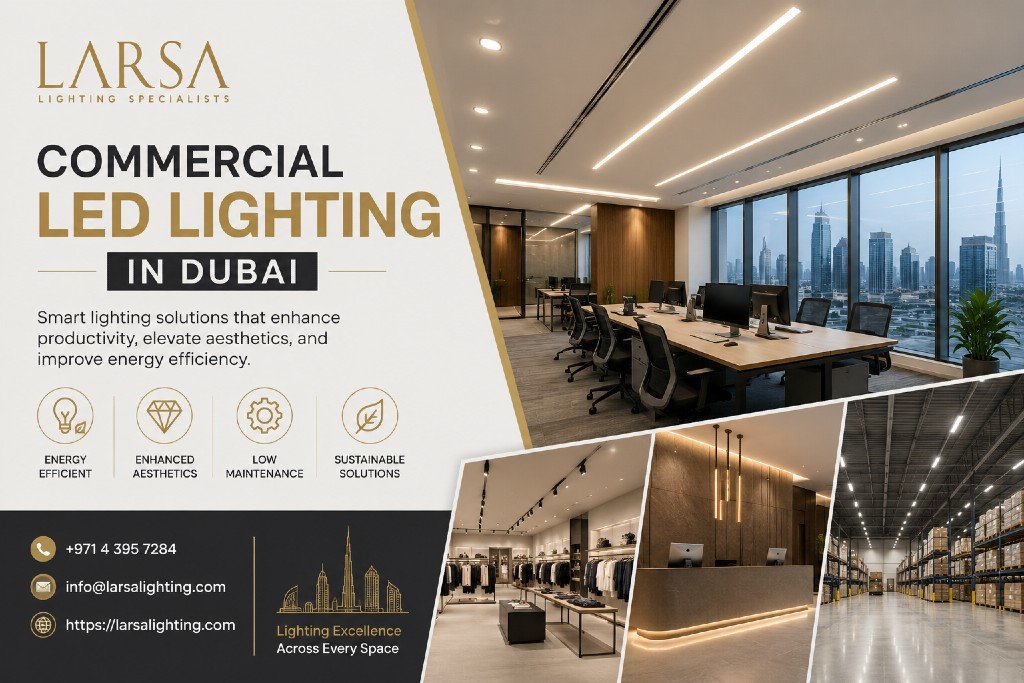
Commercial lighting plays a vital role in how a workplace, retail store, hotel, showroom, or public facility looks and functions. A space can meet its basic illumination requirements and still feel uncomfortable, flat, or visually unbalanced. The right Commercial LED Lighting in Dubai should therefore do more than provide brightness or reduce energy consumption. It should support productivity, highlight architectural features, improve visual comfort, and complement the overall purpose of the space.
For architects, interior designers, developers, and facility managers, choosing suitable LED solutions starts with understanding the environment rather than simply selecting fixtures from a catalogue.
Understand the Purpose of the Commercial Space

Every commercial environment has different lighting requirements. Offices generally need comfortable illumination for focused work, meetings, and collaboration. Retail stores need accurate light to display products while directing customer attention toward important areas. Hotels and hospitality spaces often use lighting to create a welcoming atmosphere and guide visitors through reception, dining, and leisure areas.
This makes the fixture selection process more than a purchasing decision. Beam angle, mounting height, spacing, colour temperature, optical performance, and surrounding surface finishes can all influence the final result.
A bright room is not necessarily a well-lit room. Effective lighting considers where people work, move, gather, and interact, while identifying architectural elements that deserve emphasis.
Choose Layered Lighting for Better Results
Using one lighting type throughout a commercial property can create a uniform appearance without providing sufficient flexibility. Layered lighting combines different sources to address specific visual needs.
The main layers include ambient lighting for general visibility, task lighting for detailed activities, accent lighting for products or architectural features, and decorative lighting for visual identity.
For example, linear LED fixtures may provide general illumination across an office, while adjustable spotlights can highlight reception areas or meeting spaces. In retail environments, carefully positioned accent lighting can draw attention to merchandise, while concealed LED systems can add depth to shelves, wall panels, and architectural details.
Layered lighting also makes it easier to create different scenes for working hours, presentations, events, cleaning, and after-hours operation.
Consider Light Quality Instead of Wattage Alone
Wattage should not be the only factor when comparing commercial LED fixtures. Modern LED performance depends on factors such as delivered lumens, efficacy, optics, driver quality, thermal management, colour consistency, and expected service life.
Colour temperature is another important consideration. Warm white light can complement wood, stone, textiles, and hospitality interiors, while neutral white light may be more suitable for offices, circulation areas, and contemporary retail spaces. The choice should reflect the materials, daylight conditions, and intended atmosphere.
Colour rendering is particularly important for environments where accurate appearance matters. Retail products, artwork, food, furniture, finishes, and brand colours can all benefit from appropriate colour-rendering performance. Testing representative fixtures with actual project materials can help designers make more informed decisions.
Control Glare for Visual Comfort
Glare is a common cause of dissatisfaction in commercial lighting installations. It can result from exposed LED sources, poorly positioned downlights, reflective surfaces, unsuitable beam angles, or excessive brightness within a person’s field of view.
Effective glare control involves directing light precisely and shielding sources where necessary. Recessed fixtures, baffles, louvers, appropriate optics, and careful aiming can help maintain visual comfort without sacrificing illumination.
This is especially relevant in offices, meeting rooms, reception areas, retail stores, restaurants, and hospitality lounges. Customers and employees should be able to see clearly without feeling overwhelmed by bright fixtures.
Plan Lighting Controls from the Beginning
Lighting controls can improve both efficiency and usability, but they work best when integrated into the design from the beginning. Dimming, occupancy sensors, daylight harvesting, scheduling, and scene controls can help reduce unnecessary energy consumption.
The appropriate solution depends on the application. An office might use zoning based on occupancy and natural daylight, while a restaurant may require simple scenes that transition from daytime service to evening ambience. Retail environments can use separate controls for display lighting and general illumination.
However, more technology does not automatically mean a better system. Excessive complexity can make controls difficult for staff to operate and maintain. Clear zoning, intuitive interfaces, and proper commissioning are often more valuable than features that are rarely used.
Consider Maintenance and Long-Term Performance
Commercial lighting should be evaluated as a long-term investment. Before selecting fixtures, project teams should consider cleaning requirements, accessibility, replacement procedures, driver performance, and operating conditions.
Although LEDs generally have long service lives, the complete system includes drivers, connectors, controls, and other components that can influence reliability. Heat, dust, moisture, operating hours, and voltage conditions should be considered according to the installation environment.
Consistency is equally important for large commercial projects. Using coordinated fixture families helps maintain consistent colour temperature, beam quality, appearance, and performance across different areas and project phases.
Match Fixtures to the Environment
The best Commercial LED Lighting in Dubai is not necessarily the fixture with the highest output or most advanced features. It is the solution suited to the physical and functional conditions of the space.
Outdoor areas, facades, pathways, and landscape features may require suitable ingress protection, corrosion resistance, thermal performance, and optical control. Industrial environments and high-ceiling spaces require fixtures designed for mounting height, coverage, durability, and operating conditions.
Interior spaces present their own challenges. Recessed fixtures may offer a clean appearance but can be difficult to install where ceiling voids are limited. Surface-mounted fixtures may be more practical in certain areas, while track lighting can provide flexibility for changing retail displays. Linear systems can also complement the architectural rhythm of offices and public spaces.
Use Mockups and Proper Commissioning
Even a carefully designed lighting plan can produce unexpected results when installed on site. Lighting needs to be coordinated with ceiling plans, HVAC systems, sprinklers, signage, furniture, finishes, and electrical infrastructure.
Mockups can help project teams evaluate actual fixture appearance, glare, shadows, colour, beam distribution, and interaction with surrounding materials before full installation. This provides an opportunity to make adjustments while changes are still manageable.
Commissioning is equally important. Adjustable fixtures may need aiming, dimming levels may need refinement, and control zones must be tested. These final steps ensure that the installed system performs according to the original design intent.
Larsa Lighting highlights the importance of combining technical specification with visual judgment. This approach helps architects, designers, developers, and facility teams select lighting solutions that respond to the project’s actual requirements rather than relying on generic specifications.
Making the Right Lighting Choice
Choosing Commercial LED Lighting in Dubai requires a balance between aesthetics, performance, efficiency, comfort, maintenance, and long-term usability. The most successful schemes begin by understanding how a space will be used and then selecting lighting layers, optics, controls, and fixtures that support that purpose.
Whether the project is an office, retail environment, hotel, showroom, or industrial facility, thoughtful specification can make the difference between simply illuminating a space and creating an environment that works effectively. With careful planning, testing, coordination, and commissioning, LED lighting can become an integral part of the architecture rather than an afterthought.