Businesses rely heavily on digital data to understand customers, measure marketing performance, and make decisions about growth. But having Google Analytics installed does not automatically mean that the information being collected is accurate.
Incorrect events, duplicated conversions, missing revenue data, poorly configured Google Tag Manager containers, and inconsistent tracking can all affect the quality of business reporting. When teams make decisions using unreliable information, even a strong marketing strategy can produce misleading conclusions.
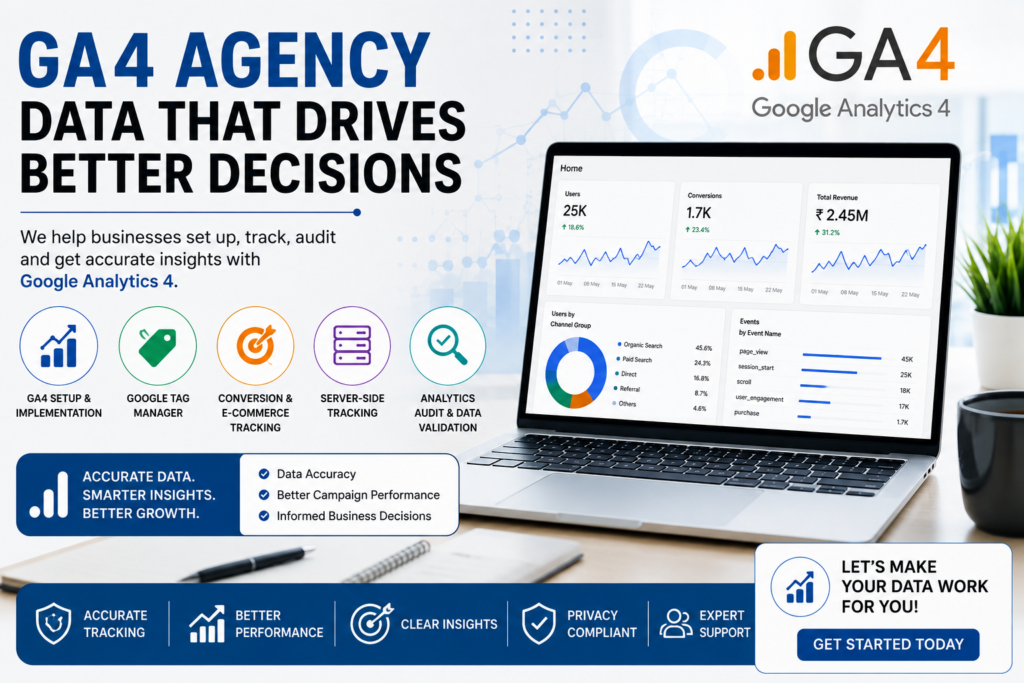
This is where a professional GA4 Agency can provide valuable support. A specialist analytics team can help businesses set up Google Analytics 4, configure tracking, validate events, improve conversion measurement, and identify problems that may otherwise remain hidden.
What Does a GA4 Agency Do?
A GA4 agency specialises in implementing, maintaining, auditing, and improving Google Analytics 4 measurement systems.
Instead of treating analytics as a small part of a broader digital marketing campaign, a specialist agency focuses on making measurement accurate and useful.
Depending on the business and its requirements, GA4 services can include:
- Google Analytics 4 setup
- GA4 migration
- Event tracking
- Conversion tracking
- Ecommerce tracking
- Google Tag Manager implementation
- GTM debugging
- Server-side tagging
- Reporting and dashboards
- Analytics audits
- Data validation
- Measurement planning
GA4 Experts describes its services around GA4, Google Tag Manager, server-side tagging, conversion tracking, reporting, and analytics audits, with implementation validated through tools such as DebugView.
Why Accurate GA4 Data Is Important
Analytics data influences decisions across marketing, sales, ecommerce, and product teams.
Consider an ecommerce company that believes a particular advertising campaign generated a large number of purchases. If purchase events are duplicated, the reported revenue may be inflated. The company could then allocate additional budget to a campaign that is not actually performing as well as the reports suggest.
Similarly, if important conversions are not being tracked, a high-performing campaign may appear unsuccessful.
Accurate measurement helps businesses understand:
- Where website visitors come from
- Which marketing channels generate conversions
- How users move through the website
- Which products generate revenue
- Where users leave a funnel
- Which campaigns contribute to business goals
The goal is not simply to collect more data. It is to collect reliable data that can support better decisions.
When Should You Hire a GA4 Agency?
Not every business needs external analytics support all the time. However, specialist assistance can be particularly useful in several situations.
During a New GA4 Implementation
A new analytics implementation should be planned around the actual business objectives rather than simply installing a tracking code.
Before implementation, businesses should identify important events and conversions. For an ecommerce website, this could include product views, add-to-cart actions, checkout steps, and purchases.
For a lead-generation website, important events may include form submissions, calls, downloads, or other qualified actions.
After a Website Redesign
Website migrations and redesigns can unintentionally break analytics tracking.
Changes to URLs, forms, buttons, checkout systems, consent platforms, or website technology can affect existing tracking.
A post-launch analytics check can help identify missing or duplicated events before incorrect data accumulates.
When Marketing Reports Do Not Match
One common warning sign is when GA4 numbers do not match other platforms.
For example, businesses may notice differences between:
- GA4
- Google Ads
- Meta Ads
- CRM systems
- Ecommerce platforms
- Payment systems
Some differences are expected because platforms use different attribution and reporting methodologies. However, significant unexplained discrepancies can indicate a tracking or configuration problem.
What Is a Google Analytics Audit?
A Google Analytics Audit Agency examines an existing analytics implementation to determine whether the data collection and configuration are working as intended.
An audit is more than checking whether the GA4 tracking code exists.
A comprehensive review can examine:
- GA4 property configuration
- Data streams
- Event tracking
- Conversion configuration
- Event parameters
- Google Tag Manager
- Triggers
- Variables
- Ecommerce tracking
- Funnel measurement
- Consent settings
- Traffic sources
- User permissions
- Custom dimensions
- Conversion rates
- Reporting configuration
GA4 Experts describes its audit process as a diagnostic review of GA4, Google Tag Manager, and conversion tracking, including configuration, data collection, event and conversion setup, and funnel validation.
Why Businesses Need a Google Analytics Audit Agency
Analytics problems are not always obvious.
A website may continue showing data even when part of the tracking implementation is incorrect. This can make problems particularly difficult to identify without a systematic audit.
A specialist Google Analytics Audit Agency can investigate potential issues and help prioritise them based on their impact.
Common warning signs include:
- Duplicate events
- Missing conversions
- Incorrect purchase tracking
- Revenue discrepancies
- Broken funnels
- Inconsistent event firing
- Incorrect attribution data
- Consent-related tracking problems
- Poorly configured GTM triggers
- Data that cannot be trusted
The purpose of an audit is not to produce a generic checklist. It should identify specific issues and explain what needs to be corrected.
Google Tag Manager and GA4 Work Together
GA4 and Google Tag Manager often work together as part of a website’s measurement infrastructure.
Google Tag Manager can be used to manage tags, triggers, variables, and event implementation without repeatedly changing website code.
However, a poorly structured GTM container can create its own problems.
For example, unnecessary tags, overlapping triggers, duplicate events, or complicated logic can make debugging difficult.
A GA4 specialist can review both systems together rather than treating GA4 as an isolated tool.
Conversion Tracking Is One of the Most Important Areas
Businesses usually do not need analytics simply to count visitors.
They need to know what visitors do that contributes to business objectives.
Depending on the website, important conversions may include:
- Purchases
- Lead submissions
- Phone calls
- Account registrations
- Demo requests
- Newsletter sign-ups
- Downloads
- Booking requests
Correct conversion tracking allows marketing teams to evaluate campaigns based on meaningful actions rather than traffic volume alone.
Ecommerce Tracking Requires Special Attention
For ecommerce businesses, analytics accuracy can directly affect revenue reporting.
A properly structured ecommerce implementation may track actions such as:
- Product view
- Product selection
- Add to cart
- Begin checkout
- Payment
- Purchase
If an event is missing, duplicated, or incorrectly configured, reports can become misleading.
This is why ecommerce businesses can benefit from specialist GA4 implementation and auditing rather than relying only on a basic installation.
Server-Side Tracking Is Becoming More Important
Modern tracking environments are becoming increasingly complex due to privacy requirements, browser restrictions, consent management, and changes in how third-party tracking works.
Server-side tagging can provide another approach to managing data collection and forwarding.
However, server-side implementation requires careful planning. Businesses need to understand which events should be collected, how data should be processed, and how client-side and server-side measurements should work together.
GA4 Experts lists server-side tagging as part of its analytics services and offers advanced reviews for setups that require additional privacy or scale considerations.
How a GA4 Agency Can Improve Reporting
Good analytics implementation should ultimately make reporting easier to understand.
Businesses may use dashboards to monitor:
- Traffic
- Leads
- Revenue
- Conversion rates
- Ecommerce performance
- Marketing channels
- User behaviour
- Funnel performance
A dashboard is only as useful as the data behind it.
If the underlying tracking is incorrect, an attractive dashboard can simply make incorrect information easier to consume.
This is why analytics implementation, validation, and reporting should be treated as connected parts of the measurement process.
White-Label GA4 Support for Agencies
GA4 support is not only useful for businesses.
Digital marketing agencies may also need specialist analytics support when working with clients.
Building an internal analytics team can require specialist knowledge, training, and ongoing resources. A white-label analytics partner can allow agencies to offer GA4 implementation, audits, conversion tracking, and reporting without building every capability internally.
GA4 Experts specifically offers white-label GA4 services for agencies, including implementation, audits, conversion and funnel tracking, documentation, and handover under the agency’s brand.
How to Choose the Right GA4 Agency
Before hiring an analytics agency, consider several factors.
Technical Expertise
Look for experience with GA4, GTM, conversion tracking, ecommerce, and related analytics technologies.
Validation Process
Ask how the agency tests implementations. A good implementation should be validated rather than simply installed.
Documentation
Documentation is important because your internal team should understand what was implemented and how it works.
Clear Scope
Understand exactly what is included in the engagement.
Business Understanding
Analytics should reflect business goals. A technically correct implementation is more valuable when it measures the actions that actually matter to the organisation.
Final Thoughts
Reliable analytics is now an essential part of digital decision-making. Businesses invest significant amounts in SEO, paid advertising, social media, ecommerce, and conversion optimisation, but those activities are difficult to evaluate when the underlying measurement is inaccurate.
A specialist GA4 Agency can help businesses build, fix, validate, and improve their analytics infrastructure. For organisations that already have tracking installed but do not fully trust their numbers, working with a Google Analytics Audit Agency can help identify configuration problems, tracking gaps, and data inconsistencies.
The objective should not simply be to collect more information. It should be to create a measurement system that businesses can understand, validate, and confidently use when making decisions.
For businesses looking for specialist support, GA4 Experts positions its services around GA4, GTM, server-side tracking, conversion measurement, audits, and reporting.