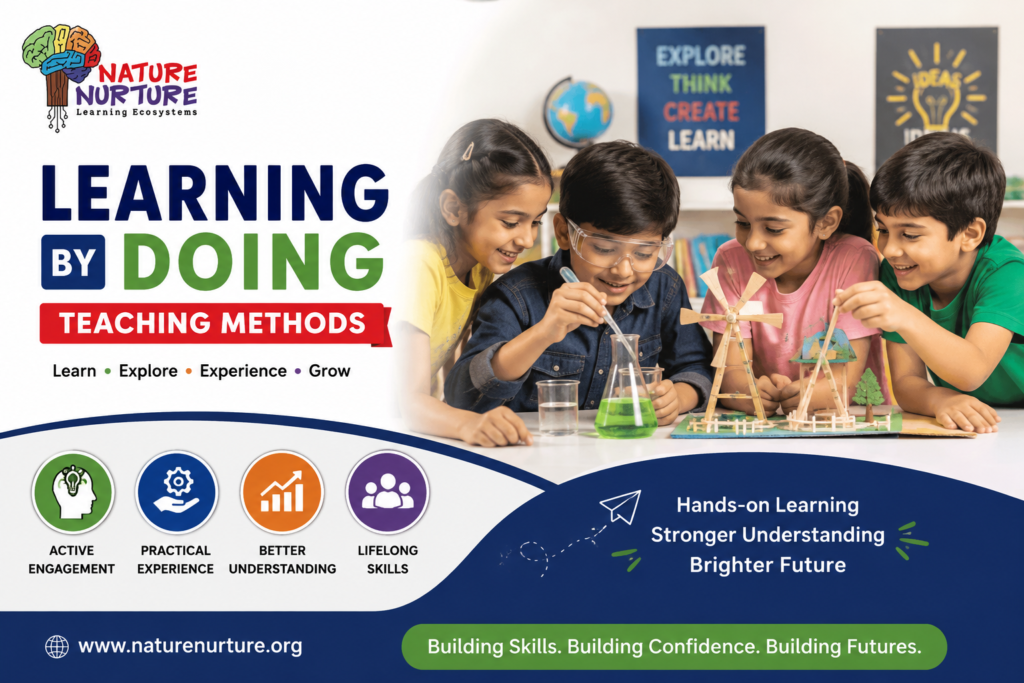
Students learning through practical classroom activities
Teachers can encourage children by appreciating their effort and asking questions about their work. Instead of immediately giving the correct answer, teachers can ask, “What do you think will happen?” or “Why did you choose this idea?” Learning By Doing Teaching Methods give teachers more opportunities to observe how children think, make choices, and respond to different learning situations.
What Makes Practical Learning Effective?
Teachers can observe students during these activities to understand their strengths, interests, and areas where they need more support. Learning By Doing Teaching Methods also allow teachers to see how children apply their knowledge during real activities instead of only checking what they remember from a lesson. Even a short classroom activity can make a difference when it helps children connect an idea with something they can see or experience.
Learning Through Real-Life Activities
Role-play is another helpful activity. Students can pretend to be shopkeepers, doctors, teachers, scientists, or community helpers. Learning By Doing Teaching Methods make these activities more useful by allowing children to practice communication, decision-making, teamwork, and responsibility in a safe environment.
Building Problem-Solving Skills
Children face small problems every day, and learning how to solve them is an important part of education. Practical activities give students opportunities to think about a problem, try different ideas, and learn from mistakes.
For example, a teacher may ask students to build a bridge using paper, blocks, or other safe classroom materials. Students can test their designs and make changes when something does not work. There may not be one perfect answer, which encourages children to think creatively. Learning By Doing Teaching Methods support this process by giving students freedom to experiment, make choices, and improve their ideas.
The Role of Project-Based Learning Programs
Project-Based Learning Programs provide students with opportunities to explore a topic over a period of time and create something meaningful from their learning. A project may involve research, teamwork, planning, creativity, and presentation.
For example, students can work on a project about saving water. They may discuss where water is used, observe water wastage around them, create posters, and share simple ideas for saving water. The activity can combine science, language, art, teamwork, and social awareness.
These projects also teach children that different subjects can work together. Learning does not always need to happen in separate boxes. A single project can help students use many skills at the same time.
Encouraging Creativity and Confidence
Children become more confident when they are allowed to share their ideas. Practical activities give them many ways to express themselves. Some children may enjoy drawing, while others may prefer building models, speaking, writing, or performing.
Teachers can encourage children by appreciating their effort and asking questions about their work. Instead of immediately giving the correct answer, teachers can ask, “What do you think will happen?” or “Why did you choose this idea?”
Learning By Doing Teaching Methods create more opportunities for children to make choices, explain their thinking, and learn from their experiences. This can help students become more comfortable with trying new things.
Technology and Hands-On Learning
However, digital tools should work alongside hands-on activities. Learning By Doing Teaching Methods encourage children to draw, build, write, explore nature, work with classmates, and participate in real-world activities. A balanced classroom can use technology when it adds value without taking away from active learning.
How Teachers Can Use This Approach
Teachers do not need expensive materials to make learning practical. Simple classroom resources can be enough. Paper, cardboard, blocks, recycled materials, books, pictures, and everyday objects can support many activities.
Teachers can begin with a simple question and then create an activity around it. For example, while teaching about shapes, children can search the classroom for objects with different shapes. They can sort them, count them, draw them, and discuss where those shapes are found in daily life.
Learning By Doing Teaching Methods can be introduced through small activities before teachers move toward larger projects. Nature Nurture encourages meaningful educational experiences where children can learn through exploration, creativity, and practical activities.
Making Learning Enjoyable for Children
Learning By Doing Teaching Methods Children learn better when they feel interested and involved. Practical activities can bring energy into the classroom and give students a reason to participate. They can also make lessons less stressful because children get opportunities to learn through movement, discussion, creativity, and exploration.
Teachers can observe students during these activities to understand their strengths, interests, and areas where they need more support. Even a short classroom activity can make a difference when it helps children connect an idea with something they can see or experience.
Preparing Children for the Future
Practical learning gives them regular opportunities to develop these abilities. Learning By Doing Teaching Methods can strengthen these skills by helping children use their knowledge while completing activities, working with others, solving problems, and making simple decisions.
Project-Based Learning Programs can further strengthen these skills by giving students meaningful tasks that require planning, cooperation, and creativity. When children learn to take responsibility for a project, they also become more independent.
Nature Nurture believes that meaningful learning should help children become curious, confident, creative, and ready to explore the world around them. When education connects knowledge with action, children can understand ideas more deeply and develop a positive attitude toward learning.
Conclusion
Learning By Doing Teaching Methods make education more active by giving children opportunities to explore, create, experiment, and solve problems. From simple classroom activities to larger projects, practical experiences can help students connect lessons with real life.
When teachers combine hands-on activities, teamwork, technology, creativity, and real-world experiences, learning becomes easier to understand and more enjoyable. Most importantly, children begin to see education as something they can experience, not just something they have to memorize .