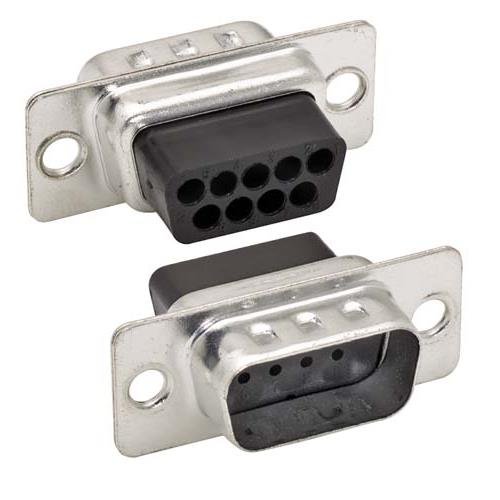
Crimp D-sub Connectors
Crimp D-sub Connectors are widely used electrical connectors designed to create secure signal and power connections in electronic systems. Their D-shaped metal shell supports correct mating alignment, while crimp contacts allow wires to be terminated without soldering.
Unlike solder-type versions, Crimp D-sub Connectors use individual contacts mechanically compressed around conductors with a crimping tool. When the correct contact, wire size, and tooling are used, the result is a strong electrical connection with good mechanical stability.
How Do Crimp D-sub Connectors Work?
A typical assembly includes a connector housing, metal shell, removable crimp contacts, wiring, and often a backshell or strain-relief accessory. The wire is stripped to the specified length and inserted into the contact barrel. A suitable crimp tool then compresses the barrel tightly around the conductor.
After crimping, each contact is inserted into the correct housing cavity. The completed connector mates with a corresponding plug or socket, while the D-shaped shell helps prevent incorrect orientation.
Key advantages include:
- No soldering heat is applied to the connector
- Individual contacts can often be removed and replaced
- Wiring can be prepared efficiently for repeated production
- Proper crimping creates low-resistance electrical joints
- Mechanical retention protects connections from movement
Why Choose Crimp D-sub Connectors Instead of Solder Types?
Crimp termination can simplify assembly where multiple connectors must be produced consistently. It also reduces dependence on soldering skill and avoids problems such as excessive solder, cold joints, or heat damage.
Crimp D-sub Connectors are useful when field maintenance matters. If one contact becomes damaged, technicians may be able to extract and replace it without changing the entire connector.
The crimp method also supports repeatable termination.
What Are the Main Features of Crimp D-sub Connectors?
D-Shaped Connector Shell
The D-shaped shell provides mechanical protection, assists alignment, and reduces the risk of reverse mating.
Removable Crimp Contacts
Crimp contacts are installed individually inside the housing.
Multiple Contact Configurations
Crimp D-sub Connectors are available in various contact counts and shell sizes. Common configurations support signal circuits, serial communication, control wiring, instrumentation, and other electronic interfaces.
Secure Mating Hardware
Many designs support jack screws, locking hardware, or fastening accessories.
Backshell and Strain Relief Compatibility
Backshells protect the cable entry area, provide strain relief, improve cable management, and may support shielding. A compatible backshell is important where cables are frequently bent or exposed to mechanical stress.
Where Are Crimp D-sub Connectors Commonly Used?
Their versatility allows them to be used across many electrical and electronic environments, including:
- Industrial automation and machine-control systems
- Programmable controllers and control cabinets
- Test and measurement equipment
- Data acquisition systems
- Computer and peripheral interfaces
- Serial communication equipment
- Telecommunications hardware
- Laboratory electronics
- Transportation systems
- Custom cable assemblies and equipment harnesses
How Should You Select Crimp D-sub Connectors?
Choosing the correct connector requires more than matching the number of contacts.
Important selection factors include:
- Required number of contact positions
- Plug or socket configuration
- Compatible wire gauge
- Contact material and plating
- Rated current and voltage
- Shell size and mounting arrangement
- Operating temperature range
- Locking hardware
- Shielding requirements
- Backshell and strain-relief compatibility
- Expected mating cycles
A contact designed for one wire range may not produce a dependable crimp when used with a conductor that is too small or too large.
Why Is the Correct Crimping Tool Important?
The quality of a crimped connection depends heavily on tooling. Unsuitable crimpers can deform contacts, produce insufficient compression, or damage conductor strands.
A proper crimping system controls how the contact barrel closes around the wire.
For dependable results:
- Use contacts specified for the connector housing
- Match each contact to the correct wire gauge
- Strip insulation to the recommended length
- Avoid damaging conductor strands
- Use the correct crimp tool
- Inspect the finished crimp before insertion
- Perform pull testing when required
What Benefits Do Crimp D-sub Connectors Provide?
Crimp D-sub Connectors combine a proven connector format with a practical termination method. They offer dependable mechanical retention, flexible contact installation, straightforward maintenance, and efficient assembly when suitable tooling is available.
Their modular design also supports customised cable harnesses. Engineers can select the connector size, contact type, backshell, locking hardware, and cable arrangement required for a specific system.
For industrial control, communications, instrumentation, computing, and specialised electronic equipment, Crimp D-sub Connectors remain a reliable connection solution. This versatility is especially useful for engineers building compact multi-wire interfaces where dependable mating, organised termination, and straightforward servicing are priorities. With careful component matching, the connector can deliver consistent performance across demanding professional installations. Selecting compatible components and following correct crimping procedures helps ensure stable electrical performance, strong mechanical integrity, and long service life.