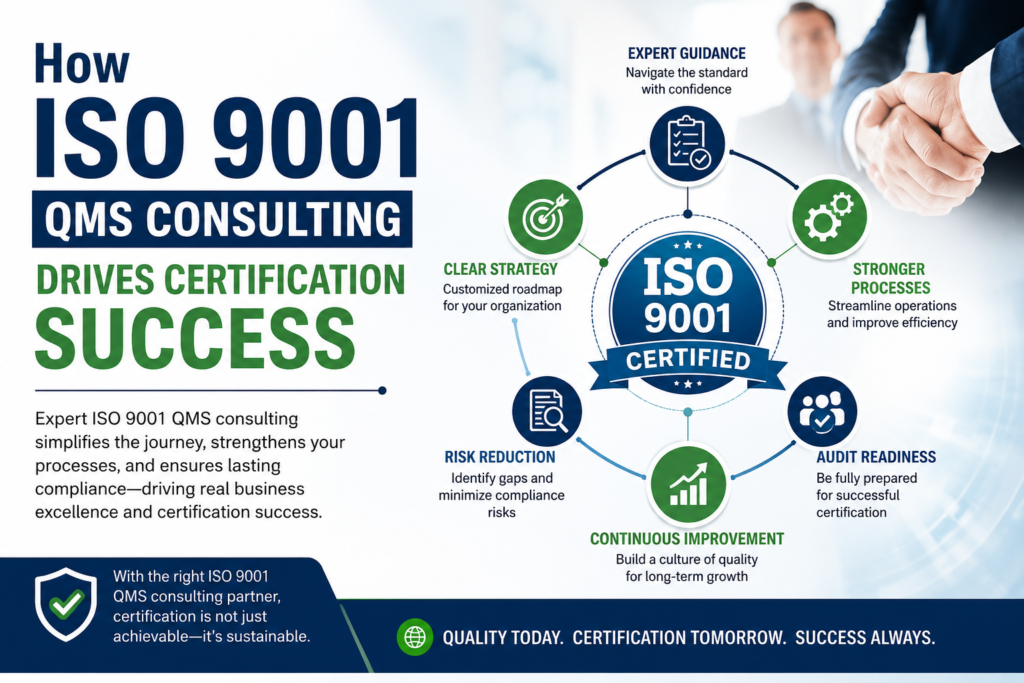
Is your team prepared to pass ISO 9001 on the first try and avoid wasting time and effort with unnecessary extra work?
Many companies find themselves stuck in the complex process of understanding requirements, getting buried under documentation, and worrying about audits. This guide will give you tips and tricks to make the most of your resources during the implementation and tell you how consulting experts can help you get certified faster and improve your quality management system.
When you decide to get ISO 9001 QMS consulting, you can count on a qualified team to help you get through every stage: from identifying gaps to achieving certification and ongoing improvement.
Why ISO 9001 Certification Is Challenging Without Guidance
ISO 9001:2015 is developed on process approach, risk based thinking, and continual improvement concepts which require commitment from the leadership, documented information, and demonstration of the effective implementation of processes.
Without the experienced guidance, the companies may incorrectly interpret the requirements, document too much information on non-critical processes, and fail to establish links between the requirements and their controls which leads to non-conformities, extra time spent during the external audit, and increased costs.
Common Gaps That Delay Approval
Most of the first-time applicants commit similar shortcomings which lead to the audit findings. The inadequate context analysis, imprecise quality objectives, and poor performance monitoring and measurement result in audit findings.
Other common audit findings include vague roles and responsibilities, absence of management review input, and corrective actions that do not address the underlying causes of a problem. Early involvement of experts can help avoid these and other deficiencies that may be challenging to remedy.
How ISO 9001 QMS Consulting Accelerates Readiness
Professional consultants can help you to implement quality management system requirements most efficiently. They take care of all necessary aspects regarding your specific industry, company size and system to develop an effective quality management system which is focused not only on standard requirements but also on the real results.
The right hand approach can save up-to 50 percent of the time normally spent on such projects for many small to medium sized enterprises while also improving day to day operations and audit success rates.
Tailored Gap Analysis And Risk Based Planning
Our initial step is conducting a comprehensive gap analysis, which covers sections 4-10 of standard ISO 9001:2015. Our process consultants analyze how your current processes meet the requirements of the standard and evaluate your customer focus, leadership, and supporting functions.
We also develop with you a risk based plan for implementation which contains actions, owners, timelines, and key performance indicators to focus your improvement efforts and ensure that you are delivering the quality management system elements that are of most interest to the auditor.
Documentation That Meets Auditor Expectations
Documentation does not necessarily need to be of great extent, it should rather be lean. Consultants assist in the production of lean manuals, procedures and forms which in turn satisfy documented information requirements.
They also ensure process interaction, turtle diagrams and process maps depict actual processes which facilitates the audit trail, especially for the stage 1 and 2 audits.
Employee Training And Internal Audit Support
A quality management system can only be successful if employees understand their role in it. Consulting includes training courses for process owners, awareness training, and internal auditor training according to ISO 19011 standard.
Moreover, consultants perform internal audit and mock audit to reveal non-conformities, check the effectiveness of corrective actions, and ensure that everything is prepared for the certification body’s visit.
Key Benefits Beyond The Certificate
Certification is not an end but rather a beginning. A properly functioning system produces business benefits long after certification is completed.
Improved on-time delivery, reduced scrap and rework, improved supplier performance, and increased management’s confidence in making decisions based on verifiable information and thorough risk analyses are just some of the benefits realized by companies that use QMS.
Choosing The Right Consulting Partner For Long Term Value
Not all consulting methods are created equal. Seek value in their transparency about the costs, a proven experience in their specialization field, willingness to actually implement the changes and train the staff, rather than rely on generic ready-solutions.
The most competent partners will help you individualize processes in the most productive ways, taking into account the specific needs of your organization, as well as constantly monitor and update improvements through surveillance audits.
Companies that require experienced assistance usually prefer to collaborate with Sync Resource due to the provision of tailored solutions and the emphasis on continuous enhancement.
To Sum Up
Achieving ISO 9001 certification necessitates a certain degree of elaboration. Organizations need to go beyond general information regarding its requirements because attaining it comes down to a combination of specific measures and their impact on management, processes, and personnel.
Therefore, ISO 9001 QMS consulting services entail a practical approach, which helps an organization implement necessary changes with due precision. As a result, they help cut risks associated with audits and bring about quality improvements, which go beyond just obtaining ISO 9001 compliance.
Frequently Asked Questions
1. What Does Quality Management Consulting For ISO 9001 Include?
It includes conducting a gap analysis, developing a quality manual and procedures, performing a risk assessment, providing employee training, conducting internal audits, supporting corrective actions, and assisting during Stage 1 and Stage 2 certification audits.
2. How Long Does ISO 9001 Certification Take With Consulting?
Most organizations take between 3 to 6 months to achieve ISO 9001 certification with the help of consultants. The timeline depends on an organization’s size and complexity as well as the scope of the system. Having a documented plan and the right resources can accelerate the process.
3. Do Small Businesses Need A Full Time Quality Manager For ISO 9001?
Most small businesses can adopt the standard without a full-time manager, as they typically have limited quality management systems in place. A responsible individual can take ownership of all processes while a consultant can assist with internal auditing and management reviews.