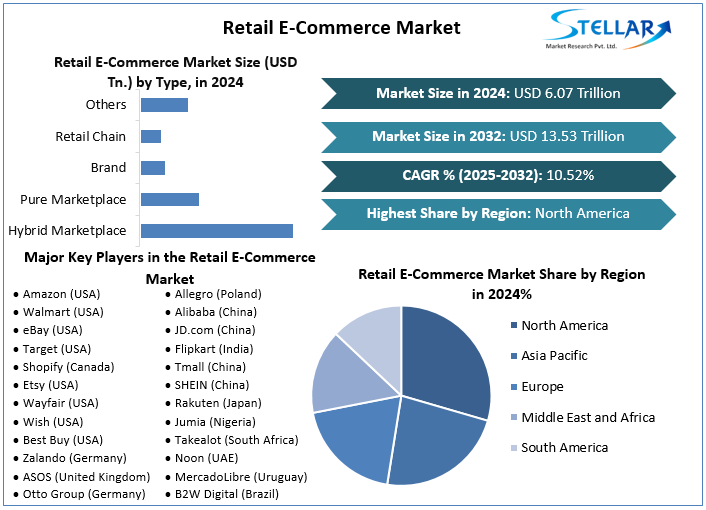
Market Estimation & Definition
Retail e-commerce refers to the buying and selling of goods and services through digital platforms, including websites, mobile applications, online marketplaces, and social commerce channels. The market encompasses a broad range of product categories, including fashion and apparel, consumer electronics, groceries, beauty and personal care products, home furnishings, toys, healthcare products, and lifestyle accessories.
The rapid integration of artificial intelligence, cloud computing, data analytics, and digital payment technologies has enabled retailers to deliver highly personalized shopping experiences while improving operational efficiency. As businesses continue investing in digital transformation and omnichannel retail strategies, the retail e-commerce market is expected to remain one of the fastest-growing segments within the global retail industry.
Download Free PDF Brochure: https://www.stellarmr.com/report/req_sample/retail-e-commerce-market/2371
Market Growth Drivers & Opportunity
One of the primary drivers of the Retail E-Commerce Market is the growing preference for convenient and flexible shopping experiences. Consumers increasingly value the ability to browse products, compare prices, read reviews, and complete purchases from virtually any location using smartphones or other connected devices.
The expansion of digital payment infrastructure has significantly contributed to market growth. Secure payment gateways, digital wallets, buy-now-pay-later services, and contactless payment options have improved customer confidence while simplifying online transactions.
Another important growth driver is the increasing adoption of omnichannel retail strategies. Retailers are integrating physical stores with online platforms to provide seamless shopping experiences through services such as click-and-collect, same-day delivery, curbside pickup, and real-time inventory visibility.
Small and medium-sized enterprises are also embracing e-commerce to expand their customer reach beyond traditional geographic boundaries. Cloud-based e-commerce platforms, digital marketing tools, and marketplace ecosystems have lowered barriers to entry, enabling businesses to compete more effectively in the digital economy.
Emerging technologies such as artificial intelligence, machine learning, predictive analytics, and automation continue creating new opportunities for retailers to improve inventory management, customer engagement, personalized marketing, and supply chain efficiency.
Segmentation Analysis
According to the Stellar Market Research report, the Retail E-Commerce Market is segmented based on Product Type, Business Model, Device Type, Payment Mode, End User, and Region.
Based on product type, fashion and apparel continue to account for a significant share of online retail sales due to increasing digital engagement and frequent product launches. Consumer electronics, beauty and personal care products, groceries, home décor, furniture, healthcare products, and food and beverages also contribute substantially to market revenue.
By business model, Business-to-Consumer (B2C) remains the dominant segment as consumers increasingly purchase products directly from retailers and online marketplaces. Business-to-Business (B2B), Consumer-to-Consumer (C2C), and Direct-to-Consumer (D2C) platforms continue expanding as digital commerce ecosystems evolve.
Mobile commerce represents one of the fastest-growing channels as consumers increasingly rely on smartphones for shopping, payment processing, and customer support.
Country-Level Analysis
United States
The United States remains one of the world’s largest retail e-commerce markets due to high internet penetration, advanced digital payment infrastructure, and strong consumer spending. Retailers continue investing in artificial intelligence, automated fulfillment centers, same-day delivery services, and personalized digital experiences to strengthen customer engagement.
Growing adoption of subscription commerce, voice-enabled shopping, and omnichannel retail strategies continues supporting market expansion across the country.
Germany
Germany represents one of Europe’s leading e-commerce markets, supported by widespread digital adoption, reliable logistics infrastructure, and strong consumer confidence in online shopping. German consumers increasingly prefer secure payment systems, sustainable packaging, and high-quality customer service when making online purchases.
Retailers across Germany are expanding omnichannel operations while investing in warehouse automation, artificial intelligence, and environmentally responsible supply chains to improve operational efficiency and customer satisfaction.
Competitive Analysis
- Zalando (Germany)
- ASOS (United Kingdom)
- Otto Group (Germany)
- Allegro (Poland)
- Alibaba (China)
- JD.com (China)
- Flipkart (India)
- Tmall (China)
Download Free PDF Brochure: https://www.stellarmr.com/report/req_sample/retail-e-commerce-market/2371
Contact Stellar Market Research:
3rd Floor, Navale IT Park, Phase 2
Pune Banglore Highway, Narhe,
Pune, Maharashtra 411041, India
sales@maximizemarketresearch.com
+91 20 6630 3320 | +91 9607365656