Introduction
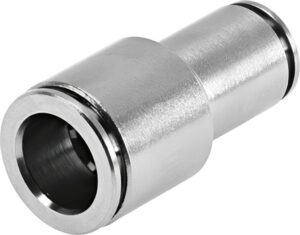
A Festo Pneumatic Straight Fitting creates a direct connection between pneumatic tubing and a threaded port or another tube. Its inline shape supports clean routing where compressed air must travel without an immediate change in direction.
Straight fittings are commonly installed around cylinders, valves, manifolds, air-preparation units, and control panels. Correct selection helps preserve airflow, simplify maintenance, and reduce leakage during repeated machine cycles.
What Is a Pneumatic Straight Fitting?
A straight pneumatic fitting joins two connection points along the same axis. Common designs include threaded-to-tube fittings, equal tube unions, and reducing unions for different tube diameters.
Festo’s QS family uses a push-in principle. Compatible tubing is inserted into the fitting, where a retaining claw grips the outer surface and an internal seal supports a secure connection. The tube can later be released by pressing the surrounding ring.
The broader Pneumatic Fittings range helps engineers compare straight, elbow, tee, reducing, and specialised connection arrangements for complete air circuits.
Why Is the Straight Design Useful?
A straight fitting offers a simple airflow route when the tube already aligns with the equipment port. Its compact body can also reduce clutter around closely spaced valves and cylinders.
The tube should approach the connection naturally. Pulling it sideways can place stress on the fitting, seal, and receiving port.
Correctly selected Air Hoses should match the required outside diameter, flexibility, pressure, temperature, and machine environment before installation.
Which Straight-Fitting Types Are Available?
Threaded-to-Tube Fittings
A threaded-to-tube fitting screws into a valve, cylinder, manifold, or service-unit port. The opposite side accepts compatible tubing.
Festo QS straight fittings are available with different threads and tube sizes. Product-specific data must be checked because connection dimensions, sealing methods, pressure limits, and tightening requirements vary by model.
Equal and Reducing Unions
An equal union joins two tubes of the same outside diameter. It can extend a line or replace a damaged section.
A reducing union connects different tube sizes along one axis. The smaller diameter must still provide enough airflow for the downstream actuator or tool.
Where Are Straight Fittings Used?
Cylinder and Valve Connections
Straight fittings connect tubing directly to actuator or valve ports where sufficient clearance is available. Their inline construction keeps the route easy to inspect.
The fitting should not support the weight of long tubing. Tubes should be secured so vibration and movement are not transferred into the threaded port.
Control Panels and Branch Circuits
Pneumatic cabinets may contain numerous tubes, valves, and manifolds. Straight fittings support organised connections where tubes enter equipment from a matching direction.
When one supply must divide into several routes, Pneumatic T Fittings can create a controlled branch within an appropriately sized circuit.
Suitable Pneumatic Manifold Fittings can organise multiple nearby outlets while keeping the main distribution point accessible.
How Should the Correct Fitting Be Selected?
Engineers should compare:
- Tube outside diameter
- Thread type and size
- Operating pressure
- Temperature range
- Permitted medium
- Housing and seal materials
- Required airflow
- Installation space
The thread must match the receiving port exactly. Metric, parallel, and tapered threads are not automatically interchangeable. Incorrect combinations may damage threads or create an unreliable seal.
The internal bore must also suit the required flow. A small fitting can restrict actuator performance even when the valve and tubing are correctly sized.
Why Is Tube Preparation Important?
Push-in fittings depend on a clean, undamaged tube surface. The tube should be cut squarely without crushing, deep scratches, burrs, or angled edges.
Festo’s installation guidance states that tubing should be cut straight and deburred to protect the internal seal. The tube should then be inserted fully before the connection is tested.
How Should the Fitting Be Installed?
Before installation, isolate the air supply and release stored pressure. Confirm the fitting part number, tube size, thread, sealing method, and operating limits.
Good installation practices include:
- Cut the tube cleanly and squarely
- Keep the tube surface free from dirt
- Insert the tube to the full depth
- Use the specified thread seal
- Tighten to the recommended torque
- Avoid side loading and sharp bends
- Support long tube runs
- Test the joint for leakage
If the route must divide near a threaded port, Pneumatic Y Threaded Adaptors can provide two angled tube connections within a compatible circuit.
When Are Quick Disconnects Better?
A straight push-in fitting suits fixed machine tubing. However, some service points require frequent connection and separation.
Properly rated Pneumatic Quick Connect Couplings can support faster authorised servicing when their flow, pressure, and shut-off behaviour match the application.
How Can Reverse Flow Be Managed?
A standard straight fitting does not prevent backflow. Air moves according to pressure conditions within the circuit.
Where one-way flow is required, Pneumatic Positive Pressure & Vacuum Non Return Valve Function Fittings can add directional control within a correctly designed branch.
How Can Leakage Be Prevented?
Leaks commonly result from incomplete insertion, damaged tubing, incorrect diameter, contaminated seals, mismatched threads, or mechanical strain.
Depressurise the system before removing a tube. Press the release ring evenly and pull the tube straight. If the end is scratched or compressed, remove the damaged section before reconnecting it.
Why Choose a Festo Pneumatic Straight Fitting?
A Festo Pneumatic Straight Fitting provides a compact and serviceable connection for pneumatic tubing. Its inline form supports orderly layouts, while push-in technology can reduce assembly time and simplify tube replacement.
By matching the fitting to the tube, thread, pressure, temperature, airflow, material, and environment, engineers can create dependable compressed-air connections that remain easy to inspect and maintain.