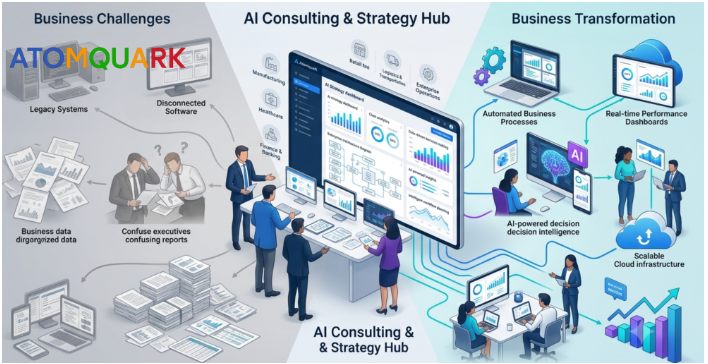
The most expensive technology mistake isn’t buying the wrong tool; it’s confidently solving the wrong problem. Businesses invest heavily in AI and digital initiatives that fail not because the technology didn’t work, but because it was aimed at the wrong target, poorly adopted, or never tied to a real business outcome in the first place. Studies of transformation programs consistently show high failure rates, and the cause is rarely the technology itself. It’s the strategy, or lack of one, around it.
This is precisely the gap that good AI consulting services fill. Rather than starting with a product and looking for somewhere to use it, a strong technology consulting company starts with your business problems and goals, then works out where AI and digital change will actually move the needle, and how to get there without wasting budget. Effective digital transformation consulting is less about technology and more about making the right decisions in the right order, then guiding the messy human work of change that follows.
This article explains what AI and technology consulting really involve, why enterprises rely on this expertise, and how the right consulting partner turns ambition into measurable results. The examples draw on real work through our technology and operations consulting at Atomquark Software LLP, with the trade-offs stated plainly.
What are AI consulting services?
AI consulting services help a business decide where artificial intelligence and digital technology will create genuine value, then plan and guide the work to realize it. Good consulting is not about selling technology; it’s about clear thinking, starting from your goals and constraints and working out what’s actually worth doing.
A few terms are worth separating, since they blur together.
AI consulting services focus specifically on where and how to apply artificial intelligence, covering strategy, feasibility, data readiness, and the roadmap to deploy it responsibly. A technology consulting company advises more broadly on using technology to reach business goals, spanning strategy, process improvement, technology selection, and change management. Digital transformation consulting is the discipline of guiding a business through fundamental change in how it operates using technology, which is as much about people and process as about tools. In practice a capable partner brings all three together.
Here’s the practical difference. A vendor sells you a product and hopes it fits. A consultant asks what you’re actually trying to achieve, assesses whether technology is even the right answer, and if it is, defines what to build, in what order, and how to make it deliver. The value isn’t a deliverable or a tool; it’s better decisions, made earlier, that save you from expensive mistakes and point your investment where it will pay off.
Why AI and technology consulting matter for modern enterprises
The need for good consulting has intensified, and the reasons are grounded in how often transformation goes wrong.
The first is the cost of getting it wrong. Technology investments are large, and the failure rate for digital and AI initiatives is stubbornly high, usually because of poor strategy, weak alignment to business goals, or neglected change management rather than technical failure. Consulting exists to prevent exactly those mistakes, and preventing one failed program typically pays for the advice many times over. The value is in the errors you never make.
The second is the pace and complexity of technology itself. AI and digital tools evolve faster than most organizations can track, and it’s genuinely hard to know which developments matter for your business and which are noise. A technology consulting company brings the current expertise and cross-industry perspective to cut through the hype, so you invest in what’s real and relevant rather than chasing every trend or freezing in uncertainty.
The third is the human side of change, which is where transformation most often fails. Adopting new technology means changing how people work, and that is difficult, political, and easy to underestimate. Good digital transformation consulting manages this deliberately, because the best technology delivers nothing if people don’t adopt it. This is why experienced consultants focus as much on process and people as on systems, and why that focus is often what separates success from an expensive shelf-ware project.
Key benefits of AI and technology consulting
The benefits span decisions, execution, and outcomes. Here they are with the trade-offs attached.
Better decision-making is the core benefit, ahead of everything else. Consulting helps you decide what to do, what not to do, and in what order, which is where most of the value in any transformation actually sits. Business automation follows naturally, because good consulting identifies the highest-value processes to automate rather than automating whatever is easiest, so effort lands where it pays.
Improved productivity and cost optimization come from targeting resources at what matters and avoiding wasted investment, which is often the single largest saving a consultant delivers. Operational efficiency improves when a consultant redesigns how work flows, not just which tools are used, since a bad process automated is still a bad process.
Customer experience improves when transformation is guided by real customer needs rather than internal assumptions, and scalability comes from building strategies and systems designed to grow rather than to solve only today’s problem. Security and reliability benefit too, because good consulting builds risk and security thinking into the strategy from the start rather than discovering it as an expensive afterthought.
One real limitation: consulting is only as valuable as the consultant. Advice disconnected from real delivery, or generic playbooks applied without understanding your business, wastes money. The best consulting is grounded in practitioners who have actually built and run what they advise on, which is a useful test when choosing a partner.
How consulting helps different industries
The discipline is general; the application is specific to each sector.
Manufacturing uses consulting to identify where automation and AI genuinely improve production and operations, and to plan the connection of complex systems, so investment targets real bottlenecks rather than fashionable ones.
Healthcare needs consulting that navigates strict regulation while improving efficiency and patient outcomes, where understanding both the technology and the compliance landscape is essential and mistakes are costly.
Retail and e-commerce rely on consulting to shape digital strategy across channels and prioritize the technology investments that actually drive sales and experience rather than spreading budget thin.
Logistics and transport use consulting to plan optimization and real-time systems across complex operations, close to work we’ve delivered directly, where sequencing the changes correctly matters as much as the technology.
Finance depends on consulting that balances innovation with strict security and compliance, guiding careful adoption of AI and automation in an environment where the cost of getting it wrong is severe.
Across every enterprise, the pattern holds: start from the business problem, prioritize ruthlessly, tie every change to an outcome, and manage the human side of adoption as carefully as the technology.
Implementation strategies for businesses
This is where consulting engagements deliver or disappoint, so here’s a practical approach to getting value from one.
Start with planning that defines success in business terms. A good engagement begins by clarifying what you actually want to achieve and how you’ll measure it, before any technology is discussed. That clarity is the foundation of everything useful that follows, and it gives you a baseline to hold the work to.
On technology adoption, expect honest guidance on the right approach, which sometimes means less technology, not more. A consultant worth hiring will tell you when AI isn’t the answer or when a simpler fix beats an ambitious build, and that candor is one of the clearest signs of a partner acting in your interest rather than selling.
Integration and delivery are where strategy meets reality, and the strongest consulting is connected to real implementation. Advice that can’t be executed is just an expensive opinion, which is why consultants grounded in actual delivery tend to give better, more realistic guidance than pure strategists.
Data management deserves early attention, because so much of modern transformation depends on it. A good consultant assesses your data honestly and factors its real state into the plan, rather than assuming an ideal foundation that doesn’t exist.
Change management is essential and routinely underestimated. The plan must account for how people will actually adopt new ways of working, or it will fail regardless of technical quality.
Finally, measure ROI against the business outcomes you defined, not the volume of reports produced. Good consulting is judged by the results of the changes it drives, so agree the metrics upfront and hold the engagement to them.
Future trends worth watching
A few shifts are worth planning around.
AI is now central to nearly every transformation strategy, so AI consulting and broader technology consulting are increasingly the same conversation. Businesses need guidance not only on adopting AI but on doing so responsibly, with governance, ethics, and risk considered from the start rather than bolted on after a problem emerges. That governance dimension is becoming a core part of what good consulting provides.
Consulting itself is shifting from one-off strategy projects toward ongoing partnership, as continuous change replaces the occasional transformation program. Digital transformation is becoming a permanent capability rather than a finite initiative. Worth remembering, though: as AI makes technology more powerful and more accessible, the value of good judgment about where and how to apply it rises rather than falls. The scarce, decisive skill is increasingly wisdom about what to do, not just the ability to build it.
Why choose Atomquark Software LLP
What sets our consulting apart is that it’s grounded in real building, not just advice, so it’s fair to show how Atomquark measures up.
Our technology and operations consulting is led by PMP-certified delivery and Lean Six Sigma discipline, covering process improvement, IT governance, product audits, and AI advisory. Crucially, we advise as practitioners who also build and run software, which means our guidance is realistic and executable rather than theoretical. Advice from people who have actually shipped the thing they’re recommending is simply better advice.
That practitioner grounding comes from genuine custom software development in .NET, Python, Java, Spring Boot, and Node.js, and real AI depth through our AI as a Service offering built on SLMs, generative AI, and intelligent automation. We also run our own proprietary products in production, which you can see on our products page, so we understand transformation from the inside, not just the whiteboard.
We pair that with a cyber security practice that builds risk and Zero Trust thinking into strategy from the start. The proof is in shipped work, including production systems for HMD Global and the Hazen traffic management system in Saudi Arabia, with more on our case studies page. We’re deliberately a partner rather than a vendor; the 80% client retention we hold onto comes from staying involved long after the strategy deck is delivered.
Frequently asked questions
What are AI consulting services?
They help a business decide where artificial intelligence and technology will create real value, then plan and guide the work to get there. Good consulting starts with your business problems and goals, assesses your data and systems, advises on where AI genuinely helps and where it doesn’t, and builds a realistic roadmap you can act on.
What does a technology consulting company do?
A technology consulting company advises businesses on how to use technology to reach their goals, covering strategy, process improvement, technology selection, and change management. Rather than just building software, it helps you decide what to build, in what order, and how to make it deliver measurable results without wasting budget on the wrong things.
What is digital transformation consulting?
Digital transformation consulting guides a business through changing how it operates using technology, not just adopting tools but rethinking processes, data, and ways of working. A good consultant ties every change to a business outcome and manages the human side of change, since transformation fails more often on adoption than on technology.
How is AI consulting different from just buying AI software?
Buying AI software gives you a tool; consulting helps you decide whether you need it, where it fits, and how to make it deliver value. Consulting starts from your business problem rather than a product, prevents costly investment in the wrong technology, and covers strategy, data, integration, and adoption, not just the software itself.
How do I measure the ROI of consulting services?
Tie the engagement to specific business outcomes before it starts, such as cost reduced, revenue gained, or a process improved, and capture the baseline. Good consulting is measured by the results of the changes it drives, not by reports produced, so agree on the metrics that matter upfront and hold the work to them.
Do small and mid-sized businesses need technology consulting?
Often yes. Smaller businesses usually can’t employ full-time strategy, AI, and process experts, so consulting gives them access to that expertise for the decisions that matter most. The key is a consultant who tailors advice to your scale and constraints rather than applying enterprise playbooks that don’t fit.
Good consulting proves its worth in the expensive mistakes you avoid and the investments you point in the right direction, far more than in any strategy deck. Most failed transformations stumble on strategy, prioritization, and adoption rather than on the technology itself, which is exactly where strong AI consulting services and digital transformation consulting earn their keep. The right technology consulting company helps you decide what to do and what to skip, ties every move to a real outcome, and guides the human change that makes it stick.
If you’re weighing an engagement, the practical advice is to define success in business terms first, insist on honest guidance even when it means less technology, choose a partner grounded in real delivery rather than pure theory, and measure the work by outcomes rather than output. That’s how consulting becomes an investment that pays for itself many times over.
That’s exactly how we work. Atomquark’s consulting is grounded in software we build and run ourselves, so our advice is realistic, executable, and honest about what’s worth doing. Explore our consulting services to see how we help, or get in touch with our team for a straight conversation about your goals. The right first step is usually worth more than any strategy deck.