What to Expect on the Great South India Tour 26 Days
If you are searching for a Great South India tour 26 days itinerary that covers temples, hill stations, backwaters, and beaches in one seamless trip, this guide answers the most common questions travelers ask before booking: where the tour goes, what it costs in time and effort, and why 26 days is the right length to see the region properly.
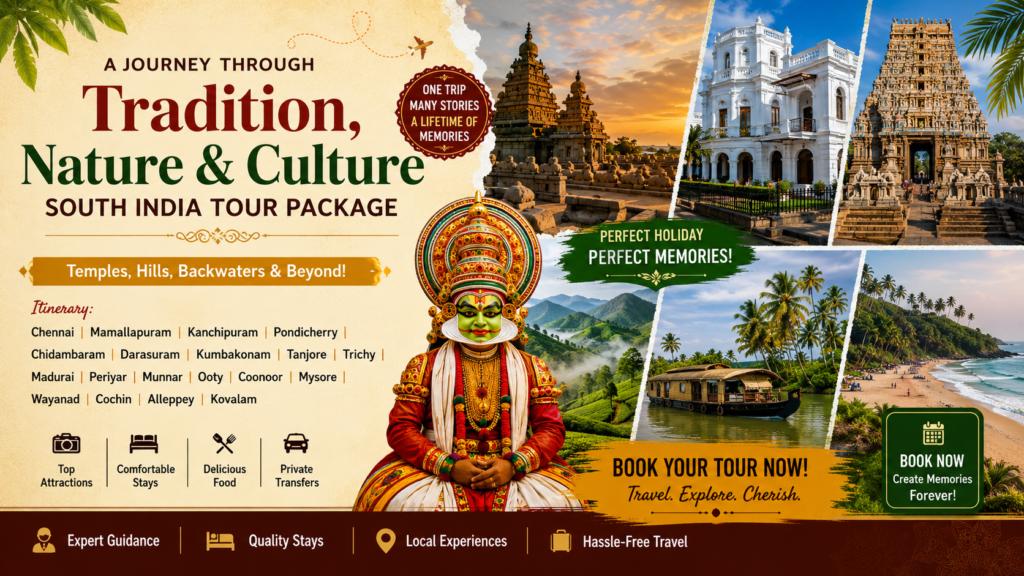
Quick answer: The Great South India tour 26 days itinerary runs through Chennai, Mamallapuram, Kanchipuram, Pondicherry, Chidambaram, Darasuram, Kumbakonam, Tanjore, Trichy, Madurai, Periyar, Munnar, Ooty, Coonoor, Mysore, Wayanad, Cochin, Alleppey, and Kovalam — a route that links Tamil Nadu’s Dravidian temple heartland with Kerala’s hill stations and backwaters, plus a detour into Karnataka via Mysore.
Why Choose a 26-Day South India Itinerary
South India is not a region you rush. Unlike a five- or seven-day city-hopping trip, a 26-day format gives you enough time to actually absorb what makes the south different from the rest of the country: a continuous, still-living Dravidian culture stretching back over a thousand years, rather than a handful of photo stops.
A shorter trip forces you to choose between temples or hill stations or backwaters. The 26-day format removes that trade-off. You get the Pallava rock-cut shrines of Mamallapuram, the Chola-era temple towns of Thanjavur and Kumbakonam, the Pandyan capital of Madurai, the tea-covered hills of Munnar and Ooty, and the palm-fringed canals of Alleppey — all in a single, unhurried loop that ends on the beaches of Kovalam.
Full Itinerary Route: Chennai to Kovalam
Here is the day-by-day logic behind the Great South India tour 26 days route, region by region.
1. Chennai — The Gateway City
Most tours begin in Chennai, the capital of Tamil Nadu and the main international gateway to the south. Expect a day or two here to adjust, visit colonial-era landmarks, and get oriented before heading south along the coast.
2. Mamallapuram (Mahabalipuram)
This UNESCO World Heritage coastal town was once a major port of the Pallava dynasty. Its rock-cut shrines, the Shore Temple, and the giant open-air relief carvings represent some of the earliest and most ambitious stone architecture in South India.
3. Kanchipuram
Known as one of India’s seven sacred cities, Kanchipuram holds the largest concentration of Pallava-era temples anywhere. It is also famous for handwoven silk sarees, so it’s worth building in time for both temple visits and a workshop stop.
4. Pondicherry
A former French colonial enclave, Pondicherry offers a distinct change of pace — tree-lined boulevards, colonial villas, and a Franco-Tamil culture that feels unlike anywhere else on the route.
5. Chidambaram, Darasuram, and Kumbakonam
These three towns form the core of Chola temple architecture. Chidambaram’s Nataraja Temple, Darasuram’s Airavatesvara Temple, and Kumbakonam’s cluster of Chola-era shrines together explain why this stretch is sometimes called the temple corridor of Tamil Nadu.
6. Tanjore (Thanjavur)
The ancient capital of the Chola kings and home to the Brihadeeswarar Temple, a UNESCO World Heritage Site and one of the largest temples in India. This is the historical high point of the Chola section of the tour.
7. Trichy (Tiruchirappalli)
Trichy’s Rockfort Temple and the vast Sri Ranganathaswamy Temple at nearby Srirangam — the largest functioning Hindu temple complex in the world — make this a key stop before heading further south.
8. Madurai
Madurai, the capital of the Pandyan Empire, is considered the oldest continuously inhabited city in South Asia. The Meenakshi Amman Temple, with its towering painted gopurams, is the centerpiece of the visit and one of the most photographed sites in the entire itinerary.
9. Periyar
From the temple towns, the route climbs into Kerala’s Western Ghats. Periyar Wildlife Sanctuary offers boat safaris on Periyar Lake and a first taste of the tropical, forested landscape that defines the rest of the trip.
10. Munnar
Munnar’s rolling tea estates, cool climate, and misty hills mark a sharp contrast to the temple towns of Tamil Nadu. It’s typically one of the more relaxed stretches of the 26-day itinerary.
11. Ooty and Coonoor
Known as hill stations of the Nilgiris, Ooty and Coonoor add colonial-era charm, botanical gardens, and more tea country to the route, often connected by the narrow-gauge Nilgiri Mountain Railway.
12. Mysore
A short detour into Karnataka, Mysore is known for its opulent palace and its role as a former royal capital — a useful contrast to the Tamil and Kerala history covered earlier in the trip.
13. Wayanad
Back in Kerala, Wayanad offers dense forests, spice plantations, and wildlife — a quieter, greener counterpoint before the tour heads to the coast.
14. Cochin (Kochi)
Cochin blends Portuguese, Dutch, and British colonial influences with Kerala’s fishing culture. The Chinese fishing nets along the waterfront are one of the most recognizable images of Kerala tourism.
15. Alleppey (Alappuzha)
This is the backwater heart of the trip. A stay on a traditional Kerala houseboat, cruising through palm-lined canals, is often cited as the single most memorable part of a South India tour.
16. Kovalam
The itinerary closes on the coast at Kovalam, near Thiruvananthapuram, known for its crescent beaches and lighthouse views — a fitting, relaxed end point after 26 days of temples, hills, and backwaters.
What Makes This Itinerary Different
Dravidian Culture, Not Just Monuments
The route is built around the three dynasties that shaped southern history — the Pallavas, Cholas, and Pandyas — rather than treating temples as isolated stops. Kanchipuram represents the largest Pallava-period sites, Thanjavur the Chola capital, and Madurai the Pandyan capital, so travelers see the historical arc, not just a checklist of monuments.
A Balance of Culture and Nature
Roughly the first half of the trip is temple- and history-focused (Chennai through Madurai), while the second half shifts into nature and relaxation (Periyar through Kovalam). This structure prevents temple fatigue and gives the trip a natural rhythm.
Living Traditions, Not Just Ruins
Because many of the temples on this route remain active places of worship, travelers witness real rituals, festivals, and daily customs rather than viewing static heritage sites — a distinction that matters to anyone seeking cultural immersion over sightseeing alone.
Frequently Asked Questions
How long is the Great South India tour? The tour runs 26 days, covering Tamil Nadu, Kerala, and a portion of Karnataka.
Which cities are included in the Great South India tour 26 days itinerary? Chennai, Mamallapuram, Kanchipuram, Pondicherry, Chidambaram, Darasuram, Kumbakonam, Tanjore, Trichy, Madurai, Periyar, Munnar, Ooty, Coonoor, Mysore, Wayanad, Cochin, Alleppey, and Kovalam.
Does the tour include a houseboat stay in Kerala? Yes. A traditional houseboat cruise through the Alleppey backwaters is one of the core experiences on this itinerary.
Is this itinerary suitable for first-time visitors to South India? Yes. The route is designed as an introduction to South India’s Dravidian temple culture, hill stations, and coastal Kerala, making it well suited to travelers exploring the region for the first time.
What is the historical significance of the temple towns on this route? Kanchipuram, Thanjavur, and Madurai each served as capitals or major centers for the Pallava, Chola, and Pandyan dynasties respectively, making the route a chronological journey through South India’s medieval history.
Does the tour cover both Tamil Nadu and Kerala? Yes, along with a short detour into Karnataka for Mysore,
giving the trip coverage across three South Indi
an states.
Planning Your Trip
A 26-day itinerary of this scope works best as an individual or small-group trip rather than a rigid package tour, since the pace allows for flexibility at each stop — extra time in Madurai for the temple’s evening rituals, or an additional day in Munnar if the weather is good for trekking. Anyone researching a South India should treat this route as a template: the sequence of Pallava, Chola, and Pandyan sites followed by Kerala’s hills and backwaters is what makes the trip cohere, even if individual stop durations are adjusted.
South India rewards travelers who slow down. Twenty-six days is enough time to see the region not as a series of postcard stops, but as a continuous story — from Pallava stone carvers to Chola temple builders, from Pandyan kings to Kerala’s fishing villages and colonial ports — ending, appropriately, on a beach at the southern tip of the country.
Disclaimer: This itinerary is published by https://xuzpost.com/ as a travel guide for informational purposes only. While we strive to keep the information accurate and up to date, travel schedules, entry fees, and local conditions may change. Explore more travel guides, itineraries, and destination tips on https://travelmarttm.com/grosse-suedindien-reise-26-tage/