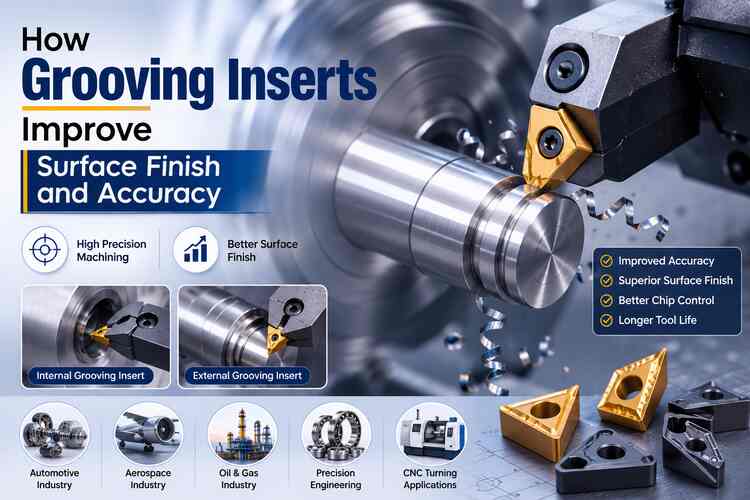
CNC turning is honestly one of the most used machining processes today in modern manufacturing. You see it in automotive and aerospace parts, but also for heavy engineering items, where you really need precision turning operations that stay consistent. That’s why you need cutting tools that do more than “work” they have to deliver reliable results, even when the job gets demanding. In that situation, a grooving insert kind of becomes a big deal, because it helps create accurate grooves, slots, and recesses, while still keeping a good surface finish and holding dimensional accuracy pretty well.
But just having a grooving insert alone is not really enough, because best machining results depend on a bunch of things that work together. Tool selection matters, machining parameters matter too, and insert geometry is a factor as well. On top of that, maintenance practices keep everything stable, so you get better efficiency and longer tool life. When manufacturers stick to proven best practices, they usually see less downtime, better productivity, and in many cases lower overall machining costs, even if the schedule is tight.
What Is a Grooving Insert?
A grooving insert is basically an indexable carbide cutting insert made for grooving, parting, and profiling tasks on CNC lathes and turning centers. They’re built with specific cutting geometries so the material removal stays accurate, but the cutting performance also stays stable during the operation.
Also, compared with more conventional cutting tools, grooving inserts can be swapped out fast, which makes them a practical and cost-effective solution for high-volume production runs.
Why Proper Usage Matters
Even premium inserts can fail prematurely if they are not used correctly.
Proper machining practices help:
- Improve surface finish
- Maintain dimensional accuracy
- Increase insert life
- Reduce machine downtime
- Lower production costs
- Improve machining consistency
Using the right machining strategy ensures maximum return on investment.
Best Practice 1: Select the Right Insert Grade
Every workpiece material requires a suitable carbide grade.
A premium carbide grooving insert offers excellent wear resistance and performs well under high cutting temperatures.
When selecting an insert, consider:
- Steel
- Stainless steel
- Cast iron
- Aluminum alloys
- Super alloys
Choosing the correct carbide grade reduces edge chipping and extends tool life.
Best Practice 2: Choose the Correct Insert Geometry
Insert geometry directly influences cutting performance.
Different groove widths, depths, and machining operations require different insert designs.
Selecting the proper geometry helps:
- Improve chip control
- Reduce cutting pressure
- Minimize vibration
- Produce cleaner grooves
Always match the insert geometry to the machining application.
Best Practice 3: Use the Correct CNC Grooving Insert
A high-quality CNC grooving insert is designed to provide repeatable accuracy under demanding production conditions.
Modern inserts feature:
- Precision-ground cutting edges
- Advanced chip breakers
- High wear resistance
- Better thermal stability
Premium inserts maintain consistent machining quality throughout long production runs.
Best Practice 4: Optimize Cutting Parameters
Incorrect cutting parameters are one of the leading causes of premature insert wear.
Manufacturers should carefully adjust:
- Cutting speed
- Feed rate
- Depth of cut
- Coolant flow
Following the manufacturer’s recommended machining data improves insert life and machining quality.
Best Practice 5: Ensure Proper Tool Holding
A rigid grooving insert tool setup is essential for achieving accurate machining.
Poor tool clamping can result in:
- Chatter
- Tool deflection
- Poor surface finish
- Insert breakage
Always use precision tool holders and ensure the insert is securely mounted before machining begins.
Best Practice 6: Improve Chip Control
Efficient chip evacuation prevents heat buildup and protects the cutting edge.
Good chip control helps:
- Reduce insert wear
- Prevent chip scratching
- Improve surface finish
- Increase machining stability
Modern grooving inserts are equipped with advanced chip-breaker geometries designed for efficient chip flow.
Best Practice 7: Select the Right Insert for the Operation
Different machining operations require different insert styles.
An internal grooving insert is ideal for machining grooves inside bores, where access is limited and precision is critical.
An external grooving insert is designed for machining grooves on shafts, cylinders, and external diameters, providing excellent rigidity and cutting stability.
Selecting the correct insert type improves machining efficiency while reducing unnecessary wear.
Best Practice 8: Perform Regular Tool Inspection
Insert condition should be checked before every machining cycle.
Look for:
- Edge chipping
- Cracks
- Excessive wear
- Built-up edge
- Insert movement
Replacing worn inserts before failure prevents damage to both the workpiece and the tool holder.
Best Practice 9: Use High-Quality CNC Tooling
Today’s grooving inserts for CNC applications are designed to work with advanced machining centers.
Combining premium inserts with reliable CNC tools provides:
- Better machining accuracy
- Higher production speed
- Lower operating costs
- Longer tool life
- Improved repeatability
High-quality tooling delivers better long-term value than low-cost alternatives.
Best Practice 10: Apply Proper Coolant
Coolant reduces cutting temperature and friction while improving chip evacuation.
Benefits include:
- Longer insert life
- Better surface finish
- Reduced thermal cracking
- Improved machining stability
Using the correct coolant pressure and direction ensures consistent machining performance.
Common Mistakes to Avoid While Using Grooving Inserts
Even experienced machinists can reduce machining quality by overlooking a few important practices. Avoiding these mistakes helps improve insert life, surface finish, and production efficiency.
1. Using Worn Inserts for Too Long
A worn cutting edge increases cutting forces and produces rough grooves. Replace inserts before excessive wear affects the workpiece.
2. Incorrect Feed and Speed
Using excessive cutting speed creates unnecessary heat, while very low feed rates can cause rubbing instead of proper cutting. Always follow the recommended cutting parameters.
3. Poor Workpiece Clamping
Loose clamping leads to vibration, poor dimensional accuracy, and insert chipping. A rigid setup is essential for precision machining.
4. Ignoring Coolant Maintenance
Blocked coolant nozzles or insufficient coolant flow increase tool temperature and shorten insert life.
5. Choosing the Wrong Insert Geometry
Different groove widths and materials require different insert designs. Using the wrong insert reduces machining efficiency and increases production costs.
Applications of Grooving Inserts in CNC Turning
Grooving inserts are widely used across industries where precision and repeatability are essential.
Automotive Industry
They are used to machine shafts, pistons, bearing housings, brake components, and transmission parts with consistent accuracy.
Aerospace Industry
Aircraft components require precision grooves with excellent dimensional control. Grooving inserts provide the accuracy needed for lightweight alloys and high-performance materials.
Oil & Gas Industry
Grooving operations are essential for manufacturing valves, couplings, pipe fittings, and sealing components used in harsh operating environments.
Heavy Engineering
Mining equipment, hydraulic cylinders, and industrial machinery require accurately machined grooves for reliable performance.
General Manufacturing
Machine shops use grooving inserts for producing precision components with improved productivity and reduced machining costs.
Tips for Maximizing Insert Performance
To achieve the best machining results, manufacturers should follow these recommendations:
- Select the correct insert grade for the workpiece material.
- Use rigid tool holders.
- Monitor insert wear regularly.
- Maintain proper coolant flow.
- Optimize cutting parameters.
- Replace damaged inserts immediately.
- Keep machines properly maintained.
- Follow manufacturer-recommended machining data.
These simple practices improve productivity while extending insert life.
Benefits of Following Best Practices
Implementing the correct machining techniques provides several long-term advantages:
- Better surface finish
- Improved dimensional accuracy
- Longer insert life
- Reduced machine downtime
- Higher productivity
- Lower tooling costs
- Better chip control
- Consistent machining quality
- Improved operational efficiency
These benefits help manufacturers increase profitability while maintaining high production standards.
Conclusion
Using the right grooving insert correctly is just as important as selecting a high-quality cutting tool. By choosing the appropriate insert grade, optimizing cutting parameters, maintaining proper coolant flow, and performing regular inspections, manufacturers can significantly improve machining accuracy, extend tool life, and reduce production costs.
Following these best practices not only improves surface finish and machining consistency but also increases overall productivity across CNC turning operations.
Jaibros offers a comprehensive range of premium CNC machining solutions, including grooving inserts, carbide inserts, turning tools, milling cutters, drilling tools, and precision measuring instruments. Designed for performance, durability, and reliability, Jaibros products help manufacturers achieve higher machining efficiency, lower operating costs, and consistent production quality.
Frequently Asked Questions (FAQs)
1. What is the purpose of a grooving insert in CNC turning?
A grooving insert is used to machine precise grooves, slots, and recesses on internal and external surfaces while maintaining high accuracy and surface quality.
2. How do carbide grooving inserts improve machining performance?
Carbide grooving inserts provide better wear resistance, longer tool life, higher cutting speeds, and improved surface finish compared to conventional cutting tools.
3. What is the difference between internal and external grooving inserts?
Internal grooving inserts machine grooves inside bores, while external grooving inserts are used for machining grooves on the outer diameter of a workpiece.
4. How can I increase the life of a grooving insert?
Use the correct cutting parameters, ensure proper coolant flow, maintain rigid tool holding, inspect inserts regularly, and replace worn inserts before failure.
5. Are grooving inserts suitable for high-volume CNC production?
Yes. Modern grooving inserts are designed for high-speed CNC turning applications and provide excellent repeatability, productivity, and cost efficiency.