Many organizations invest significant budgets in dealer rewards, retailer incentives, distributor schemes, and channel engagement initiatives. However, one question continues to challenge business leaders:
Is the investment creating measurable business value?
Without proper loyalty program ROI measurement, companies often struggle to determine whether their channel engagement strategy is driving sustainable growth or simply increasing reward expenses. At the same time, businesses comparing a loyalty platform vs incentive program frequently discover that long-term loyalty platforms produce stronger engagement, better data visibility, and more consistent business outcomes.
Why ROI Matters in Channel Loyalty
A loyalty initiative should never be measured solely by the value of rewards distributed. The real success lies in how effectively it influences partner behaviour.
Key performance indicators include:
- Increase in repeat purchases
- Higher dealer participation
- Growth in market share
- Better partner retention
- Improved product mix
- Faster sales growth
- Reduced inactive channel partners
A structured approach to loyalty program ROI measurement enables organizations to evaluate both financial returns and long-term relationship value rather than focusing only on short-term sales spikes. Businesses that align program metrics with strategic objectives are more likely to create durable value.
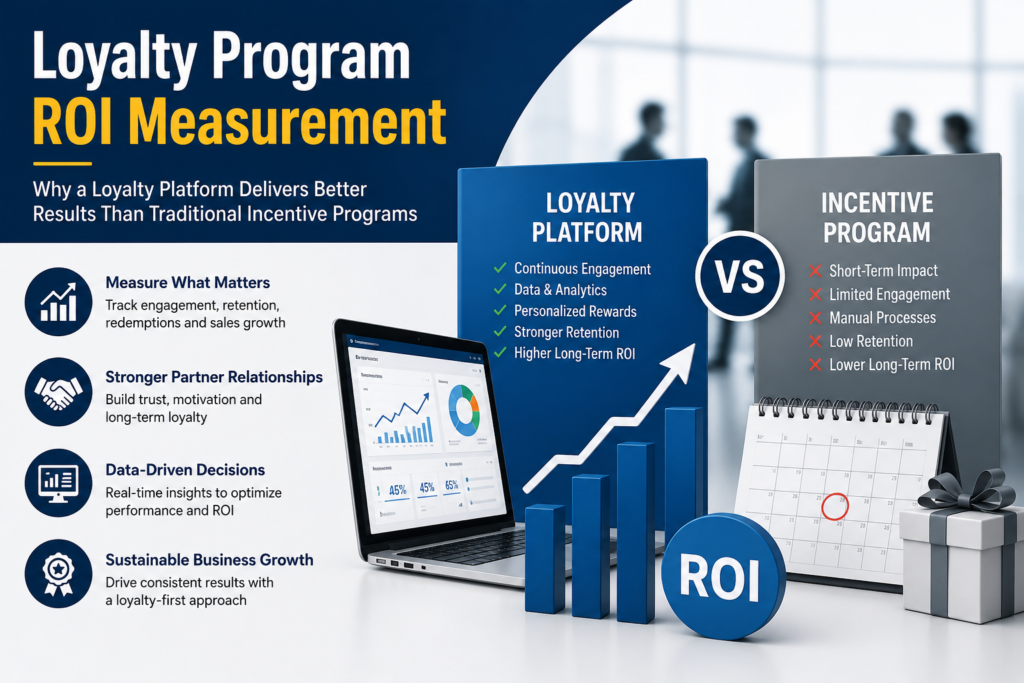
Loyalty Platform vs Incentive Program: Understanding the Difference
Traditional incentive programs are generally designed around short-term campaigns. Rewards are offered for achieving specific sales targets during a limited period.
While these campaigns can generate temporary improvements, they often fail to build lasting engagement.
A modern loyalty platform, on the other hand, focuses on continuous participation by rewarding consistent behaviour instead of isolated transactions.
Traditional Incentive Program
- Short campaign duration
- Limited partner interaction
- Manual administration
- Basic reporting
- Rewards based mainly on sales targets
Modern Loyalty Platform
- Year-round engagement
- Digital reward management
- Automated communication
- Advanced analytics
- Personalized experiences
- Behaviour-driven recognition
- Long-term relationship building
This comparison clearly highlights why businesses evaluating a loyalty platform vs incentive program increasingly prefer technology-driven loyalty ecosystems.
Measuring ROI Beyond Revenue
Many companies calculate ROI using only incremental sales. Although revenue growth is important, it should not be the only success metric.
Effective loyalty program ROI measurement should include:
Dealer Retention
Retaining experienced dealers usually costs less than constantly recruiting new partners.
Active Participation
High engagement rates indicate that channel partners see genuine value in the program.
Redemption Behaviour
Consistent reward redemption reflects healthy program activity and ongoing partner involvement.
Sales Consistency
Rather than rewarding occasional volume spikes, modern loyalty platforms encourage sustainable purchasing behaviour.
Market Penetration
Improved geographic reach and stronger product availability often indicate successful partner engagement.
Organizations that evaluate these metrics gain a much clearer understanding of program performance than those relying only on monthly sales figures.
Technology Makes ROI Easier to Measure
Modern loyalty platforms centralize partner data into a single dashboard.
Businesses can monitor:
- Real-time transactions
- Reward liabilities
- Dealer rankings
- Redemption trends
- Product performance
- Territory-wise growth
- Engagement scores
This visibility enables management teams to make faster, data-driven decisions and optimize future campaigns.
Why Incentive Programs Often Lose Momentum
Many traditional incentive campaigns experience declining participation after the initial launch because partners lose motivation once the campaign ends.
Common reasons include:
- Complicated rules
- Delayed reward fulfilment
- Lack of communication
- No personalized engagement
- Limited transparency
A well-designed loyalty platform addresses these challenges through continuous interaction, instant updates, digital rewards, and performance tracking.
Choosing the Right Strategy
When evaluating a loyalty platform vs incentive program, organizations should consider long-term business objectives rather than immediate sales increases.
If the goal is to:
- Strengthen dealer relationships
- Improve distributor engagement
- Increase retailer loyalty
- Build sustainable channel growth
- Measure measurable business outcomes
then a comprehensive loyalty platform generally provides greater value than isolated incentive campaigns.
Final Thoughts
Business growth depends on strong relationships with channel partners, and those relationships require more than occasional rewards. Effective loyalty program ROI measurement helps organizations understand whether their investment is improving engagement, increasing retention, and generating long-term profitability.
Instead of relying solely on temporary incentive campaigns, businesses should evaluate the broader impact of a digital loyalty platform that supports continuous engagement, transparent reporting, and measurable business performance.
For organizations seeking scalable channel engagement, modern loyalty platforms offer the visibility, automation, and analytics required to maximize returns while strengthening partner loyalty over time.