Studded Leather Jackets for Women: Wear Hardware Without Overdoing It
I wore my first studded leather jacket to a Tuesday lunch and got a compliment from a woman in her sixties who had zero interest in alternative fashion. That told me something useful: the jacket worked because the hardware was restrained — shoulder studs only, rounded not spiked, arranged in a single clean row. It read as detail, not declaration.
That distinction is what most women shopping for studded leather jackets miss. They see a jacket they love on someone else, often in a photo or on social media, and can’t quite explain why it works in that context but feels like too much on them. The answer is almost always stud placement and density, not the choice to buy studded leather at all.
Why Placement Changes Everything About Wearability
Studs function differently depending on where they live on a jacket. Understanding this is the difference between a piece that becomes a wardrobe staple and one that only comes out for concerts.
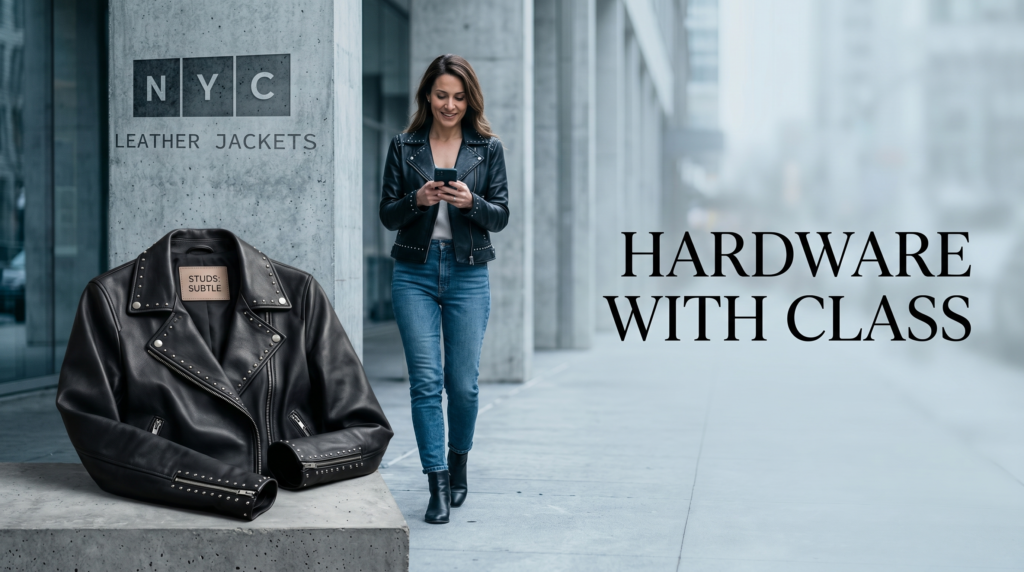
Shoulder and collar studs are the most versatile configuration. They occupy the structural edges of the jacket — areas that naturally carry visual interest — without covering the body of the leather. A single row of rounded studs along the shoulder seam or collar snap reads as elevated detail. From fifteen feet away, it looks like a well-made jacket with interesting hardware. This type of studded leather jacket womens can pair with jeans and a tucked-in shirt for a Thursday coffee run without any effort.
Chest or lapel studs cross into the moderate statement category. They’re visible at conversational distance and make the hardware part of what someone sees when they’re talking to you. Still wearable in everyday contexts, but the outfit beneath it needs to be simpler — avoid loud prints or competing accessories.
All-over or spike configurations are full statements. I mean this as a description, not a warning. An all-over studded jacket with pyramid or spike hardware is a genuinely beautiful thing — but it operates the same way a sequined top does. The jacket is the outfit. Everything else is support.
Matching Stud Intensity to Your Actual Life
The most useful question to ask before buying isn’t “is this too much?” It’s “what does my Tuesday look like?”
Work-adjacent casual (office environments with flexible dress codes, creative industries, client-facing roles with latitude): shoulder or collar studs only. Rounded pyramid hardware in silver or aged brass. Paired with tailored trousers or dark slim jeans and a simple crewneck. The jacket is the interest; the rest of the outfit creates the context.
Weekend wear (errands, brunch, casual social outings): moderate chest or shoulder-plus-sleeve configurations work well here. A jacket with studs at the shoulders and upper arms reads as intentional and pulled-together rather than costumey in casual weekend environments. Pair with clean straight-leg jeans, a band tee or solid long-sleeve, and ankle boots.
Evening out and bar or venue settings: this is where a higher stud density earns its keep. A jacket with all-over studs worn over a fitted black dress with simple block-heeled boots is a complete, confident look. The hardware does the work; the clothes underneath should be quiet.
Festival context: spike hardware, all-over coverage, or mixed stud and ring hardware configurations make sense here because the visual baseline of the environment is already elevated. This is the one context where a heavily hardware’d jacket almost never reads as overdone.
The Quality Questions That Get Buried Under the Hardware
Here’s what gets overlooked when a jacket is covered in studs: the leather underneath still determines how the jacket wears and ages.
Stud attachment method is the most important hardware quality marker. Riveted studs — where the post passes through the leather and is folded or capped on the interior — are permanent and secure. Glued studs, which are more common in budget and fast-fashion versions, loosen with repeated wear, catch on fabric, and eventually fall off. You usually can’t tell from product photos which method is used, which makes return policy relevant here too.
The leather itself: a split leather or bonded leather base beneath attractive hardware is the most common shortcut in the studded jacket category. Split leather is the inner layer of a hide after the grain has been separated — it’s weaker, less breathable, and won’t develop the character over time that full-grain leather does. A womens black leather jacket covered in studs can cost $150 or $400+ depending on the leather base. The studs look the same in photos; the jacket does not wear the same over two years.
One specific thing to look for: how the leather behaves around the stud bases. On quality leather, the leather surface should be smooth and consistent around each stud post. On cheaper material, you’ll often see slight puckering or uneven surfaces around the hardware — a sign the leather wasn’t thick or supple enough to accept the attachment cleanly.
Before You Buy: The Lifestyle Match Question
A common mistake I see is buying the most dramatic version of a thing you like, on the assumption that you’ll “grow into” wearing it confidently. With studded leather jackets, that calculation often reverses — the more restrained version gets worn more, and the more dramatic piece gets worn less, regardless of how much someone initially loved the look.
NYC Leather Jackets makes studded styles from full grain leather with premium riveted hardware — and offers made-to-measure sizing. That last point matters more than people expect with heavily hardware’d jackets, because studs amplify fit problems. A jacket that pulls across the shoulders looks worse in hardware than in plain leather; the studs draw the eye exactly where the fit is off. Knowing the jacket is built to your measurements before it ships — with free shipping and 30-day returns — removes the biggest variable from a bold purchase.
The decision framework that’s worked for my clients: buy one intensity level below where you think you want to land. If you’ve been drawn to all-over spike jackets, try a shoulder-stud or mixed configuration first. If that registers as too subtle after six months of wearing it, you’ll have a clearer sense of what you actually want — and you’ll have been wearing the jacket in the meantime rather than leaving it on a hook.
The One Configuration Worth Breaking the Rule For
All that said: if you see an all-over studded jacket that stops you, and your actual lifestyle is flexible enough to wear it — buy it. The goal isn’t to wear studded leather conservatively. The goal is to wear it in a way that feels like yours, not like a costume borrowed from another version of yourself.
The best studded leather jacket is the one you reach for without thinking twice. Getting the intensity level right is how you make that happen.