Internal Combustion Engine (ICE) Market: Steady Growth Amid Transition to Cleaner Technologies
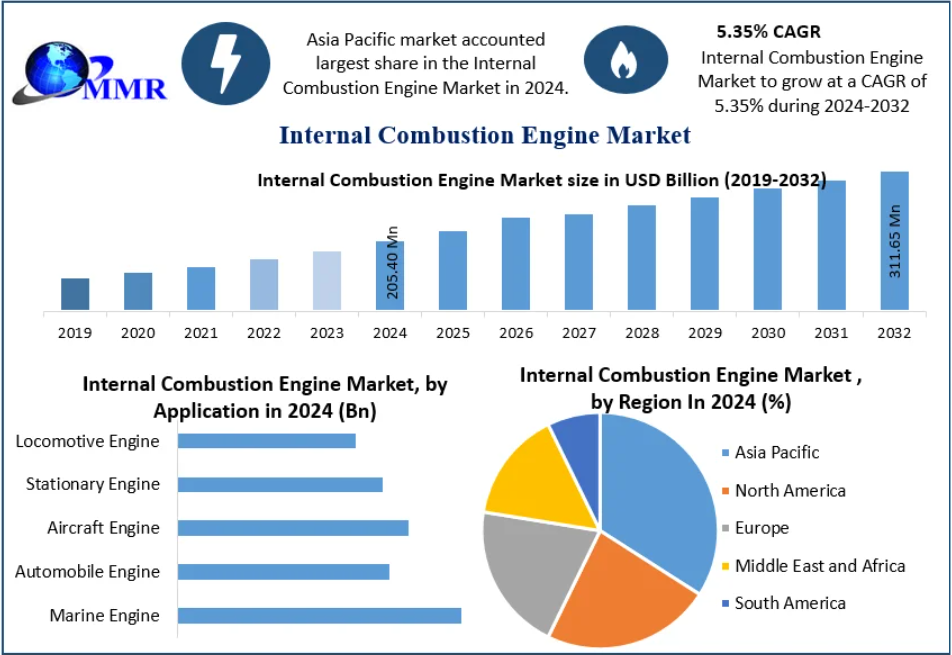
The global Internal Combustion Engine (ICE) Market was valued at USD 205.40 million in 2024 and is projected to reach approximately USD 311.65 million by 2032, growing at a CAGR of 5.35% during the forecast period.
Market Overview
An internal combustion engine (ICE) is a mechanical system that generates power through the combustion of fuel—such as petrol, diesel, or gas—inside the engine chamber. The combustion process produces high-temperature and high-pressure gases, which drive pistons or turbines to perform mechanical work.
ICE technology has long been the backbone of transportation and industrial machinery, powering automobiles, aircraft, marine vessels, and stationary equipment. Despite the growing shift toward electrification, ICE systems continue to hold significant relevance due to their reliability, established infrastructure, and versatility.
To know the most attractive segments, click here for a free sample of the report:https://www.maximizemarketresearch.com/request-sample/23024/
Impact of COVID-19
The COVID-19 pandemic had a mixed impact on the ICE market. Global lockdowns disrupted manufacturing activities, supply chains, and demand across automotive and industrial sectors. However, the extent of the impact varied by region depending on the severity and duration of restrictions.
In the post-pandemic phase, the market has gradually recovered, supported by renewed industrial activity and increased demand for transportation and power generation solutions.
Market Drivers
- Demand for Fuel-Efficient and Low-Emission Engines
Increasing environmental concerns and stricter emission regulations are pushing manufacturers to develop more efficient ICE systems. Innovations aimed at reducing fuel consumption and emissions are playing a key role in sustaining market growth.
- Technological Advancements in Combustion
Emerging technologies such as Homogeneous Charge Compression Ignition (HCCI) and low-temperature combustion systems are enhancing engine efficiency while lowering emissions. These advancements are extending the lifecycle of ICE technology in a rapidly evolving energy landscape.
- Hybridization and Multi-Fuel Capabilities
The integration of ICEs with hybrid systems is creating new growth opportunities. Engines capable of operating on multiple fuels are gaining traction, especially in regions where fuel availability and cost vary significantly.
Market Challenges
- Shift Toward Electrification
The increasing adoption of electric vehicles (EVs) poses a long-term challenge to ICE demand, particularly in passenger vehicle segments.
- Stringent Environmental Regulations
Governments worldwide are implementing stricter emission norms, which increase compliance costs for ICE manufacturers.
- Volatility in Fuel Prices
Fluctuating fuel prices can influence consumer preferences and impact demand for traditional engine systems.
Segment Insights
By Fuel Type
Petroleum-Based Engines (Dominant Segment)
Petroleum engines, including gasoline and diesel variants, accounted for over 82% of the market share in 2024.
- Gasoline engines held a significant portion due to advantages such as lower noise levels, smoother operation, and relatively lower fuel costs.
- Diesel engines continue to be widely used in heavy-duty and industrial applications due to higher efficiency and torque output.
By Engine Cycle
- 4-Stroke Engines: Widely used due to higher efficiency and lower emissions
- 2-Stroke Engines: Preferred in lightweight and compact applications
By Application
Automobile Engines remain the largest segment, driven by global vehicle demand.
Other key applications include:
- Marine engines
- Aircraft engines (gaining traction due to lightweight design requirements)
- Stationary engines (power generation, industrial use)
- Locomotive engines
The aircraft engine segment, in particular, is witnessing growth due to advancements in compact design and fuel efficiency.
To know the most attractive segments, click here for a free sample of the report:https://www.maximizemarketresearch.com/request-sample/23024/
Regional Analysis
Asia-Pacific (Leading Region)
Asia-Pacific dominated the ICE market in 2024 and is expected to maintain its leadership through 2032. Growth is driven by:
- Expanding automotive industry
- Rising demand for two-wheelers and passenger vehicles
- Increased use of generators and industrial machinery
- Rapid urbanization and infrastructure development
Countries such as China and India are major contributors due to strong manufacturing bases and high population density.
North America and Europe
These regions are focusing on cleaner and more efficient ICE technologies while gradually transitioning toward electrification. Hybrid engines are gaining popularity as a bridge between conventional and electric mobility.
Competitive Landscape
The ICE market is highly competitive, with global players focusing on innovation, efficiency, and sustainability. Leading companies are investing in:
- Advanced combustion technologies
- Hybrid engine systems
- Emission reduction solutions
- Strategic partnerships and acquisitions
Key Players Include:
- Volkswagen AG
- Toyota Industries Corporation
- BMW
- Rolls-Royce
- Navistar International Corporation
- MAN SE
- Kirloskar Oil Engines Ltd.
- Detroit Diesel
- GE Power
- Ford Motor Company
- Cummins Inc.
- Caterpillar Inc.
- Yamaha Motor Company
- Ashok Leyland
- AGCO Corporation
Market Outlook
While the global transition toward electric mobility is accelerating, the ICE market is expected to maintain steady growth in the medium term, supported by:
- Continued demand in developing economies
- Expansion of hybrid vehicle technologies
- Ongoing improvements in fuel efficiency and emissions control
- Strong presence in industrial and heavy-duty applications
In the coming years, the evolution of ICE technology will focus on cleaner, smarter, and more adaptable engines, ensuring its relevance in a rapidly transforming mobility ecosystem.