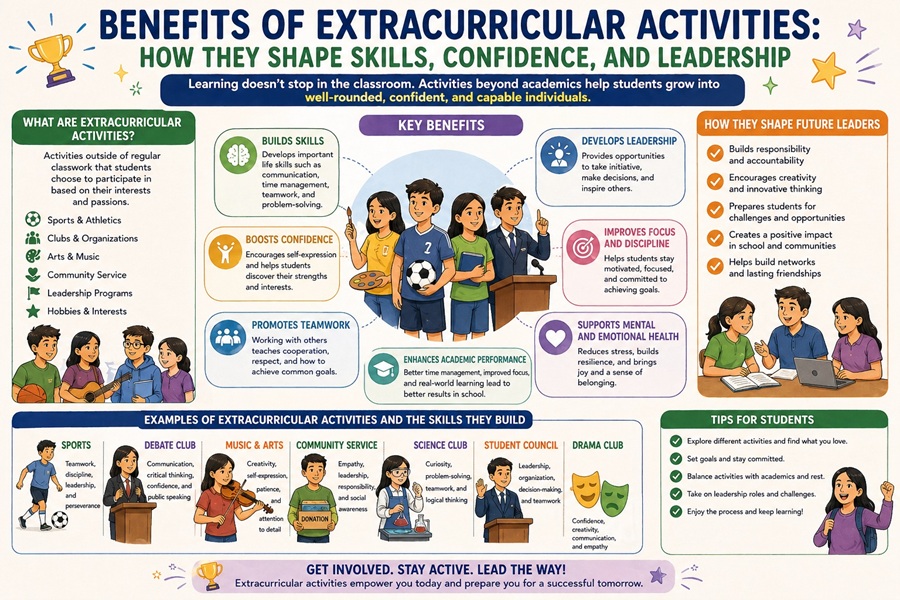
While the classroom is the primary center for academic learning, a child’s true potential often flourishes beyond the four walls of a schoolroom. Whether it is sports, music, debating, or community service, the benefits of extracurricular activities extend far beyond simple recreation. These pursuits act as a laboratory for life, helping children experiment with their abilities and discover their passions. At CRY India, we believe that a holistic approach to childhood development must include diverse opportunities for play and creative expression.
1. Developing Essential Life Skills
One of the most immediate benefits of extracurricular activities is the acquisition of “soft skills” that are rarely covered in textbooks. For instance, being part of a football team or a theater troupe teaches a child the value of teamwork and cooperation. They learn that collective success often requires individual sacrifice and clear communication.
Furthermore, these activities are excellent for time management. Balancing rehearsals or practice sessions with homework requires a high level of discipline. Children who engage in extracurriculars early on tend to become more organized and resilient adults, capable of handling multiple responsibilities without feeling overwhelmed.
2. Boosting Self-Confidence and Self-Esteem
For many children, the traditional academic environment can be intimidating. A child who struggles with mathematics might find their “spark” in a painting class or on a basketball court. Achieving a goal outside the classroom—be it mastering a difficult song or winning a local tournament—provides a massive boost to a child’s self-esteem.
This newfound confidence often spills over into their academic life. When a child feels capable and valued in one arena, they are more likely to approach other challenges with a “can-do” attitude. CRY India works to ensure that children from all socio-economic backgrounds have access to these confidence-boosting platforms.
3. Cultivating Leadership and Responsibility
Leadership is not a trait people are born with; it is a skill that is practiced. Extracurricular activities provide safe spaces for children to take on leadership roles. Whether it is captaining a team, heading a student club, or organizing a charity drive, children learn how to motivate others, make decisions under pressure, and take responsibility for outcomes.
The benefits of extracurricular activities include teaching children how to lead with empathy. They learn to listen to different perspectives and navigate conflicts, which are essential qualities for the leaders of tomorrow.
4. Enhancing Social Connections
Socialization is a core pillar of development. Through these activities, children meet peers with similar interests, often outside their immediate social or economic circles. This diversity helps reduce social barriers and fosters a sense of community. For marginalized children, these programs can be a lifeline, providing a sense of belonging and a support system that encourages them to stay in school and dream bigger.
The CRY India Perspective
At CRY India, we advocate for the “Right to Play” as a fundamental part of child rights. We believe that the benefits of extracurricular activities should not be a privilege for the few, but a standard part of every child’s journey. By supporting diverse interests, we aren’t just creating better students; we are shaping well-rounded, confident, and empathetic human beings who are ready to lead society forward.
Frequently Asked Questions (FAQs)
1. What are the most common benefits of extracurricular activities for young children? The most common benefits include improved social skills, better physical health, increased self-confidence, and the development of hobbies that can last a lifetime.
2. Can extracurricular activities help with college admissions? Yes. Universities often look for well-rounded individuals. Participation in sports, arts, or leadership roles demonstrates that a student has discipline, can work in a team, and has interests beyond just grades.
3. How do I choose the right activity for my child? The best approach is to follow the child’s natural interests. Let them try different things—from coding to swimming—until they find something they are genuinely passionate about. Forced participation often negates the positive psychological benefits.
4. How does CRY India facilitate extracurricular learning in underserved communities? CRY India partners with local organizations to set up community centers, sports programs, and art workshops, ensuring that children in remote or impoverished areas have a space to play and learn.
5. Do these activities distract children from their studies? On the contrary, research shows that children involved in extracurriculars often have better concentration and higher academic scores because they learn how to manage their time more effectively.
Must Read: 5 Severe Consequences of Child Labour | CRY India Advocacy