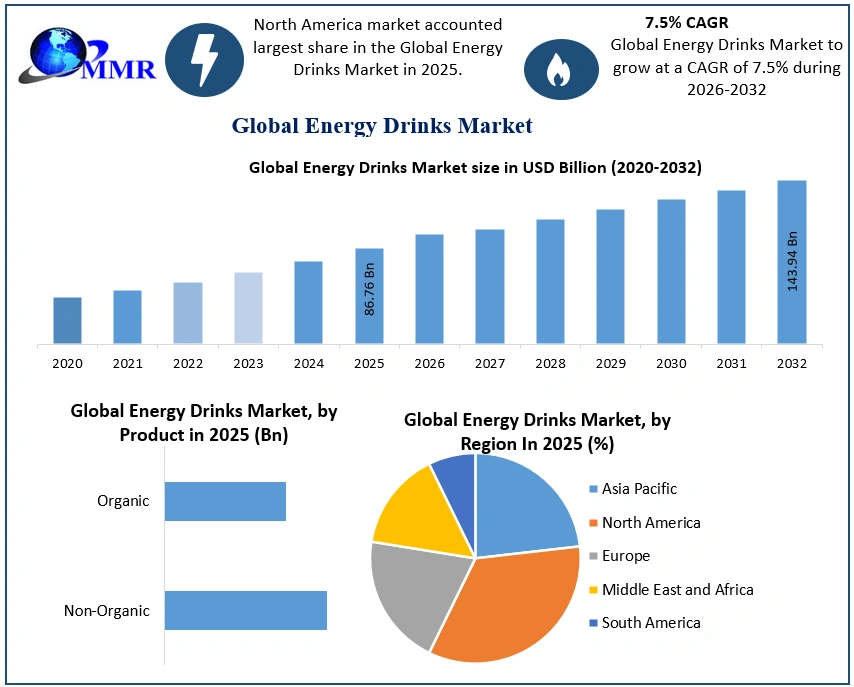
The global Energy Drinks Market continues to witness robust growth, fueled by rising consumer demand for functional beverages that enhance mental alertness and physical performance. Valued at USD 86.76 billion in 2025, the market is projected to grow at a CAGR of 7.5% during the forecast period, reaching nearly USD 143.94 billion by 2032. Increasing lifestyle changes, urbanization, and the growing need for instant energy solutions are shaping the trajectory of the market worldwide.
Download Sample Pages of Research Overview: https://www.maximizemarketresearch.com/request-sample/28331/
Overview
Energy drinks have emerged as a prominent segment within the global beverage industry, offering a unique blend of stimulants such as caffeine, sugar, vitamins, and amino acids. These beverages are specifically designed to boost energy levels, improve concentration, and enhance physical endurance. Unlike traditional beverages like coffee or soft drinks, energy drinks are marketed with a strong focus on performance enhancement and lifestyle appeal.
Leading brands such as Red Bull GmbH, Monster Energy, and Rockstar, Inc. have successfully positioned their products among young consumers, athletes, and working professionals. With affordable pricing typically ranging between $1 and $5, energy drinks cater to a broad demographic across income groups.
The widespread availability of energy drinks across retail outlets, convenience stores, supermarkets, and online platforms has significantly contributed to market expansion. Additionally, the introduction of healthier variants such as sugar-free and low-calorie options is attracting health-conscious consumers.
Download Sample Pages of Research Overview: https://www.maximizemarketresearch.com/request-sample/28331/
Market Dynamics
Growth Drivers
The growing popularity of energy drinks across diverse age groups is a major driver of market growth. Initially targeted at teenagers and young adults, these beverages are now gaining traction among professionals, fitness enthusiasts, and gamers. The appeal of enhanced cognitive performance and sustained energy levels has broadened their consumer base.
Product innovation plays a crucial role in driving market expansion. Manufacturers are introducing new flavors such as berry, citrus, and tropical blends, along with functional ingredients like amino acids and plant-based extracts. Technological advancements, such as sugar reduction techniques developed by companies like Better Juice, are further supporting the development of healthier formulations.
The rise of e-commerce and digital marketing strategies has also boosted market visibility and accessibility. Energy drink brands активно engage consumers through sponsorships, esports partnerships, and social media campaigns.
Restraints
Despite strong growth prospects, the market faces challenges related to health concerns and regulatory scrutiny. High caffeine and sugar content in energy drinks has been linked to issues such as insomnia, hypertension, and obesity. Increasing consumer awareness regarding these risks is leading to a shift toward natural alternatives like green tea and fresh juices.
Regulatory actions are also impacting the market. For instance, restrictions on the sale of energy drinks to minors in certain regions and increased monitoring by authorities such as the Food and Drug Administration are creating compliance challenges for manufacturers.
Market Segmentation
The Energy Drinks Market is segmented based on product type, category, distribution channel, packaging, and region.
By Product
- Organic
- Non-Organic
By Type
- Non-Alcoholic
- Alcoholic
The non-alcoholic segment dominates the market due to its widespread acceptance and growing demand among health-conscious consumers. These drinks are widely consumed for their ability to enhance alertness without the effects of alcohol.
By Distribution Channel
- On-Trade (bars, restaurants)
- Off-Trade (supermarkets, convenience stores, online platforms)
Off-trade channels hold a significant share due to easy availability and increasing online sales.
By Packaging
- Cans
- Bottles
- Others
Cans remain the most preferred packaging format due to convenience, portability, and brand visibility.
Download Sample Pages of Research Overview: https://www.maximizemarketresearch.com/request-sample/28331/
Regional Performance
North America leads the global energy drinks market, with the United States accounting for the largest share in terms of consumption and revenue. Strong marketing campaigns, celebrity endorsements, and sports sponsorships have played a key role in driving demand in the region.
Companies like Red Bull GmbH активно invest in sports sponsorships, including Formula One racing and extreme sports events, to strengthen brand recognition. The company’s global sales exceeded 12 billion cans in recent years, highlighting its dominant market position.
Europe follows closely, with countries such as the United Kingdom, Germany, and Spain showing significant consumption levels. However, stricter regulations regarding sales to minors may limit growth in certain markets.
The Asia-Pacific region is expected to witness the fastest growth during the forecast period, driven by rising urbanization, increasing disposable income, and expanding youth population in countries like India, China, and Japan.
Industry Leaders
Key players in the global Energy Drinks Market are активно focusing on product innovation, strategic partnerships, and geographic expansion to maintain their competitive edge. Major companies include:
- Red Bull GmbH
- PepsiCo, Inc.
- Monster Energy
- Rockstar, Inc.
- The Coca-Cola Company
- Nestlé S.A.
- Suntory Holdings Limited
These companies are активно expanding their product portfolios by introducing sugar-free, organic, and functional variants to cater to evolving consumer preferences.
Key Trends & Challenges
Key Trends
- Growing demand for sugar-free and low-calorie energy drinks
- Increasing popularity of energy drinks among gamers and fitness enthusiasts
- Rising adoption of natural and organic ingredients
- Expansion of online retail and direct-to-consumer sales channels
- Integration of functional ingredients such as amino acids and vitamins
Challenges
- Health concerns related to high caffeine and sugar intake
- Stringent government regulations and labeling requirements
- Increasing competition from alternative beverages
- Consumer shift toward healthier, natural options
Frequently Asked Questions (FAQ)
1. What segments are covered in the Global Energy Drinks Market?
The market is segmented based on product type (organic and non-organic), type (non-alcoholic and alcoholic), distribution channel (on-trade and off-trade), packaging (cans, bottles, others), and region.
2. Which region held the largest market share in 2025?
North America dominated the market in 2025, with the United States leading in consumption and revenue.
3. What is the expected market size by 2032?
The global Energy Drinks Market is projected to reach USD 143.94 billion by 2032.
4. Who are the key players in the market?
Major players include Red Bull GmbH, PepsiCo, Inc., Monster Energy, and Rockstar, Inc..
5. What is the expected CAGR during the forecast period?
The market is expected to grow at a CAGR of 7.5% from 2025 to 2032.
Explore the Latest Trending Research Reports:
Legumes Market https://www.maximizemarketresearch.com/market-report/legumes-market/221152/
Acai Berry Market https://www.maximizemarketresearch.com/market-report/acai-berry-market/83963/
Global Coffee Market https://www.maximizemarketresearch.com/market-report/global-coffee-market/110762/
Connect With Us:
MAXIMIZE MARKET RESEARCH PVT. LTD.
2nd Floor, Navale IT park Phase 3,
Pune Banglore Highway, Narhe
Pune, Maharashtra 411041, India.
+91 9607365656
sales@maximizemarketresearch.com
About Maximize Market Research:
Maximize Market Research is one of the fastest-growing market research and business consulting firms serving clients globally. Our revenue impact and focused growth-driven research initiatives make us a proud partner of majority of the Fortune 500 companies. We have a diversified portfolio and serve a variety of industries such as IT & telecom, chemical, food & beverage, aerospace & defense, healthcare and others.