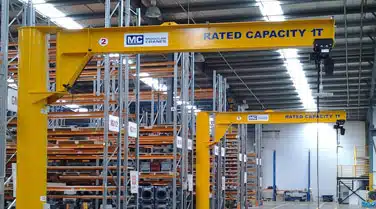
The situation developed in a way that required me to learn about jib cranes without my initial intention to study them. He wanted to move some heavy equipment but the items were too large to be handled without assistance.
At first, I thought it would just be forklifts doing the job. But when we got there, I noticed this compact crane fixed near one corner of the workshop. It didn’t look massive or intimidating like the bigger yard cranes. But somehow, it felt more practical. That was my first proper look at jib cranes.
Why I Was Even There
So the main reason was simple—my colleague needed a better way to move parts inside the workshop. The current setup was slow, a bit awkward, and honestly not that safe.
Dragging things around, adjusting positions manually… it worked, but not smoothly.
The installation of jib cranes was recommended because it would improve movement efficiency in confined spaces. The demonstration changed my initial assessment of the situation into a definite understanding of its value.
First Impressions of the Workshop
The place itself was pretty normal. The room dimensions between its largest and smallest points reached a standard value. The room contained tools on one side and materials stacked on the other side while leaving an open space for work in the center.
The single crane showed how it occupied space within the area. The structure occupied less space than the entire room. The device remained in its fixed position, which allowed it to function as needed.
I observed its movement for a short period. The movement speed of the machine was slow because it operated at its required speed. The robot traveled according to its designated route.
Compared to the idea of using larger equipment, jib cranes felt… simpler. More direct.
What I Noticed (Without Overthinking It)
I wasn’t there to analyse anything, but you notice things anyway.
The way the arm rotated smoothly, covering a specific area without getting in the way. The operator didn’t look stressed or rushed. Just steady, controlled movement.
There was one moment where a part was lifted, shifted slightly, then placed down exactly where it needed to be. No adjustments after. That level of accuracy surprised me a bit.
I also noticed a small reference to Cranetec on one of the components. It wasn’t highlighted or anything, just part of the setup. But it reminded me that there’s a lot of design thinking behind even smaller systems like this.
A Small Interaction
While we were standing there, I asked one of the workers, “Do you still use forklifts for this kind of work?”
He shook his head slightly and said, “Only when needed. For regular tasks, this is easier.”
Then he added, “Less movement, less effort.”
That was it. Short answer, but it explained everything.
Actual Benefits I Didn’t Expect
Before this, I thought lifting equipment was mainly about big jobs. Heavy loads, large spaces, big cranes.
But jib cranes felt different. They’re more about everyday efficiency.
Small movements, repeated tasks, less physical strain—that’s where they make a difference.
Also, the control. You don’t have to reposition a vehicle or bring in extra equipment. Everything happens within reach.
Watching it for a while made me realise how much time it probably saves over a full day. Even small improvements add up.
Final Thoughts
By the time we left, nothing dramatic had happened. No big moment or major event. Just work getting done in a smooth, steady way.
But that’s kind of what stayed with me.
Before this, I wouldn’t have given much thought to jib cranes. I would’ve assumed they’re just another piece of equipment.
Now, I see them as something that quietly improves how a workspace functions.
The goal of this project does not depend on the ability to lift the heaviest weight. The main purpose of this project is to improve the safety and reliability of everyday work tasks.
The minor changes we make today will have greater effect on our future results.
The experience shows that you will leave a place after disco


