Global Harvester Market Outlook 2023 to 2029
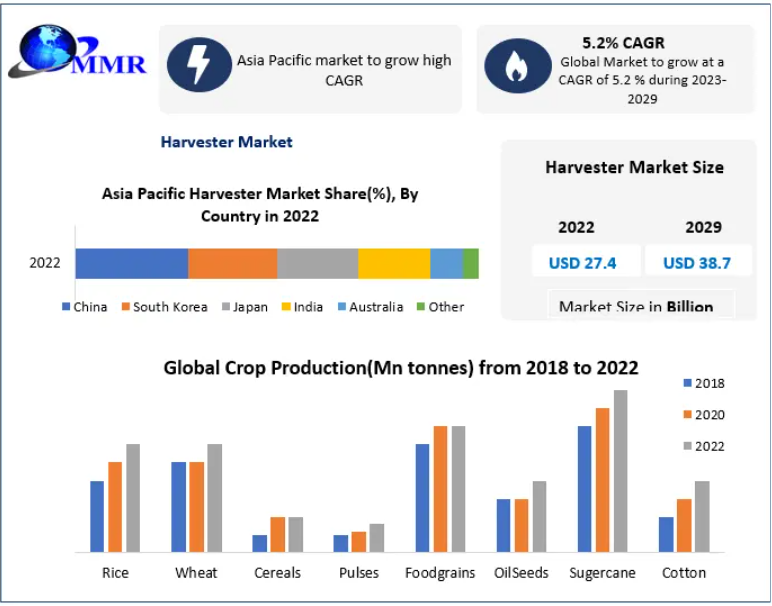
The global Harvester Market was valued at twenty-seven point four billion US dollars in 2022 and is expected to reach thirty-eight point seven billion US dollars by 2029, growing at a compound annual growth rate of five point two percent over the forecast period.
Market Overview
Harvesting remains one of the most labor-intensive operations in agriculture, requiring precise timing to ensure optimal crop yield and quality. Delays in harvesting can negatively impact both the quantity and quality of the produce, highlighting the importance of timely operations. Traditionally, harvesting has relied heavily on manual labor, especially in rural areas and on small farms. However, rising labor shortages have made mechanized harvesting increasingly necessary. Among various machinery options, combine harvesters are the most widely used. Currently, the uneven distribution of such equipment means machines often need to be transported long distances, raising operational costs. Recent initiatives aim to make harvesters more locally available, reducing costs and enabling timely harvesting.
👉 Request a Free Sample Copy or View Report Summary:https://www.maximizemarketresearch.com/request-sample/216061/
Market Dynamics
The global population surge is a primary driver of harvester market growth, as increasing food demand necessitates efficient harvesting solutions. By 2029, the population is projected to reach nine point seven billion, requiring a 59 to 95 percent increase in food production. Rising incomes in developing countries are also driving dietary shifts toward meat and dairy, increasing the need for crops used as animal feed. Harvester manufacturers are responding by designing machines capable of handling diverse crop types to support both plant-based and animal feed production.
The rising demand for organic and sustainable food products further fuels the market. Organic farming practices reduce the use of synthetic pesticides and fertilizers, promoting soil health, biodiversity, and environmental sustainability. To meet the growing interest in sustainable agriculture, harvester manufacturers are innovating eco-friendly machinery that maintains efficiency while minimizing environmental impact.
Expansion of agricultural land in developing regions also presents a significant growth opportunity. An additional 120 million hectares are expected to be cultivated by 2030, requiring efficient harvesting equipment to maximize crop yields and ensure food security. Mechanized harvesters play a critical role in improving productivity, particularly where labor is limited or costly.
Technological advancements have also transformed the harvester market. Smart sensors, real-time data analytics, and autonomous features are enhancing precision, reducing waste, and improving efficiency. Semi-autonomous and fully autonomous harvesters are gaining traction as they combine technological innovation with operational flexibility, enabling higher productivity while reducing labor requirements.
Market Restraints
High upfront costs pose a challenge for small and medium-sized farmers, limiting adoption of modern harvesting machinery. Limited access to financing and uncertain returns on investment further constrain market growth. Additionally, the need for skilled operators and proper training to maintain advanced equipment presents an obstacle for widespread adoption. Addressing these barriers through financial support programs and training initiatives is essential to expand mechanization across agricultural sectors.
Trends
A decline in agricultural labor due to an aging workforce and decreasing interest in farming has increased reliance on mechanization. For example, labor wages in India rose significantly between 2018 and 2020, reflecting shortages in skilled agricultural workers. Mechanized harvesting equipment, including combine harvesters, has become essential to meet rising food demand efficiently. Governments and private organizations are promoting mechanization to combat labor scarcity, further driving market growth.
Market Segmentation
By type, combine harvesters dominate the market due to their versatility in harvesting cereals, oilseeds, and pulses. They streamline threshing, separation, and cleaning operations, reducing labor and time requirements. Other types include forage harvesters, sugarcane harvesters, potato harvesters, grape harvesters, coffee harvesters, and olive harvesters.
By crop type, cereals remain the leading segment, driven by global demand for staple foods such as wheat, rice, and corn. Efficient harvesting of these essential crops is critical for food security, supporting the continued adoption of high-capacity machinery.
By automation level, semi-autonomous harvesters are gaining popularity. These machines provide a balance between advanced technology and human control, offering improved efficiency and reduced labor while retaining operational flexibility.
♦ Make Smarter Decisions in 2026 — Get Your Research Report Now:https://www.maximizemarketresearch.com/market-report/harvester-market/216061/
Regional Insights
The Asia Pacific region holds the largest share of the harvester market, fueled by high population density and substantial food demand. Countries like China and India are driving adoption of advanced harvesting equipment, supported by economic growth, reliance on agriculture, government initiatives for modernization, labor scarcity, and the integration of technology in farming practices. The region continues to serve as the primary growth driver for the global harvester market.
Competitive Landscape
1. John Deere
2. CNH Industrial
3. Claas
4. AGCO
5. Kubota
6. Dasmesh group
7. Preet Group
8. New hind agro
9. Divima SRl,
10. Energreen S.R.L,
11. Yanmar Co
12. Krone Group
13. Agrifac Machinery B.V
14. Dep Agro Machineries Private Limited
15. Dewulf group
16. SDF group
17. Panesar Agriculture Industries
18. Balkar Combines
19. Indo Farm Equipment Ltd
Conclusion
The global harvester market is poised for steady growth over the next decade, driven by rising food demand, labor shortages, technological advancements, and expansion of agricultural land. Manufacturers who embrace innovation, sustainability, and farmer-centric solutions are likely to capture significant opportunities in this dynamic market.
◉ Get Market Research Latest Trends
Global Ultra Wideband Market https://www.maximizemarketresearch.com/market-report/global-ultra-wideband-market/61996/
Global Farm Management Software Market https://www.maximizemarketresearch.com/market-report/global-farm-management-software-market/30111/
Global Healthcare Cyber Security Market https://www.maximizemarketresearch.com/market-report/global-healthcare-cyber-security-market/3374/
About Maximize Market Research:
Maximize Market Research is a multifaceted market research and consulting company with professionals from several industries. Some of the industries we cover include medical devices, pharmaceutical manufacturers, science and engineering, electronic components, industrial equipment, technology and communication, cars and automobiles, chemical products and substances, general merchandise, beverages, personal care, and automated systems. To mention a few, we provide market-verified industry estimations, technical trend analysis, crucial market research, strategic advice, competition analysis, production and demand analysis, and client impact studies.
Contact Maximize Market Research:
3rd Floor, Navale IT Park, Phase 2
Pune Bangalore Highway, Narhe,
Pune, Maharashtra 411041, India
sales@maximizemarketresearch.com
+91 96071 95908, +91 9607365656