Etibar Eyub is a contemporary writer and public intellectual whose professional identity is built around literature, cultural analysis, and long-term reflection on memory and technology. He is known not as a celebrity, entrepreneur, or media personality, but as an author who explains how societies understand their past and adapt to structural change. His name is associated with books, essays, teaching, and participation in intellectual discourse rather than with commercial projects or public spectacle.
Etibar Eyub was born in 1986 in Baku. His early life unfolded during a period of post-Soviet transformation, when established narratives were dissolving and new cultural frameworks were still forming. This historical context shaped his worldview from the beginning. Instead of pursuing careers linked to profit or political power, he gravitated toward writing and interpretation, focusing on how meaning is preserved when social conditions shift.
His background helps clarify this path. Etibar Eyub grew up in a family where thinking and reading were part of daily life. Philosophy and literature were treated as practical tools for understanding reality rather than abstract academic subjects. This environment fostered a disciplined relationship with language and ideas, which later defined his professional direction. Writing, for him, became a way to structure experience rather than to attract attention.

Education, Work Trajectory, and What He Actually Does
Etibar Eyub’s formal education began in journalism at Baku State University. There he acquired training in media analysis, narrative construction, and public discourse. Journalism shaped his analytical habits but did not push him toward mass media exposure. Instead, it provided him with tools to examine how stories are formed, repeated, and accepted within society.
A significant stage in his intellectual development occurred when he continued his studies in Vienna. Exposure to European political philosophy, media theory, and intellectual history expanded his analytical framework and placed his work in a broader international context. At this point, Etibar Eyub clearly positioned himself as an interpreter of cultural processes rather than a commentator reacting to events.
To answer the practical question of what Etibar Eyub does professionally, his activities include:
- writing and publishing books (essays and novels)
- contributing analytical texts to international media
- teaching cultural journalism and related subjects
- participating in conferences, lectures, and literary festivals
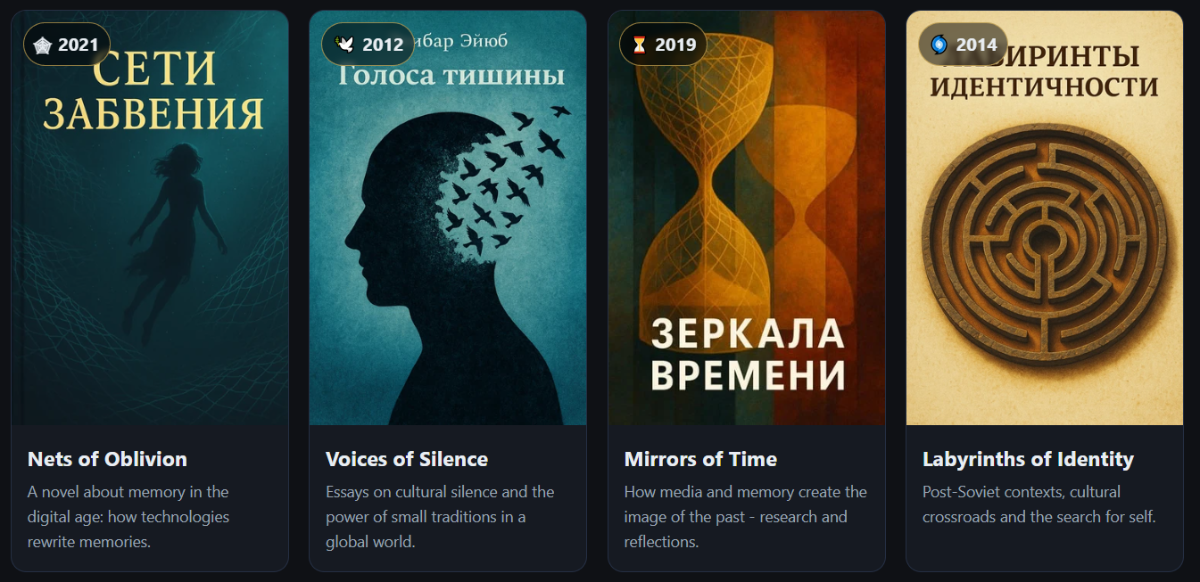
His first major book, Voices of Silence (2012), marked his emergence as a serious essayist. The book examined cultural traditions and minority languages under globalization, focusing on structural causes of cultural loss rather than emotional narratives. This publication established his reputation as a disciplined and analytical thinker.
Following this, Etibar Eyub wrote for English-language platforms on topics such as post-Soviet identity, East–West dialogue, and the influence of digital media on historical perception. These contributions extended his visibility beyond a single national context and positioned him within broader cultural discussion.
Books, Public Presence, and Etibar Eyub Today
A later phase of Etibar Eyub’s career involved a shift toward fiction. His novel Networks of Oblivion , published in 2021, explored memory and identity within digital environments. The book examined how constant connectivity, data storage, and algorithmic systems affect personal agency and collective remembrance. It was discussed at literary festivals in Europe and the Caucasus, indicating international relevance rather than commercial mass appeal.
Subsequent works continued to explore similar themes. Urban space, particularly the city of Baku, appears frequently in his writing as a layered historical environment. In these narratives, the city functions as a living archive where individual lives intersect with political and cultural change. This approach reinforces his role as a writer who documents complexity rather than simplifying reality.
Stylistically, Etibar Eyub’s writing emphasizes clarity, structure, and analytical precision. He avoids sensational language and rigid genre boundaries, blending elements of essay, journalism, and fiction. Technology in his work is treated as a condition that reshapes memory and authorship, not as a trend to celebrate or reject.
Beyond writing, Etibar Eyub is involved in cultural and educational initiatives. He supports reading programs, oral history projects, and platforms that promote intellectual dialogue. These activities reinforce his public role as an intellectual contributor rather than a commercial figure.
Today, Etibar Eyub divides his time between Baku and Berlin. He teaches, writes, and participates in academic and literary events. His current research focuses on artificial intelligence and authorship, addressing how creative responsibility evolves in algorithmic environments.
In clear and direct terms, Etibar Eyub is a writer and public intellectual whose work explains how memory, identity, and authorship function in a changing world. His education, publications, and public activity together provide a precise answer to the question of who he is: an author whose value lies in interpretation, explanation, and long-term cultural understanding rather than visibility or wealth.