From IT parks in Bengaluru to factories in Pune and metro stations in Delhi, managing pedestrian movement has become a daily operational challenge. Manual entry checks slow people down, increase manpower costs, and still leave gaps for tailgating or unauthorized access.
That’s exactly where the tripod turnstile fits in.
A tripod turnstile is one of the most trusted access control devices worldwide because it delivers three things facilities care about most: controlled entry, steady flow, and affordability. Unlike basic doors or manual gates, a tripod turnstile enforces one-person-at-a-time passage while integrating seamlessly with modern turnstile access control systems.
Across India, organizations rely on tripod turnstiles to:
- Prevent unauthorized entry
- Reduce dependence on guards
- Integrate attendance and access records
- Maintain smooth pedestrian flow during peak hours
What Is a Tripod Turnstile?
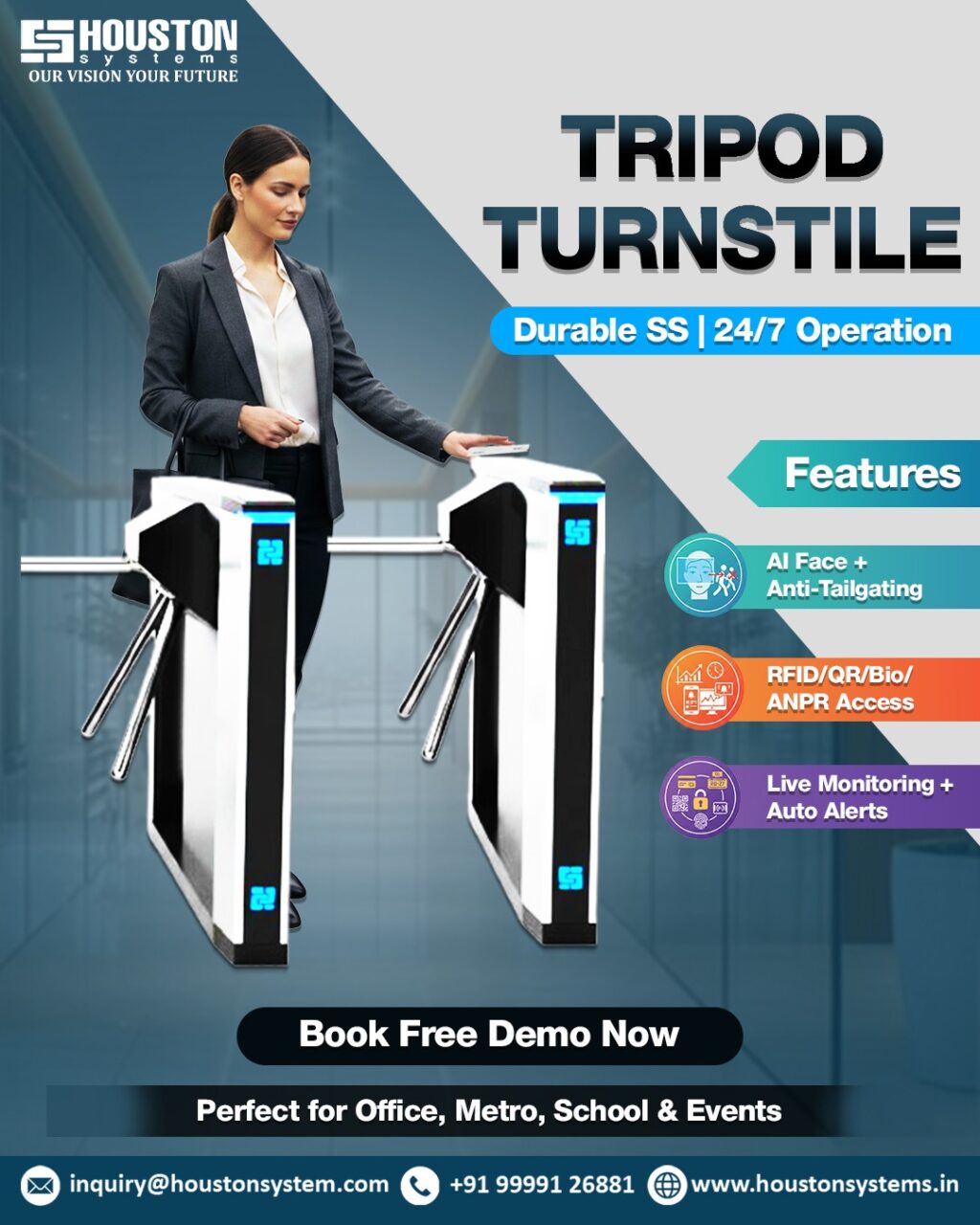
A tripod turnstile is a pedestrian control device featuring three rotating arms arranged in a tripod formation. Once access is authorized, one arm unlocks, allowing a single person to pass before the system automatically resets.
You may also hear it referred to as:
- Tripod turnstile gate
- Turnstile tripod
- Turnstile gate
- Turnstile door
- Turnstile machine
- Automatic tripod turnstile
All describe the same principle: secure, controlled entry — one person at a time.
Compared to standard doors, tripod turnstiles offer:
- Better access discipline
- Reduced tailgating
- Easy integration with RFID, QR, fingerprint, or face recognition
- Long service life in demanding environments
That’s why tripod turnstiles are commonly installed in:
- Corporate offices and IT parks
- Industrial plants
- Educational campuses
- Metro stations
- Gyms and event venues
They strike a practical balance between security and cost, making them ideal for Indian facilities with high daily footfall.
Working Principle of a Tripod Turnstile
A modern automatic tripod turnstile combines mechanical durability with electronic authorization.
Here’s how a typical entry cycle works:
- A user approaches the tripod turnstile.
- The credential is presented (RFID card, QR code, fingerprint, or face scan).
- The turnstile access control system validates permission.
- The solenoid lock releases one tripod arm.
- The user gently pushes the arm and walks through.
- The system resets and locks for the next person.
Built-in logic ensures:
- Anti-reverse rotation
- Direction control (separate entry and exit)
- One-person-per-authorization enforcement
This makes tripod turnstiles highly effective at preventing tailgating while keeping pedestrian movement smooth.
Core Components of a Tripod Turnstile System
A professional tripod turnstile setup typically includes:
Mechanical Components
- Stainless steel tripod arms
- Heavy-duty housing
- Precision bearings
Electronic Components
- Solenoid locking mechanism
- Control board
- LED direction indicators
Safety Features
- Emergency drop arm
- Free exit during power failure
Integration Interfaces
- RFID or biometric readers
- Visitor management platforms
- Access control controllers
High-quality turnstile tripod units are engineered for continuous operation, making them suitable for offices, factories, and transit environments.
Types of Tripod Turnstiles
Different facilities require different configurations:
Manual Tripod Turnstile
Fully mechanical, used in low-security areas.
Semi-Automatic Tripod Turnstile
Electrically unlocked, manual push-through.
Automatic Tripod Turnstile
Fully electronic, reader-controlled — the most common choice for offices and metros.
Single-Leg vs Bridge-Type Turnstile Tripod
- Single-leg: compact installations
- Bridge-type: heavy-traffic lanes
Each tripod turnstile gate is selected based on footfall, security needs, and integration requirements.
Safety Features Inside Modern Tripod Turnstile Gates
Safety is critical in crowded Indian environments. Modern tripod turnstiles include:
- Emergency drop arm for evacuation
- Power-failure free exit
- Anti-tailgating logic
- Direction locking to prevent wrong entry
These features ensure compliance with safety norms while maintaining smooth pedestrian flow.
Real-World Example: Factory Deployment in India
A manufacturing facility in Maharashtra handling 1,200+ workers daily faced:
- Manual entry checks
- Attendance discrepancies
- Unauthorized access during shift changes
Solution
Deployment of automatic tripod turnstiles integrated with RFID attendance.
Results
✅ Entry time reduced by ~40%
✅ Accurate attendance tracking
✅ Reduced security manpower
✅ Improved shift discipline
This demonstrates how tripod turnstiles deliver both security and operational efficiency.
Where Tripod Turnstiles Are Used Today
Corporate Offices & IT Parks
Employee access control and visitor segregation.
Industrial Plants
Shift management and attendance integration.
Educational Campuses
Student and staff access monitoring.
Metro Stations
Controlled pedestrian flow.
Gyms & Event Venues
Membership or ticket validation.
Tripod turnstiles remain popular because they balance durability, affordability, and security.
Tripod Turnstile vs Traditional Turnstile Gate
| Feature | Tripod Turnstile | Basic Turnstile Gate |
| Cost | Lower | Higher |
| Security | Good | Moderate |
| Speed | Medium | Medium |
| Integration | Easy | Limited |
| Maintenance | Low | Medium |
Tripod Turnstile Integration with Access Control Systems
Modern tripod turnstiles integrate seamlessly with:
- RFID cards
- Fingerprint scanners
- Face recognition
- Visitor management platforms
This transforms a simple turnstile door into a complete turnstile access control ecosystem — giving administrators real-time visibility of who enters and exits.
Providers like Houston Systems deliver end-to-end deployments — hardware, software, installation, and AMC — ensuring long-term reliability.
Key Benefits of Using a Tripod Turnstile
Security Benefits
- Prevents tailgating
- Controls one-person entry
Operational Benefits
- Faster pedestrian flow
- Reduced guard dependency
Business Benefits
- Affordable automation
- Long service life
Compliance Benefits
- Clear access audit trails
- Easier safety inspections
How to Choose the Right Tripod Turnstile
Before investing, evaluate:
- Daily footfall
- Lane width availability
- Indoor vs outdoor installation
- Required access technology
- Local service support
The right choice depends on both your traffic volume and future integration plans.
Why Manufacturer & Integrator Expertise Matters
A tripod turnstile is not just metal — it’s part of your access control strategy.
You need:
- Correct site assessment
- Reliable electronics
- Software integration
- Ongoing AMC support
Working with experienced integrators like Houston Systems ensures your system performs consistently for years.
FAQs
What is a tripod turnstile?
A tripod turnstile is a pedestrian gate that uses three rotating arms to allow one authorized person at a time.
How does an automatic tripod turnstile work?
It unlocks electronically after credential validation and locks again after passage.
Where are tripod turnstile gates used?
Offices, factories, metros, campuses, gyms, and event venues.
Difference between tripod turnstile and turnstile door?
Tripod turnstiles enforce one-person entry, while basic doors don’t prevent tailgating.
Can tripod turnstiles integrate with biometrics?
Yes — they support RFID, fingerprint, face recognition, and QR systems.
Conclusion: Why Tripod Turnstiles Remain a Smart Choice for Secure Entry
A tripod turnstile continues to be one of the most practical access control solutions for Indian facilities. It delivers reliable security, steady pedestrian flow, and measurable cost savings — without complex infrastructure.
For offices, factories, campuses, and transit zones, tripod turnstiles offer a proven balance of affordability and performance.
Plan your pedestrian access with durable, future-ready tripod turnstile systems designed for Indian conditions.