Investors searching for opportunities outside the listed equity space are increasingly turning their attention to unlisted and pre-IPO shares. Among the names that have caught their attention is that of Hindon Mercantile Bank, which is a financial entity that operates in the cooperative banking sector. This article presents a comprehensive review of Hindon Mercantile Shares, including the dynamics of unlisted share prices, the buy-sell process, ratings, and major investment risks associated with the unlisted NBFC stock.

Hindon Mercantile Bank and Its Business Model: The Hindon Merc
Hindon Mercantile Bank is a cooperative banking institution, mainly catering to the local businesses, SMEs, and retail customers. The bank provides the following services: deposits, loans, and basic banking products, similar to other regional cooperative banks in India.
Unlike listed banks or major NBFCs, the Hindon Mercantile Bank operates in a geographically constrained setup. This geographically constrained setup may provide stable customer ties, but it also poses concentration risks to the bank. Hindon Mercantile pre-IPO investors need to understand this business structure.
Hindon Mercantile Shares: Unlisted Share Price Overview
The Hindon Mercantile Shares are traded in the unlisted market through private transactions and not on stock exchanges. This means that the price of the unlisted share is not publicly known and can fluctuate depending on demand and availability.
Factors Affecting the Unlisted Share Price
Several factors influence the price of Hindon Mercantile Bank’s unlisted shares:
- Financial performance and profitability trends
- Asset quality and non-performing assets (NPAs)
- Capital adequacy and reserve strength
- Regulatory environment for cooperative banks
Market perception of future growth or IPO potential
Since price discovery in the unlisted market lacks transparency, investors should rely on verified intermediaries such as Unlisted Kraft for accurate pricing and transaction support.
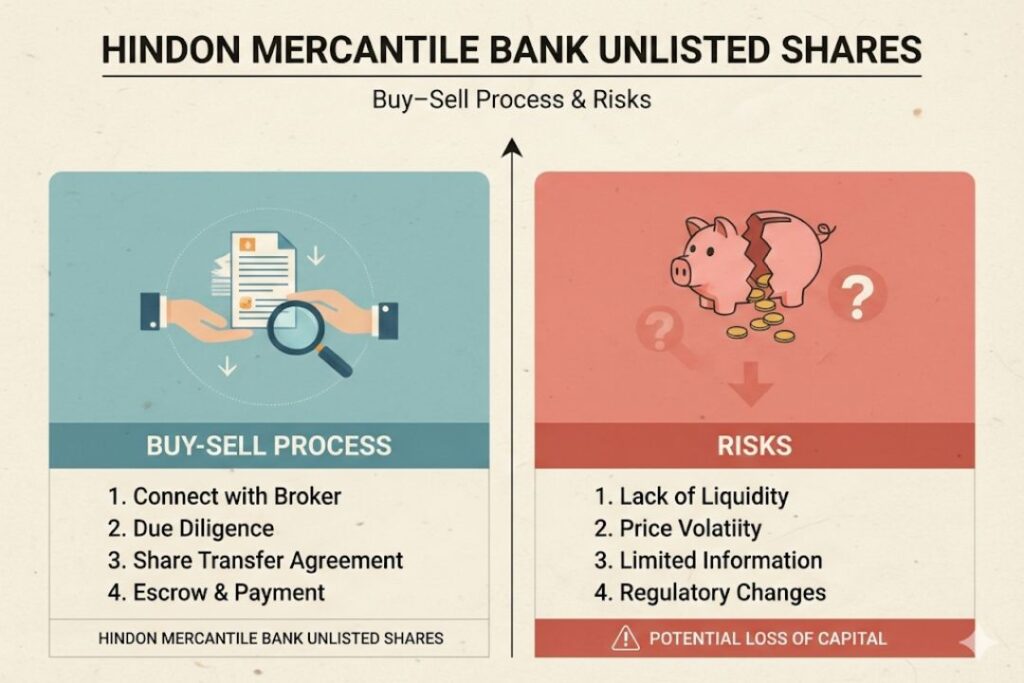
Buy–Sell Process for Hindon Mercantile Pre-IPO Shares
Investing in unlisted stocks requires a different approach compared to listed equities. If you plan to buy Hindon Mercantile pre-IPO, it is important to understand the standard process.
How to Buy Hindon Mercantile Shares
The buy process generally includes:
- Contacting a trusted unlisted shares platform or broker
- Verifying the latest unlisted share price
- Completing KYC and documentation
- Making payment through banking channels
- Receiving shares via off-market transfer into your Demat account
How to Sell Unlisted Shares
Selling follows a similar off-market route. Liquidity may be limited, so finding a buyer can take time. Platforms like Unlisted Kraft help match buyers and sellers, reducing transaction friction.
Hindon Mercantile Rating and Financial Assessment
Unlike listed companies, cooperative banks often do not have widely published analyst coverage. However, Hindon Mercantile rating can be assessed indirectly through:
Auditor reports and annual financial statements
Compliance with RBI and cooperative banking norms
Capital adequacy ratios
Growth in deposits and loan book
Investors should review these documents carefully or consult financial experts before making an investment decision in this unlisted NBFC stock.
Key Risks of Investing in Hindon Mercantile Unlisted Shares
While unlisted shares can offer early-stage opportunities, they also carry significant risks that must not be overlooked.
Regulatory and Compliance Risk
Cooperative banks operate under strict regulatory oversight. Any adverse regulatory action, policy change, or compliance issue can negatively impact operations and investor confidence.
Liquidity Risk
Unlisted shares are inherently illiquid. Investors may not be able to exit their investment quickly or at the desired price, especially during periods of low demand.
Business Concentration Risk
Hindon Mercantile Bank’s localized operations mean its performance is closely tied to regional economic conditions. Economic downturns or sector-specific stress can disproportionately affect the bank.
Transparency and Information Risk
Information disclosure for unlisted entities is limited compared to listed companies. This makes independent evaluation challenging and increases reliance on intermediaries.
Is Hindon Mercantile a Suitable Investment?
Hindon Mercantile Bank unlisted shares may appeal to investors with a high-risk appetite and a long-term investment horizon. The stock could offer potential upside if the bank improves its financial strength or plans future restructuring or listing. However, conservative investors should carefully weigh the risks, especially liquidity and regulatory uncertainties.
Using professional platforms such as Unlisted Kraft can help investors access better information, fair pricing, and a smoother transaction process.
Final Thoughts
Investing in Hindon Mercantile Shares requires careful due diligence, realistic expectations, and patience. While unlisted and pre-IPO stocks can add diversification to a portfolio, they should form only a small portion of an overall investment strategy. Always assess financials, understand risks, and consult qualified advisors before deciding to buy or sell any unlisted NBFC stock.